
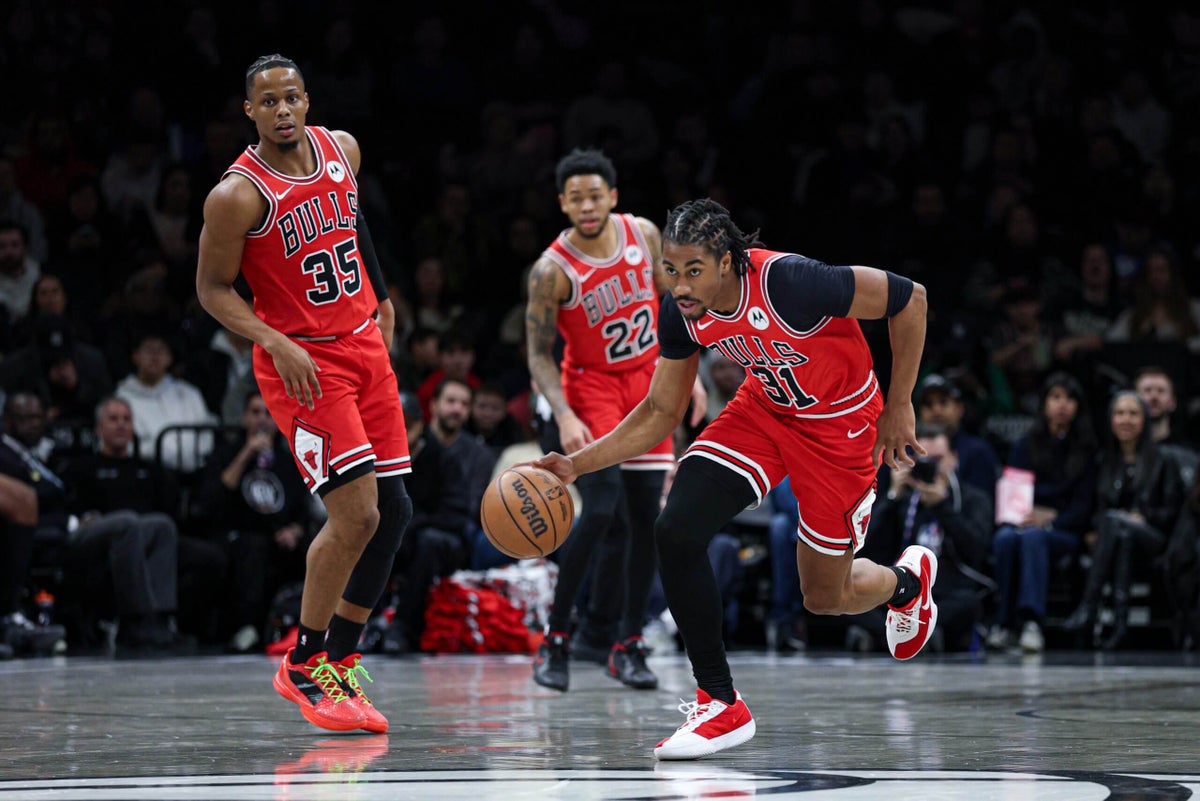
The questions the Chicago Bulls face through the remainder of this season aren’t remotely similar to the ones posed at the beginning of it. One deadline-influenced week altered their trajectory. After seven trades, they’re left with an unrecognizable roster, a tangled core of guards and an uphill battle for a good seat in May’s draft lottery.
So where do these Bulls begin? What questions will this scrambled group have to answer? What’s left to look forward to in the second half of this season?
Here are three burning questions the Bulls face through the final 27 games:
Guard play: prioritize youth, prioritize vets and winning, juggle both, fumble both?
With Chicago’s fire sale at the deadline, it essentially forfeited any shot at roster balance. This group is not intended to be cohesive. Guerschon Yabusele and Nick Richards are assigned the lofty task of being viable big-minute bigs, and the backcourt features more agendas and guards to play than seems feasible.
The Bulls’ new guard group, somehow more crowded than ever, has more answers to squeeze out than two months might allow. None should be more pressing than seeing if they’ve struck gold with either Jaden Ivey or Rob Dillingham, two buy-low candidates who lost favor with their previous teams.
Ivey, who turned 24 years old last week, is trying to recover his previously remarkable athleticism after sustaining a broken fibula last January. Dillingham is 21 and small (6-foot-2, 175 pounds), carrying an explosive handle and the burden of being drafted at a necessary position for a Western Conference contender that never truly trusted him. (He was drafted by the San Antonio Spurs at the No. 8 spot of the 2024 draft, then traded on draft night to the Minnesota Timberwolves.)
Ivey’s injury was no small feat to return from. His return-to-performance timeline feels much different than actually returning to play. If he’s ever gonna be the player he was, it doesn’t seem like it’ll happen this season. If he’s gonna morph into something else, leaning into more ancillary skills, it’ll probably take time to adjust to that idea, too.
Dillingham’s rejuvenation requires trust from this new staff. He plays at a speed that seems too fast for him to currently process, and it seems he always looked over his shoulder while doing so in Minnesota. He’ll need time in Chicago; he’s played with unfamiliar lineups, more guards than he knows what to do with and no true roll threats thus far.
All signs point to Dillingham already feeling refreshed through a handful of games with the Bulls, marking season-highs in minutes in multiple games. But there are potential obstacles for that runway.
There’s also the matter of Anfernee Simons and Collin Sexton, both on expiring deals, both of whom will be 27 this year. They’re certainly not old, but they’re beyond the outlined window of core pieces the Bulls have catered to, which seems to be anywhere from ages 19 to 24. Both are playing for their future jobs, likely for more sensible sign-and-trade deals, with a non-zero chance that one is brought back.
While neither has been particularly conducive to winning since the deadline, they better position the Bulls to scratch off tanking teams — eight of Chicago’s final 27 games come against teams who hold worse records — down the stretch. While some tank-friendly, four-guard lineups in recent games suggest otherwise, both Sexton and Simons seem like obstacles for Ivey and Dillingham’s chances at playing through as many mistakes as necessary.
Josh Giddey, out since late January with a hamstring injury, on Wednesday said he expects to return Thursday against the Toronto Raptors. If he belonged to a truly committed tanking team, would he be returning now? Maybe not. He might even conveniently be getting season-ending surgery right about now, clearing the way for some of the short-term logjam in favor of long-term insight.
But this is reality. You can’t realistically ask a player like Giddey to quell his competitive fire by shutting down his season, particularly for a team that’s too late to the tanking party.
It’s worth noting the roller-coaster nature of Giddey’s tenure in Chicago. It began by not wanting to step on any toes inside Zach LaVine’s Bulls before they became Giddey’s Bulls at last February’s deadline. After last season’s finish, which Artūras Karnišovas bought plenty of stock in, any lingering postseason ambitions were abandoned with this month’s roster flip. Giddey, tasked with accelerating the development of his young teammates, is at square one with a group that might become even more difficult to recognize this summer.
For the sake of continuity and helping survey his fit next to a player like Ivey, Giddey’s return isn’t completely unwelcome.
But add in Tre Jones, a competitive backup guard and one of the only defensive-minded players on the roster, and you’re left rubbing your forehead all over again.
Will the Bulls prioritize the future and continue to enable Ivey and Dillingham the way they did before the All-Star break? Or will this season’s finish become another cautionary tale for the franchise’s competitive nature standing in its own way?
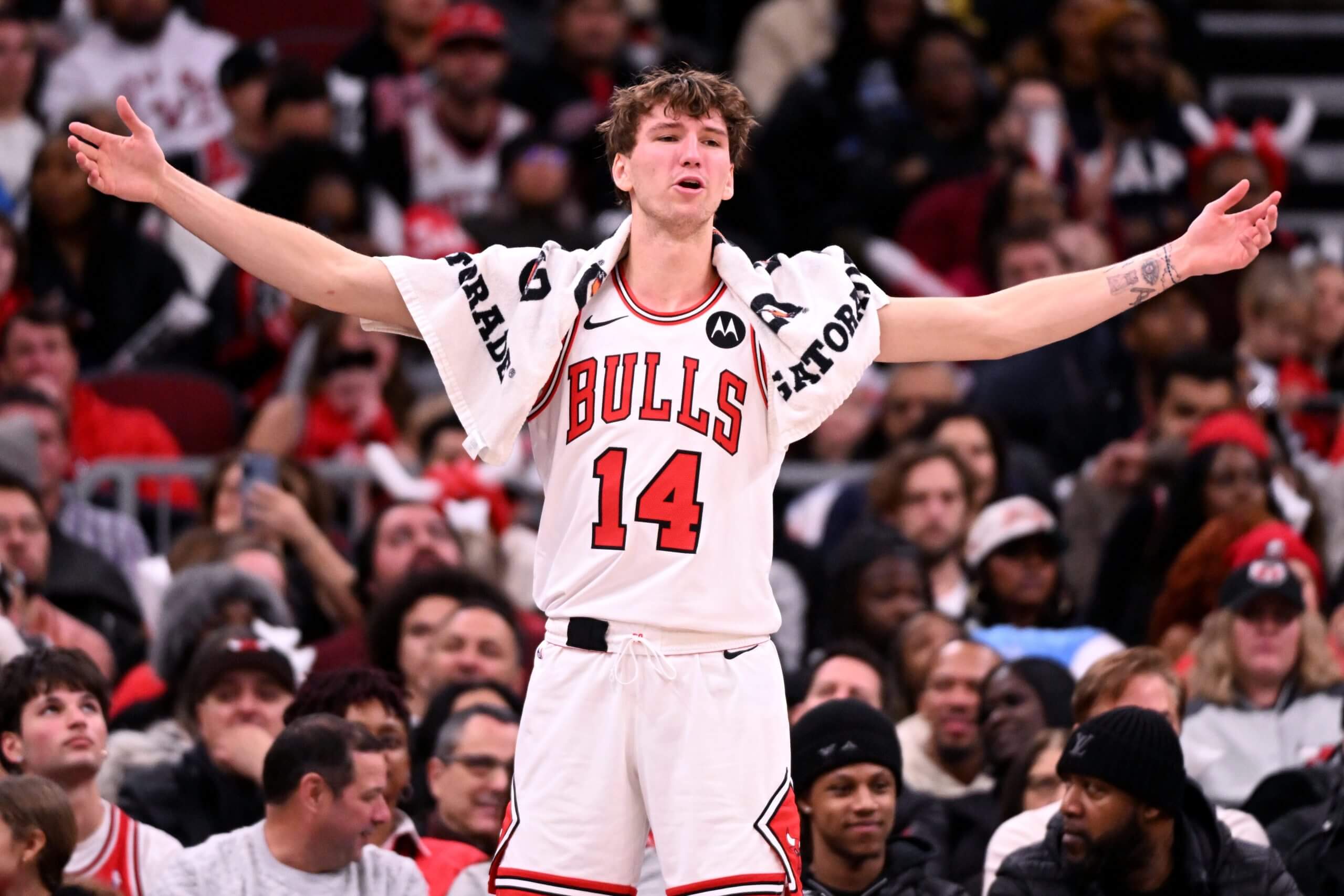
With a new group surrounding Matas Buzelis, how will the Bulls look in their final 27 regular-season games? (Bobby Goddin / Getty Images)
What should these next two months look like for Matas?
Matas Buzelis found little time to mourn the trades of the only NBA teammates he’s ever known at the deadline. He became more important to the Bulls than ever — and practically overnight.
With Nikola Vučević, Coby White, Ayo Dosunmu and all the pieces that once kept Chicago aiming for the Play-In Tournament, the 21-year-old Buzelis held the luxury of not needing to rush toward stardom. Now, he’s become one of the longest-tenured Bulls in just his second season.
Without the Bulls currently projected for a top pick in June, eyes further fixate on Buzelis as the kind of hopeful riser who can help lift the Bulls from mediocrity. Karnišovas’ previous comments on internal development, along with his most recent lottery pick (Noa Essengue) being sidelined with season-ending shoulder surgery, only underscore Buzelis’ significance.
Buzelis’ season — with short leashes, heightened expectations and changing roles — hasn’t gone according to plan. But since Jan. 29, when White and Giddey exited early with injuries in a loss to Minnesota, Buzelis has averaged 13 field-goal attempts, up from 10.3 in his first 32 games of the season. In the following weeks, he was allowed more on-ball reps, even if he hasn’t necessarily abandoned his designation as a spot-up forward who attacks closeouts and runs in transition.
So much of what’s held him back thus far is the realization of his defensive potential: being out of position, being outmuscled by larger forwards and bigs. That wasn’t aided by the ground-bound Vučević, who seemingly wore a “kick me” sign at the rim. It doesn’t seem like Buzelis’ life post-deadline became remarkably easier.
To blossom into a stronger offensive asset, the kind of scorer Chicago thirsts for, Buzelis’ handle needs improvement. Will that work itself out over the next couple months? Could Chicago just put the ball in his hands more? Will the number of question marks on the roster make Buzelis’ usage murky?
Coach Billy Donovan hasn’t had to answer this many development-related questions since the 2019-20 season, when Chris Paul and a baby-faced Shai Gilgeous-Alexander helped the Oklahoma City Thunder to a playoff spot in the bubble (go take a look at that roster). Before that? Probably since his days coaching college ball at Florida.
Can the Bulls realistically position themselves for draft?
It’s well documented by now: This tankathon is shaping up to be as egregious as any in league history.
At least a third of the league is gunning for favorable lottery position in a draft that features Darryn Peterson, AJ Dybantsa, Cam Boozer and a series of talented guards as consolation prizes. Seven teams own fewer than 20 wins at the break; five of them have 15 or less.
These teams are in a league of their own, tiptoeing the lines of tanking in ways that’ve forced Adam Silver to address them with fines totaling as much as $500,000. And these are the franchises that’ve been committed to the tank since the season tipped, not just as recently as a couple weeks ago. Just how much can the Bulls eat off the plates of these high-lottery hyenas?
The Bulls (24-31) sit at 11th in the Eastern Conference standings, underachieving enough to be just removed from the Play-In, but not committed enough to the tank to catch the East’s bottom feeders. Nine teams own a worse record, with the Milwaukee Bucks (tied with Chicago at 17 games back in the East) most likely to be eclipsed. For whatever it’s worth, Giannis Antetokounmpo seems willing to come back, which would certainly make Milwaukee more intentional about being competitive than the Bulls.
There’s also the Memphis Grizzlies and the Dallas Mavericks, who own 20 and 19 wins, respectively, and seem tougher to catch in this race for a top draft pick.
If the chips fall where they should, it seems the Bulls realistically will finish with the ninth-best odds, though there’s a world where they just faceplant at 10th or worse. It’ll prove difficult to breach the top eight, especially considering Donovan’s competitive nature and how many players on the roster face expiring deals.
To Karnišovas’ benefit, he traded into a frontcourt situation that almost guarantees a slide in the standings. But he also traded for a couple veteran guards who’ll look to audition for other teams as contributors to winning.
In a world where Utah Jazz coach Will Hardy is unabashedly telling reporters he wasn’t close to putting his best player(s) back into a close game, these Bulls don’t seem inclined to color outside the lines.