
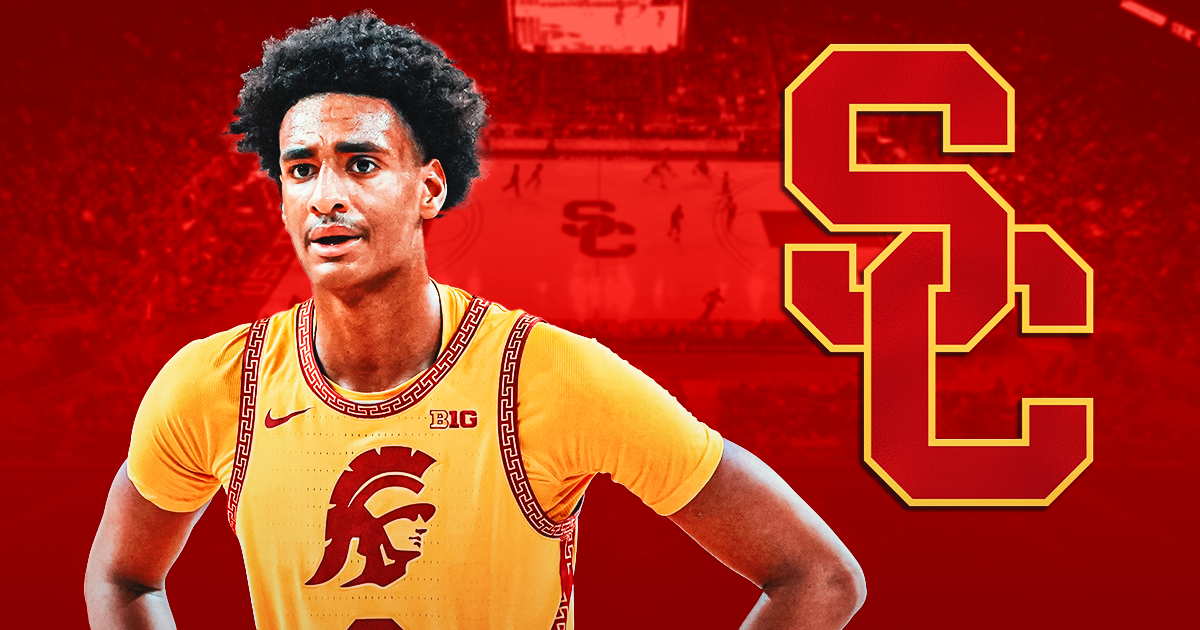
There is a version of the 2026 NBA Draft where, maybe five years down the road, NBA front offices look back and ask the simple question, “How did we let Alijah Arenas slide?”
Right now, the 6-foot-5 freshman is easy to overlook. Despite being a McDonald’s All-American, he was a late bloomer in high school who reclassified up to the 2025 cycle. He lost preseason reps and then over half the regular season with an injury. Now, he is eight games into his college basketball career, just finding his footing, and playing on a 7-8 USC team that has been hit by injuries.
However, Arenas ranked No. 7 overall in the 2025 Rivals150. Despite his string of misfortune, Arenas has natural basketball talent. And even with the fireworks that he has provided over his last two weeks of games, totals of 25, 24, and 29 points, many in the NBA Draft community are overlooking Arenas.
It is understandable to take a wait-and-see approach. His Chatsworth (CA) High games were not necessarily hot-button television, and he was not able to lean into any pre-season hype, so many have just not been able to put consistent eyes on the former five-star recruit.
However, this is not an article about an underdog; well, in a way, it is. But Arenas will soon be faced with a very interesting decision. Does he go into the NBA Draft, where he could potentially be a first-round draft pick, or does he stay in school for another year, and potentially become the No. 1 pick?
With such a fascinating story coming to the surface, it is worth slowing down and looking at the full picture.
Momentum matters, Arenas never had it
Draft boards are built months, even years in advance of June’s draft night. NBA front offices do not build their scouting departments for one-year evaluations. A player’s file gets built over time, and the file is built on repetition. The department, not just one scout, sees the development, gathers all of the intel, and lays the groundwork for what they think the player could become.
By the time February hits, we are more than halfway done with the college season, coming down the home stretch of league play, and projecting possible NCAA Tournament positions. With Alijah Arenas, that runway for him was cut short.
He reclassified in high school. Missed a good portion of the preseason at USC. Then missed more than half of the regular season his freshman year. By the time Arenas stepped onto the college floor, much of the draft class had already been labeled. Many know his name. Some have seen the flashes. But it is hard to build momentum when you are out of sight.
Why Alijah Arenas’ scoring instinct is so intriguing to NBA Scouts
Alijah Arenas is the son of former NBA guard Gilbert Arenas. Gilbert was a three-time NBA All-Star who played in the league for 11 seasons and scored 11,402 career points, averaging over 20 per game for his career.
The apple does not fall far from the tree. Arenas has the natural scoring chops. Not to mention the positional size and plus length to project moving forward. He was pulled up to play 17U with the Compton Magic during the Adidas 3SSB Finale in Rock Hill. Alongside Koa Peat (Arizona) and JJ Mandaquit (Washington), Arenas averaged 21.7 points on 48.3 percent from the field and 43.0 percent from three, leading Compton Magic to the Final Four of the Circuit.
Those scoring numbers were only proven with what he showed throughout his high school career. In only three seasons at Chatsworth (CA) High School, he scored 3,002 career points. He graduated (early) among the top-15 scorers in California high school history.
Arenas has always had a feel for the mid-range. Comfortable pulling up from the elbows, or creating a clean look from the mid-post area. There is balance involved, as well as quality footwork and spatial understanding. Getting stronger, especially in his core and his base, was always an objective, similar to learning his spots on the floor and how to consistently get to those areas.
Having only played in eight collegiate games, Arenas has scored over 20 in three of his last four. We see his natural scoring prowess. He not only has the confidence to take the shot, but also the ability to consistently get the shot. With him, it has never been a question of talent, only fine-tuning and streamlining that talent. While it might be inefficient now, there is real projection as a self-creating shot-maker.
Should Arenas declare for the 2026 NBA Draft or return for 2027?
And with putting the ball in the basket, carrying some of the biggest value at the highest levels, it is easy to see why there is so much intrigue with Alijah Arenas. He is someone who is talked about currently as a first-round pick. However, there is a level of uncertainty around him that is preventing people — right now at least — from going all-in on him as a lottery guy, or more.
That is where the intrigue of an impending decision comes. There is a realistic pathway that if Arenas were to come back to college for the 2026-27 season, he could be talked about as a potential No. 1 overall pick. Naturally, it is difficult to predict 16 months out; however, the assumption of health has to be made.
A full off-season could mean real physical development. The amount of quality strength he could add to his base and core. He would also have a freshman year under his belt and an off-season of workouts, and pick up with an understanding of the pace of play in the Big Ten.
In a vacuum, it makes a lot of sense. However, who is to say that a team in the backend of the 2026 Draft Lottery won’t see that Arenas could potentially be the No. 1 pick next year, and snag him with value this year? Then they could get him into their training program and into their workouts, and grow an understanding of their concepts.
He is not a finished product, but the upside is significant. There are a lot of natural traits in play that are very valuable at the highest level of the game.
The risk and the reward
USC has played 2026 games so far, with five regular-season matchups remaining before conference and postseason play. Meanwhile, Alijah Arenas is emerging as a fascinating story in the 2026 NBA Draft conversation.
In his first four games, Arenas averaged 7.5 points in 23.3 minutes played. Over his last four, he is averaging 21.5 points in 31.5 minutes played. His confidence is building, and there is a small sliver of a runway remaining this season to put some quality things on tape.
Once the season ends, will he declare for the NBA Draft? He would then get workouts and interviews to allow teams to get to know him more. With many of the pundits saying that the 2026 NBA Draft is as good as they have seen in a while, and following that with the 2027 Draft being as down as they have seen. The league may think it understands Arenas, but the next four months could change everything.