
Getty
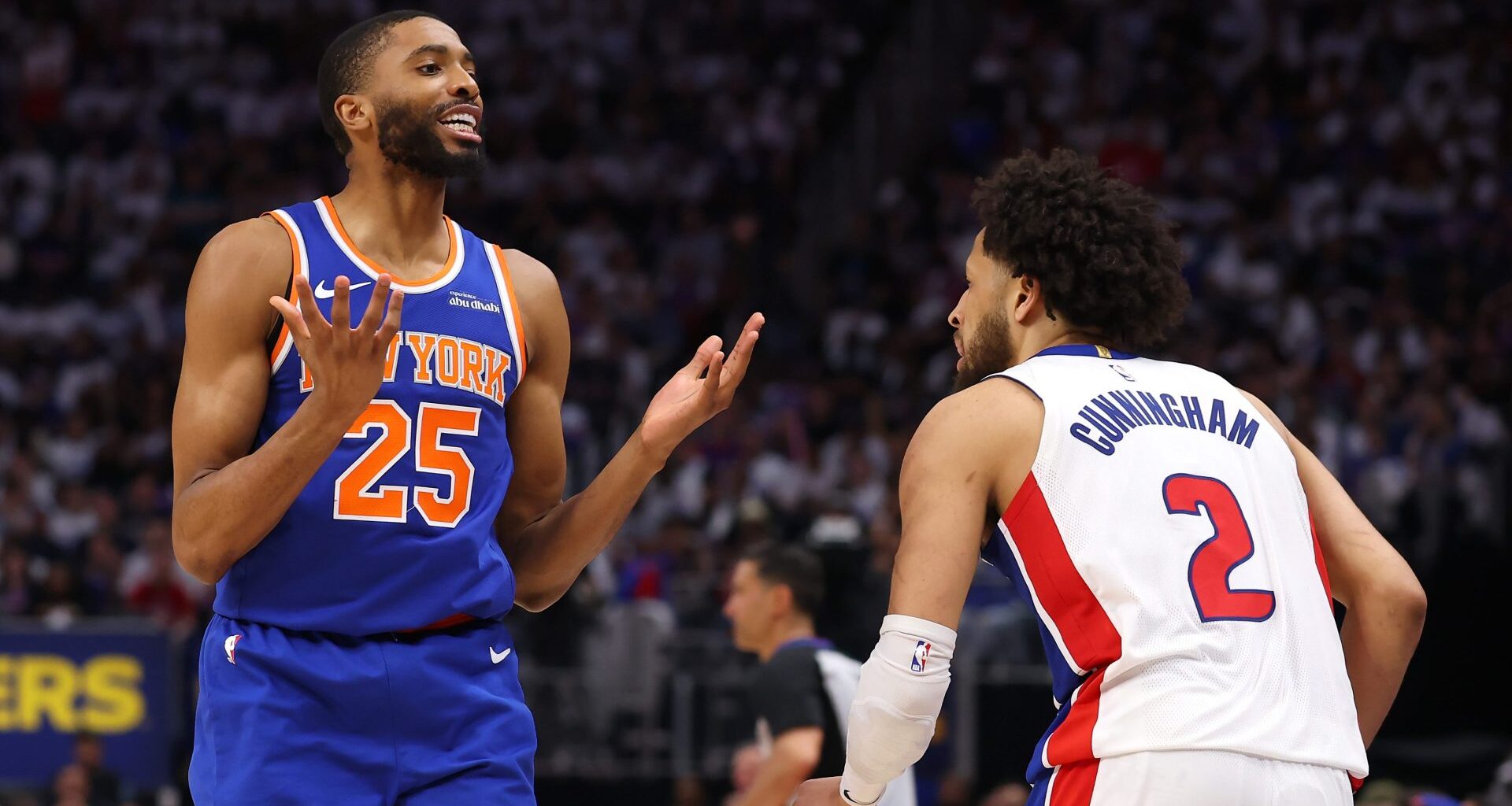
Mikal Bridges of the New York Knicks reacts against Cade Cunningham of the Detroit Pistons.
New York Knicks head coach Mike Brown was careful with his words. The game tape was far less forgiving.
After the Knicks’ 126–111 loss to the Detroit Pistons on Thursday night at Madison Square Garden, Brown was asked to explain his decision to bench Mikal Bridges early in the fourth quarter and lean on reserve Landry Shamet the rest of the way.
Brown framed the move as situational — not punitive.
“Landry had hit a couple shots. We needed to score,” Brown said via the New York Post. “They’re both really good defenders. And so I just stayed with Landry. But it wasn’t anything where, ‘Oh, I’m going to sit Mikal because he’s not doing this, or he’s not doing that.’ We were looking to score points, and Landry was the only one to make a shot from behind the arc.”
The Knicks’ Possessions That Triggered the Switch
The explanation made sense. The timing told a sharper story.
The Knicks opened the fourth quarter already trailing, and Bridges was involved in three consecutive negative possessions that quickly forced Brown’s hand.
At the 11:43 mark, Bridges drove the baseline and attempted to thread a pass to a cutting Jeremy Sochan, only for Detroit’s defense to deflect it for a turnover. Twenty seconds later, Bridges missed a contested corner three-pointer over Javonte Green. Thirty seconds after that, he fouled Green in transition.
Detroit used that brief sequence to stretch its lead to 97–81. Brown called an early timeout with 9:31 remaining — and Bridges never returned.
Shamet Provides a Brief Lift for Knicks
Shamet rewarded the trust immediately.
The Knicks pulled within 109–97 after a Shamet layup with 5:07 left, offering a flicker of life in an otherwise flat fourth quarter. The push, however, was short-lived, as Detroit quickly regrouped behind Cade Cunningham and Daniss Jenkins, closing the door on another lopsided result.
Shamet finished with 15 points on 4-of-10 shooting, including 3-for-8 from three-point range. Bridges ended the night with just eight points on 4-of-9 shooting, missing all three of his attempts from deep.
Defense Was There — Offense Wasn’t
The benching stood out because Bridges’ defense actually did its job.
Despite Cunningham erupting for 42 points on 17-of-34 shooting, Bridges limited him to 1-of-5 shooting when serving as the primary defender, according to NBA.com’s matchup tracking. When Bridges was on the floor guarding Cunningham, the Knicks found stops.
What they didn’t find was offense.
The Knicks gave up five first-round picks for Bridges, who signed a four-year, $150 million extension last summer to be a dependable two-way pillar — the kind of wing expected to stabilize games when things tilt. Against Detroit, his scoring never arrived, and Brown opted for immediate shooting over long-term trust.
Anunoby’s Return Raises Bigger Questions
That choice became even more consequential given the uneven return of OG Anunoby, who came back after missing four games with what the team described as a “painful” right toenail avulsion.
Anunoby struggled to contain Cunningham, who scored 10 of his 42 points against him on 4-of-9 shooting, per NBA.com’s matchup data. With Bridges on the bench and Anunoby unable to slow Detroit’s star, the Knicks’ defensive structure unraveled late.
The struggles carried added weight given Anunoby’s contract status. In 2024, the Knicks signed Anunoby to a five-year, $212.5 million deal — the largest contract ever given by the franchise — with the expectation that he would anchor the wing defense in games exactly like this.
“We want to try to keep the ball off the middle of the floor,” Brown said. “And we didn’t do a good job of it. We allowed him to get to the middle of the floor often. And when he got to the middle of the floor, he hurt us.”
Pistons’ Dominance Underscores the Stakes
The loss completed an alarming trend.
Detroit has now beaten New York three straight times, outscoring the Knicks by a staggering 84 points in those matchups. What was once framed as a measuring-stick opponent has instead exposed how thin New York’s margin for error becomes when its highest-paid wings fail to deliver offense.
Brown insisted his decision was about shot-making, not messages. But in the context of a season slipping into urgency, it felt instructive.
The Knicks needed shooting. Shamet gave them some. Bridges didn’t.
And in a loss that again underscored the gap between expectation and execution, Brown chose immediate impact over investment — a decision that said more than any postgame explanation ever could.
Alder Almo is a sports journalist covering the NBA for Heavy.com. He has more than 20 years of experience in local and international media, including broadcast, print and digital. He previously covered the Knicks for Empire Sports Media and the NBA for Off the Glass. Alder is from the Philippines and is now based in Jersey City, New Jersey. More about Alder Almo
More Heavy on Knicks
Loading more stories