
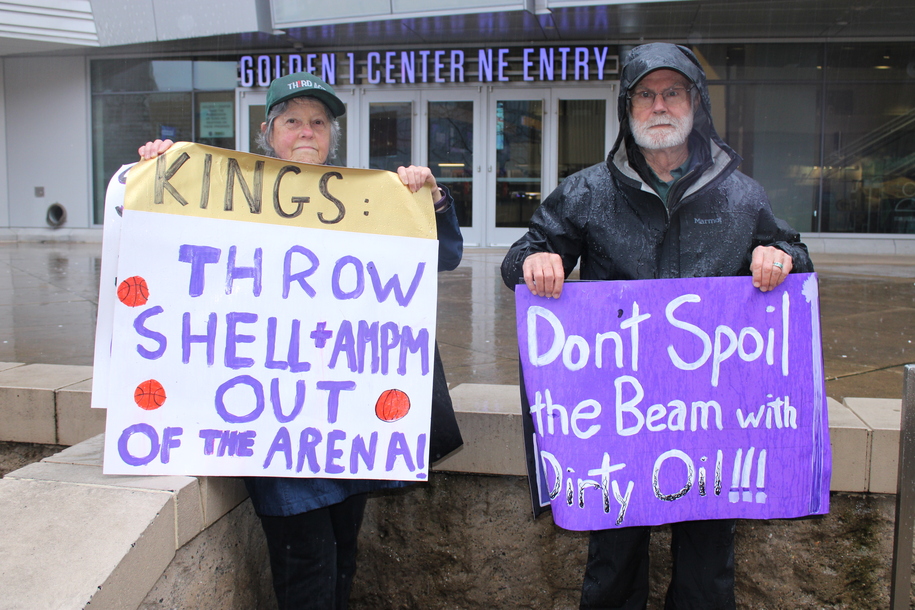
Sacramento — On February 17, a dedicated crew of Sacramento Kings fans from Third Act Sacramento braved torrential rain to protest the team’s sponsorship by Shell and AM/PM, joining environmentalists in nine other cities simultaneously demonstrating against professional teams sponsored by Big Oil, major banks that finance large fossil projects, or utilities heavy on fossil fuel generation.
The Kings are sponsored by one of the world’s largest oil companies, Shell USA, and AM/PM, which is owned by BP, another global oil giant.
Fossil fuel companies have long used partnerships with trusted institutions like sports teams to insidiously influence the way fans perceive them, according to climate justice advocates. This is called “sportswashing,” a play on the term “greenwashing, that is intended to lull fans into forgetting that fossil fuels are causing deadly air pollution and the climate change that is contributing to catastrophic wildfires, floods and other extreme weather events, including last year’s devastating fires in the LA Region.
“We are asking the Kings’ owner and executives to immediately end the team’s sponsorship deals with Shell, one of the world’s largest oil companies, and AM/PM,” said Sally Richman, a Third Act Sacramento advocate, as she and another Third Act member, Pat Ferris held signs in front of the Golden 1 Arena in Sacramento in the cold, pouring rain.
“Our region has suffered devastating wildfires in recent years. We shouldn’t pretend that fossil fuel companies are our buddies when they are causing the climate change that worsens these disasters,” Richman stated.
The national sportswashing protest was an expansion of Dodger Fans Against Fossil Fuels, a Sierra Club Angeles Chapter campaign urging Dodger owners to drop their sponsorship deal with oil giant Phillips 66, according to advocates. Simultaneous protests took place on Feb. 17 at 8:30 a.m. PST/10:30 a.m. CT/11:30 a.m. ET in the following locations:
• Los Angeles, Dodger Stadium, Dodgers (Phillips 66/76 gas)
• San Francisco, Oracle Park, Giants (Phillips 66/76 gas)
• Portland, Providence Park, Portland Timbers (Bank of America) • St. Louis, Busch Stadium, St. Louis Cardinals (Phillips 66)
• Atlanta, Mercedes-Benz Stadium, FIFA World Cup (Aramco)
• Cleveland, Progressive Field, Cleveland Guardians (Marathon)
• Philadelphia, Lincoln Financial Field, Philadelphia Eagles (NRG) • New York City, Citi Field, Mets (Citi bank)
• Boston, TD Garden, Boston Celtics (Gulf).
Juanita Chavez, director of the Sierra Club Angeles Chapter, explained why the campaign to pressure sports team owners to pull out of their partnerships with fossil fuel is so significant.
“The Dodgers rejected stadium cigarette ads decades ago for good reason,” Chavez observed. “Bans on tobacco advertising led to fewer people smoking. The team showed a similar responsiveness to fans last year, albeit too little and too late, by turning away federal immigration agents and pledging funds to help immigrant families. We’re asking Dodger owners to show the same concern for their fans’ health and our planet by refusing to allow Big Oil to advertise in their stadium.”
Naomi Oreskes, Harvard University historian pointed out, “Corporations that practice sportswashing buy goodwill by doing things that are genuinely good, like financially backing beloved teams, in order to distract us from the things they’re doing that are genuinely bad. They are advertising products that are killing people, damaging property, and making it hard to do things we care about, like play baseball or go skiing, as weather worsened by climate change melts snow or raises temperatures unbearably.”
Bill McKibben, author, environmentalist, and co-founder of Third Act/350.org, stated. “The greatest threat to sports in the years ahead is the rapid rise in temperature, which increasingly makes it too hot and stormy to play. So, you might say it’s an error for those who enjoy–and profit from–sports to be collaborating with the industry doing the most to overheat the planet.”
Sam Mattis, American Olympic discus thrower (Tokyo 2021, Paris 2024) training for the 2028 games, discussed the impact that fossil fuel-spurred climate change disasters have had on his training and competitions.
“In the last five years, I’ve had to cancel training because of flooding and wildfire smoke; I’ve had to compete in extreme heat waves with track surfaces exceeding 140 degrees; and I’ve had a heat stroke while competing,” Mattis observed. “Climate change from fossil fuel emissions is affecting sports right now and is a direct threat to the future of sport, as well. The companies polluting our atmosphere and endangering sports have no business doing business with the teams and games we love.”
The protest occurred at a critical time for climate justice in California. Big Oil pumped $34 million into influencing lawmakers in Sacramento in 2025, allowing fossil fuel corporations to stonewall and roll back critical health and climate policy in a year marked by the LA Fires and climate disasters across the planet.
In fact, the Legislature in 2025 approved and Governor Newsom signed a bill that will expand oil drilling in Kern County, the epicenter of oil and gas drilling in California, by 4,000 new permits per year.
The $34 million wasn’t far from 2024’s $38 million total, the fossil fuel industry’s highest spending year ever, according to an analysis by Sunstone Strategies for the Climate Center. Influence spending in the fourth quarter of 2025 was $7.7 million.
As usual, Chevron and the Western States Petroleum Association (WSPA) spent the most money in the fossil fuel industry – 73% of the $34 million. Chevron finished first in the spending with $12.9 million, while WSPA placed second with $12.4 million, coming to a total of $25.3 million total between the two oil industry giants.
Chevron and the Western States Petroleum Association have not been only the biggest spenders in the fossil fuel industry, but have been the top spenders on overall lobbying in Sacramento most years.
Californians for Energy Independence, an oil industry front group heavily funded by companies like Chevron that advocates for local oil and gas production, also poured $6.7 million into “general issues relating to energy independence in California,” according to disclosures on the California Secretary of the State’s website.
Yet most of the corporate media and many “alternative” media are afraid to discuss the dramatic impact that fossil fuel lobbying has on California’s climate and broader evironmental policies. At many times over the past two decades, I’ve been the lone journalist willing to investigate the Big Oil regulatory capture that permeates politics in California.
WSPA and the oil companies wield their power in 8 major ways: through (1) lobbying; (2) campaign spending; (3) serving on and putting shills on regulatory panels; (4) creating Astroturf groups; (5) working in collaboration with media; (6) sponsoring awards ceremonies and dinners, including those for legislators and journalists; (7) contributing to non profit organizations; and (8) creating alliances with labor unions, mainly construction trades.
The deep influence that Big Oil wields over California officials was made apparent to me in 2009 when Catherine Reheis-Boyd, the President of the Western States Petroleum was appointed Chair of the Marine Life Protection Act (MLPA) Initiative Blue Ribbon Task Force for the South Coast to oversee the creation of “marine protected areas” in the same region where her organization was lobbying for expanded offshore oil drilling. The oil industry lobbyist also served on the MLPA Initiative task forces for the Central Coast, North Central Coast and North Coast.