
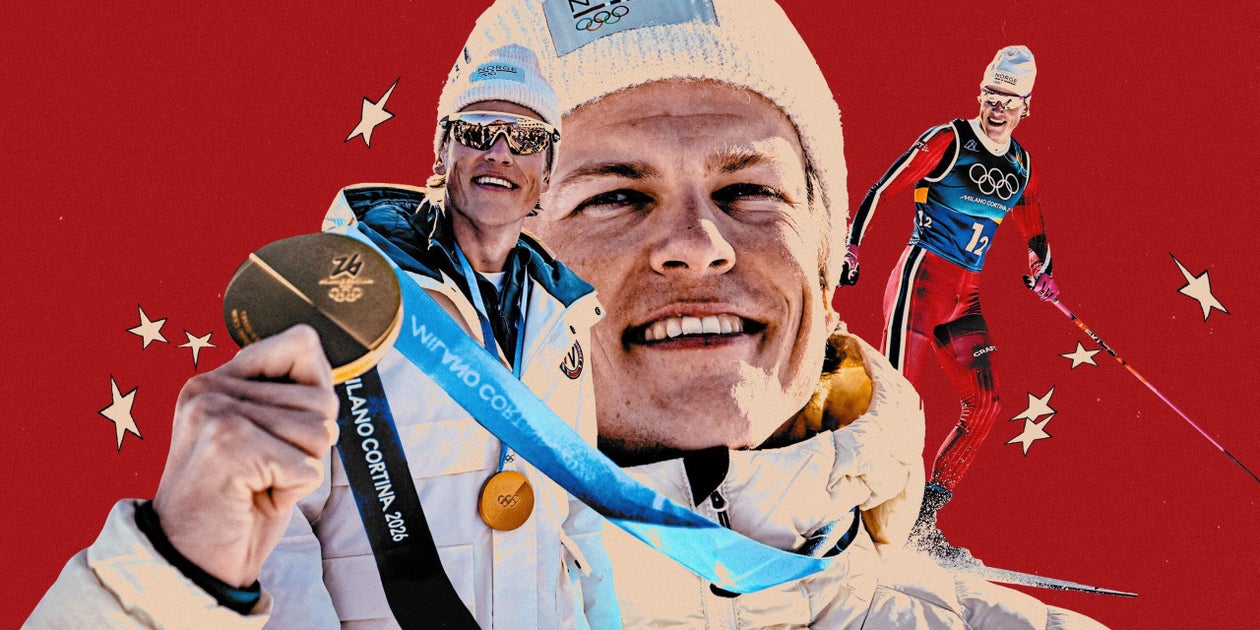
Like the smile beginning to play across his lips, Johannes Høsflot Klæbo wears his greatness lightly.
Stride shortening, he slows to a crawl. He looks back, almost in disbelief. He crosses the line. And then he collapses to the floor.
“I’m just chasing the feeling of those last 100 metres,” he recently told The Athletic. “That’s what I do this all for.”
Victory in Saturday’s 50-kilometer race was the 29-year-old Norwegian’s sixth Olympic gold of these Games — and 11th of his career. Three Norwegians entered the last lap. Klæbo emerged on his own, outkicking his teammate Martin Løwstrøm Nyenget up the course’s final hill.
Cross-country skiing is not supposed to be this simple. The sport is meant to feel as if your lungs have been dunked in corrosive acid, where saliva turns to blood in your throat. In Milan Cortina, the only bitter metal that Klæbo has tasted are gold medals between his teeth.
No athlete has ever won more gold medals in a single Winter Olympic Games, or for that matter, in the Winter Olympics overall — while he is the first competitor in over a century to sweep the cross-country skiing events. The equivalent is a runner winning the 100m, the marathon, and every distance in between.
Ahead of this race, Klæbo stood on the cusp of Olympic immortality. Two days before making history, he granted exclusive access to The Athletic to meet him.
Klæbo lies flat on his back, eyes closed, fleece ruffled around his collar.
His physiotherapist’s hands gently massage the back of his neck and the base of his jaw, searching for the vagus nerve. The aim, it is explained, is to stimulate his parasympathetic nervous system — to remove the fight-or-flight response activated by racing, to help the brain switch off. The massage leads to a lower heart rate, and ultimately, better recovery.
Physically, Klæbo needs the upkeep. Already, over the various rounds and with one day of competition remaining, he has completed 10 race efforts over the previous 11 days.
“My body feels pretty good,” he says. “But the only challenging bit is the lungs. They’re getting pretty sore.”
But this massage is mental maintenance as well. There is stress in leading a nation’s hopes, even when Norway has produced, statistically, the most dominant Winter Olympics performance in history with 18 gold medals so far. Part of Klæbo’s superpowers are his uncanny knowledge of his own body. Even after all those Olympic golds, Klæbo knows how nerves feel.
“It’s always the last couple of days before the race,” he says. “You start to feel as if your heart rate is elevated. You know that your body is getting ready to get really, really tired. Especially before the first race, the Olympics is every four years, and you’re worried about your shape.
“You just want everything to be perfect. You just want to be able to flow.”
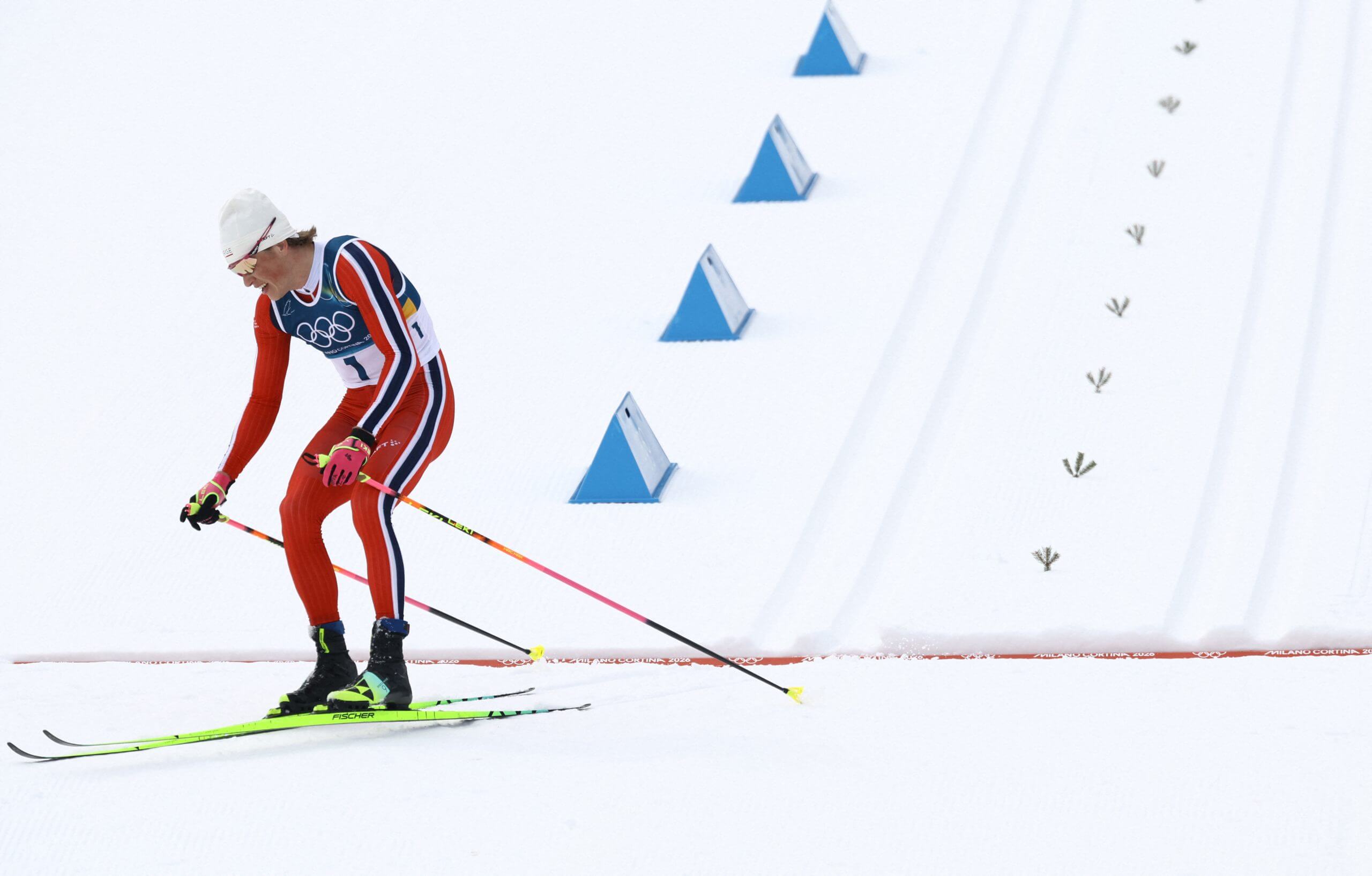
Relief — and exhaustion — set in for Klæbo soon after crossing the finish line. (Anne-Christine Poujoulat / AFP via Getty Images)
Relatively speaking, his preparations for Milan Cortina have been a walk in the park compared to his anxiety before last year’s World Championships, held in his home city of Trondheim. Klæbo had been the face of the event since he was 20 years old. Terrified of picking up an illness, as he did in Beijing four years ago, family, friends, and his fiancée were pushed to one side. He describes the pressure he put on himself as overwhelming, the sacrifices unsustainable.
In Trondheim, just as at these Olympics, he swept the board with six gold medals. But whilst Alexander the Great wept when he had no more worlds to conquer, Klæbo felt only relief. Like U.S. figure skater Alysa Liu, he resolved that, if he was to continue, he would do it on his terms, his sustainability coming first.
“I knew after the World Championships that this way of life was not going to work for very much longer,” he says. “After they finished, I was just completely exhausted. I felt like I was done with the sport for a bit.
“But then I had an amazing spring where I didn’t think about skiing, and the motivation came back a bit. I think this year has been way better in terms of what we’ve done both outside of training and during it. I think I can keep living this way for quite some time. I wouldn’t have been able to say that last year.”
He explains that forming a training group with fellow Norwegian skier Emil Iversen, five years his elder, has refilled his well. Klæbo’s team — made up of his grandfather Kåre, his coach, father Haakon, his business manager, and his physiotherapist Megan Rowlands Stowe — had always been tight-knit, but at 29, he sensed the need for a refresh.
“I was travelling for 150 days with my dad,” he laughs. “That was too much. We needed to change a little bit.”
Klæbo and Iversen’s partnership has been mutually beneficial. Following Klæbo’s training, Iversen has made it back onto the national team, winning a gold medal in the 4×7.5km relay last week, and taking bronze in Saturday’s 50km. Klæbo has companionship during the long training camps, a willing golf partner, company with which to shoot the breeze. The pair have relaxed during the Olympics by filming spoof videos after wins while brushing their teeth.
“Before it was a really lonely life,” explains Haakon over a coffee, earlier in the day. “After Trondheim, he turned to me and said: ‘I’m done.’ But now, you see how he’s been skiing. I think he’s better this year than he was last year. That’s the product of happiness. I think he feels much more free this season.”
Haakon proudly uses his son’s sprint uphill during the men’s classic sprint as an example of his improvement. It was a moment which underscored why, these Olympics, Klæbo has joined the immortals — an attack which demonstrated, in this event at least, the Norwegian operates in an entirely different sphere. Equivalent to running a six-minute mile pace, uphill and on skis, the power and intensity contained in Klæbo’s pistons went viral. And yes — he has seen the memes.
“It’s pretty cool we’re getting things like these in cross-country,” he says, smiling. “I feel like usually, they’re from soccer, all sorts of different sports. But to have them here is awesome.”
His favourite? “Oh, there have been so many. I think the coolest are just the ones where people are talking about the speed. I’ve seen people trying to do the same on a treadmill at the same incline at the same pace.”
The reality, for all his understatement, is that Klæbo can do things on skis that others can’t. Amidst tricky humid snow conditions at the Tesero Cross-Country Skiing Stadium, his technique has never threatened a fall or tangle, whilst its efficiency has also helped him conserve energy, relative to his rivals.
For Klæbo, his technical abilities come from his difficult teenage years. As the smallest kid in his class, he simply lacked the power to contend with his contemporaries — and was left behind.
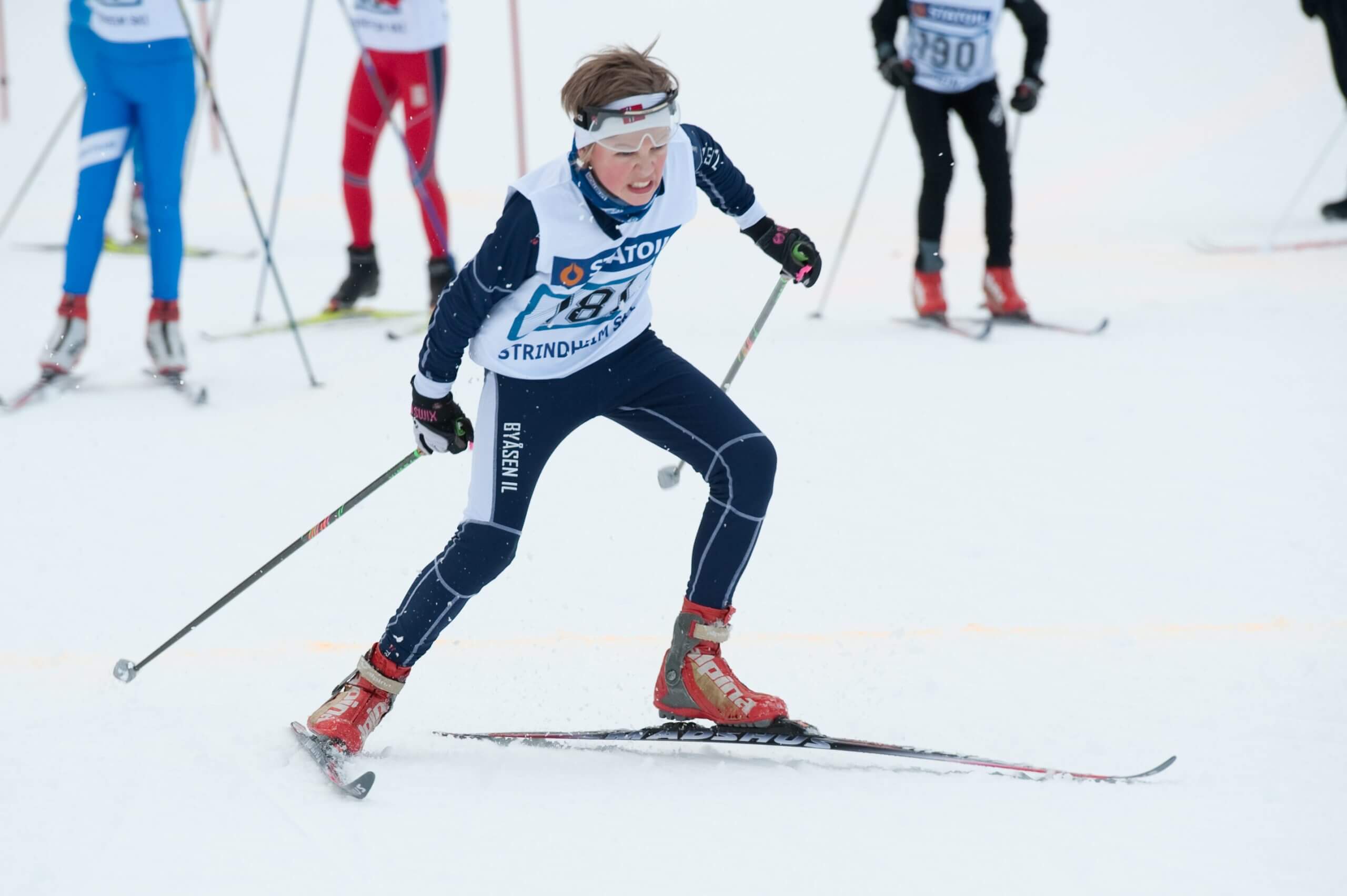
Klæbo was undersized in his youth. “It really took me a while to grow up,” he says. (Courtesy of the Klæbo family)
When his son was a 15-year-old, Haakon recalls searching for a suit for Johannes’ confirmation. As a commemorative moment in his life, Haakon wanted to buy one made from proper fabric, marking his transition into adulthood. But the only jackets that fit were children’s sizes — for kids around 12 years old. His brother, four years younger than Johannes, could fill it just one year later. That year, in Klæbo’s first national championship, he finished 108th. He had to adapt.
“It really took me a while to grow up,” he explains. “I was not a big guy. So my focus had to be about my technique. My grandfather and Rune (Sandøy, his first coach at local club Byasen) would be helping me in training, they’d make it fun to help develop me. We did so many different activities over the year to help my balance.
“Then, when I was 17, I finally started to grow. And that base meant it was easier for me to take big steps up the result list. I think it’s made a huge impact on today — I feel like balance and technique are one of my strengths. I wouldn’t be here if it wasn’t for what we did when I was 15.
Since turning 15, when he told his grandfather he wanted to be the best cross-country skier in the world, his training and lifestyle has been optimised to the point of obsession. “He hates the idea of not doing what he’s supposed to do exactly right,” says Haakon.
At these Games, the solidity of his technique became evident in the closing kilometres of the 10km time-trial, a rare race that Klæbo has previously not been competitive in at the Olympic level. His younger rival, Norway teammate Einar Hedegart, had started with the speed and purpose of a man with nothing but gold on his mind — the former biathlete had skipped the sprints to focus on this event.
Klæbo, by contrast, had opted to start the course steadily, slowly increasing his pace by the kilometre. By the final hill, a brutal minute-long climb, he was virtually accelerating, skate technique perfect, limbs flowing. By the time the more inexperienced Hedegart reached the same point, 10 minutes later, his form had melted under the midday sun.
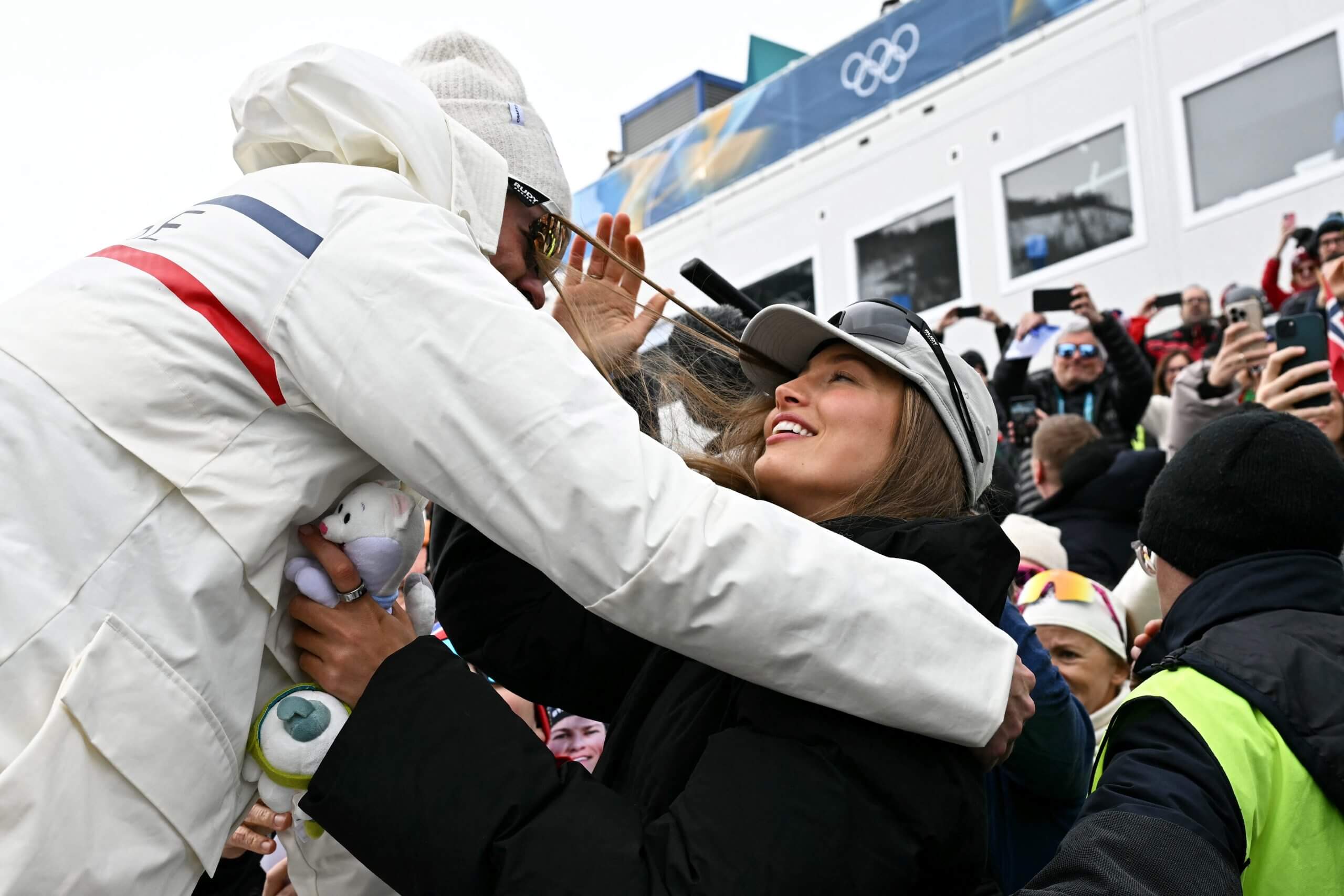
Klaebo and his fiancée Pernille Dosvik celebrate his record sixth gold of these Olympics. (Javier Soriano / AFP via Getty Images)
Klæbo and his father speak about another battle, in the team sprint two days earlier, with equal excitement — with Ben Ogden of the U.S. pushing the Norwegian hard on his way to silver, especially in the semi-final. Having worked with the American team previously when training in Utah — even receiving his own keycard to their facilities, he knows that their ongoing development could be a boost to a sport which is still largely a fringe pastime outside northern Europe.
“We see how many people are participating in running these days,” says Klæbo. “But I think the best thing about cross-country skiing is that we’re using both our legs and our upper body — it’s the most beneficial training you can do to stay in shape, regardless of what other sport you might be doing. There’s less injury risk than other sports.
“I think that’s where cross-country skiing can really come in and be a huge part of people’s health in the future — for people that really want to stay in shape, who are focused on their health, who want to live longer. It doesn’t need to be skiing in the winter, it can be roller-skiing in the summer — but I really think people are starting to see what cross-country skiing can be.”
It speaks to the position that Klæbo is now in. As the most decorated athlete in cross-country skiing history, he contains the sport’s past, present, and future.
“You know, my dream when I was younger was just to win one World Cup race,” he says. “That would have been amazing. That was the goal. And it was a far-fetched dream, to be honest, far more of a dream than it was a reality.
“But I was always really motivated to do everything to see how far I could go, how good I could be. I grew, I finally won a race, and I realised it could actually happen. I just needed to work.”
What would that 15-year-old boy have thought if he could see Johannes Høsflot Klæbo now, standing in front of him with more Winter Olympic golds than any other athlete in history?
“It’s just gone so fast, to be honest,” he replies. “The years are just flying away, you know. It feels like yesterday when I started doing World Cup races. And now these are my third Olympics.
“I’m so lucky to do cross-country skiing for a living. That was all I wanted. And when I speak to you now, when I speak to my grandfather, it’s quite easy to get a little bit emotional about it.”
It is less than a minute after the end of the 50km.
Klæbo’s mother, Elisabeth, is in tears in the stand. Haakon tries to call her from somewhere out on the course.
Using what looks like all his energy, Klæbo spins in their direction, and half sits up towards them. Then, in stages, he rises.
Legs still shaking, he stands from the snow to greet them.