
One defense has turned its season around. Another is transforming itself for a third-stringer. And two more are waiting on recent returns.
Let’s open the notebook to run through three NBA trends that have caught my eye over the past week.
The hornets
Yes, hornets is in lower-case, because the Charlotte Hornets look like … hornets.
The NBA’s latest feel-good story is in North Carolina, where one team can’t stop scoring — and yet, it’s winning for reasons beyond a free-flowing offense. The Hornets, one of the league’s hottest squads, winners of 15 of 22 since Jan. 3, are a group of bucket-getters that won’t stop getting buckets. Optimists could have predicted before the season that the points would come. But now, they’re causing commotion in a way no one on the outside could have anticipated:
The Hornets swarm opponents on the other end of the court.
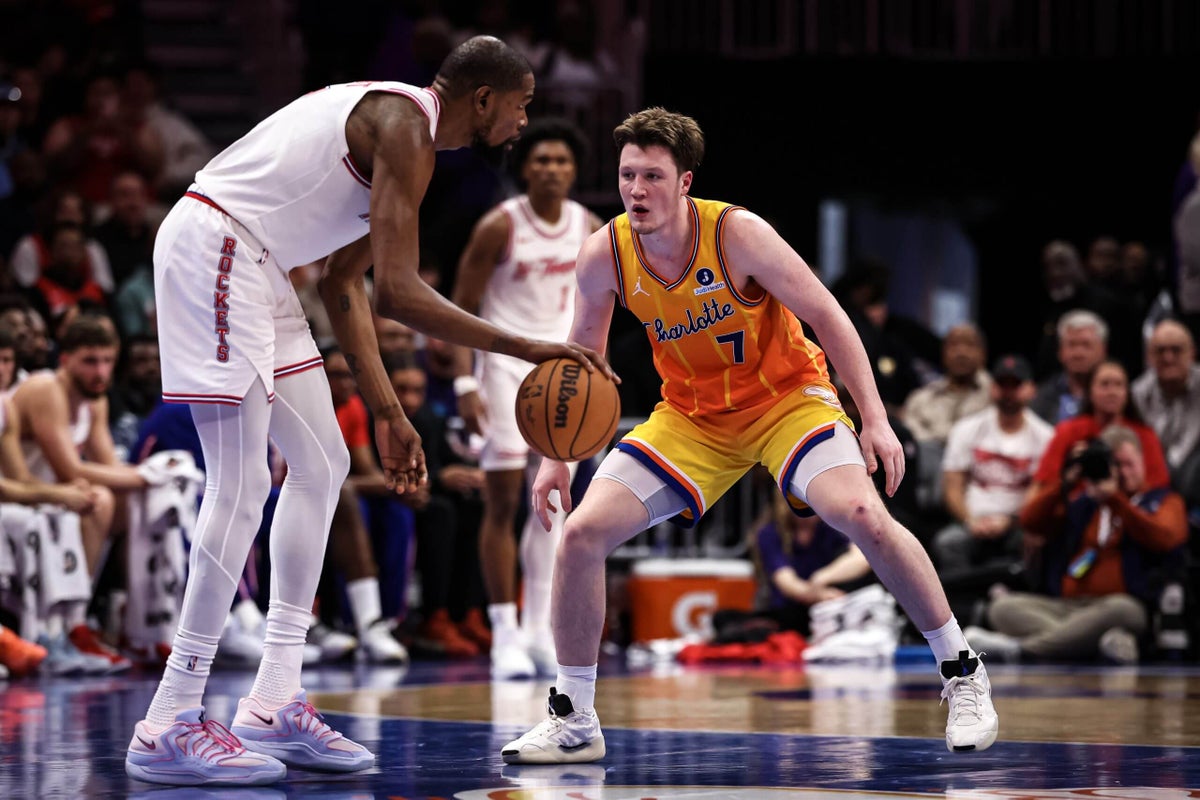
It took not even eight minutes before Kevin Durant experienced this firsthand Thursday evening. Durant received an entry pass, posting up on the right side, 20 feet from the hoop with four and a half minutes to go in the first period of what’s become a rare sight these days: a victory — albeit a narrow one — over the Hornets. Brandon Miller, Charlotte’s third-year up-and-comer, manned him. Miller has stepped up over the past couple of months as the one to defend the opposition’s top wing.
He’s fared well. And he’s had help, such as here.
As Durant spun to face the basket, second-year forward Tidjane Salaun flashed toward him. Durant tried a panicky pass to the wing, but Salaun deflected it. Before any Rocket could arrive to the ball, three Hornets surrounded it, spurring a fast break.
Charlotte swarms. And it’s showing in the results.
Sure, the offense — the pace, the chemistry between former All-Star point guard LaMelo Ball and rookie standout Kon Knueppel, the incessant stagger screens, the five-passes-in-five-seconds moments — stands out most during this stretch, but the Hornets are quietly dominating on both sides.
Heading into Jan. 3, they ranked 26th in the NBA in points per possession. Since that date, they are third.
Charlotte excels in scramble situations, whether it’s disrupting Durant or in other spots. It doesn’t give the enemy second chances. The Hornets have become the best two-way rebounding squad in the league — second in offensive rebound rate and first in defensive rebound rate since Jan. 3.
They cause nightmares even when they fail on their mission to grab the defensive board.
Over these 22 games, when they give up an offensive rebound, they allow only .92 points per ensuing chance, the lowest average in the NBA, according to Cleaning the Glass. And it’s not like fluky 3-point shooting is bogging that number down. A Hornets signifier has become the way they rush at opponents. Their recovery time — the way they bolt at opponents, how they nail rotations when an offense supposedly has the advantage — is becoming entrenched in their DNA.
Some hopeful passer will kick the ball to the perimeter only for energetic center Moussa Diabate to rush at him, forcing a drive or another pass. You can watch them direct teammates from there. The Hornets go hard. Miller’s closeouts are aggressive but controlled, as are Knueppel’s. You can’t find an NBA scout who hasn’t compared rookie second-rounder Sion James to Lu Dort.
Now, just because the Hornets have played like a top-notch defense for nearly two months doesn’t mean they’ll keep it up for the rest of the season. Charlotte has mostly avoided explosive offenses during this stretch. The contending teams that have met have been the ones who win despite unsavory shooting, such as the Rockets or the Detroit Pistons.
But Houston generally finds other ways to score and couldn’t Thursday, in part because the Hornets are one of the few groups that can match it on the glass. They have held the San Antonio Spurs in check. And blown out the Oklahoma City Thunder. And the Philadelphia 76ers. Most of their losses, like Thursday’s four-point defeat to the Rockets, are close. They’re rising in the standings, now 10th in the Eastern Conference (26-30) with a chance to reach the top half of the Play-In Tournament.
All because, in addition to an attack that zips passes every which way, a first unit that is annihilating anyone in its path and a young core that’s starting to mesh, the Hornets swarm.
Reeding the play
The Detroit Pistons capped off their third obliteration of the New York Knicks in three tries with a personal highlight reel from Paul Reed.
Detroit has now toppled New York all three times the two contenders have met this season — with a whopping score differential of 84 points. With the Pistons up double-digits in the fourth quarter, and with the backbones of their brute identity, fellow centers Jalen Duren and Isaiah Stewart, both suspended, Reed slammed the door shut.
He finished an and-1 layup. Then made the free throw. Then blocked Karl-Anthony Towns on a drive to the hoop. Then grabbed an offensive rebound after a Tobias Harris miss and kicked to Caris LeVert for an open 3.
All of this occurred over 42 seconds.
If the ball is loose, keep an eye on Reed. He has a knack for getting a hand on it, if not ending up with it altogether. Offensive rebounds, blocks, steals, deflections — they’ve always been part of Reed’s game. The Pistons are leaning into his strengths.
Pistons big men, for example, are not supposed to jump passing lanes often, but they make the exception for Reed.
“(Head coach J.B. Bickerstaff) always tells me, ‘You’re in your coverage,’” Reed said. “I got my own coverage.”
Bickerstaff has turned Reed loose. And the lean center’s coverage, though often risky, also often works.
Reed is fourth in the NBA in deflections per minute this season. He’s averaging 2.9 steals and 1.9 blocks per 36 minutes since his arrival in Detroit last season. When he takes off for the ball, he doesn’t skew onto circuitous paths. He runs in straight lines.
“It’s all instincts,” Reed said.
The Pistons are now pacing to win 62 games. They have six fewer losses than anyone else in the East. They just ransacked the Knicks without Stewart and without Duren and with their third-string center starting. Sure, Cade Cunningham’s 42 points and 13 assists might have had something to do with the win, but they also would not have made it look so easy if they didn’t also employ the best third-string center in the NBA.
More defensive turnarounds?
The Hornets aren’t the only team that’s flipped its defensive identity in recent weeks. Over the past month, two squads in particular, the Knicks and Cleveland Cavaliers, have progressed drastically.
Even after the loss to the Pistons on Thursday, New York is allowing the fewest points per possession in the NBA since Jan. 20. Cleveland is second in the league over that span. Before this stretch, the Knicks and Cavs ranked 18th and 15th in defense, respectively.
But be cautious. Neither of these squads may be as stingy as it appears.
Second Spectrum tracks a statistic that has no vernacular name, just a three-letter moniker, qSM, which calculates expected effective field goal percentage based on where shots are coming from and who is taking those shots, then contrasts that number against real-life efficiency.
Essentially, qSM tells the story of shooting luck. And since Jan. 20, it might come as no surprise that the NBA’s two luckiest defenses (and the gap between second place and the rest of the league is wide) are the Knicks and then the Cavs.
So it’s possible that New York, which has tweaked parts of its pick-and-roll coverages in recent weeks, and Cleveland, which hasn’t had reigning Defensive Player of the Year Evan Mobley for much of this stretch, have taken a leap. But it’s also possible their recent runs aren’t as indicative of dramatic turnarounds as they might seem at first glance.