
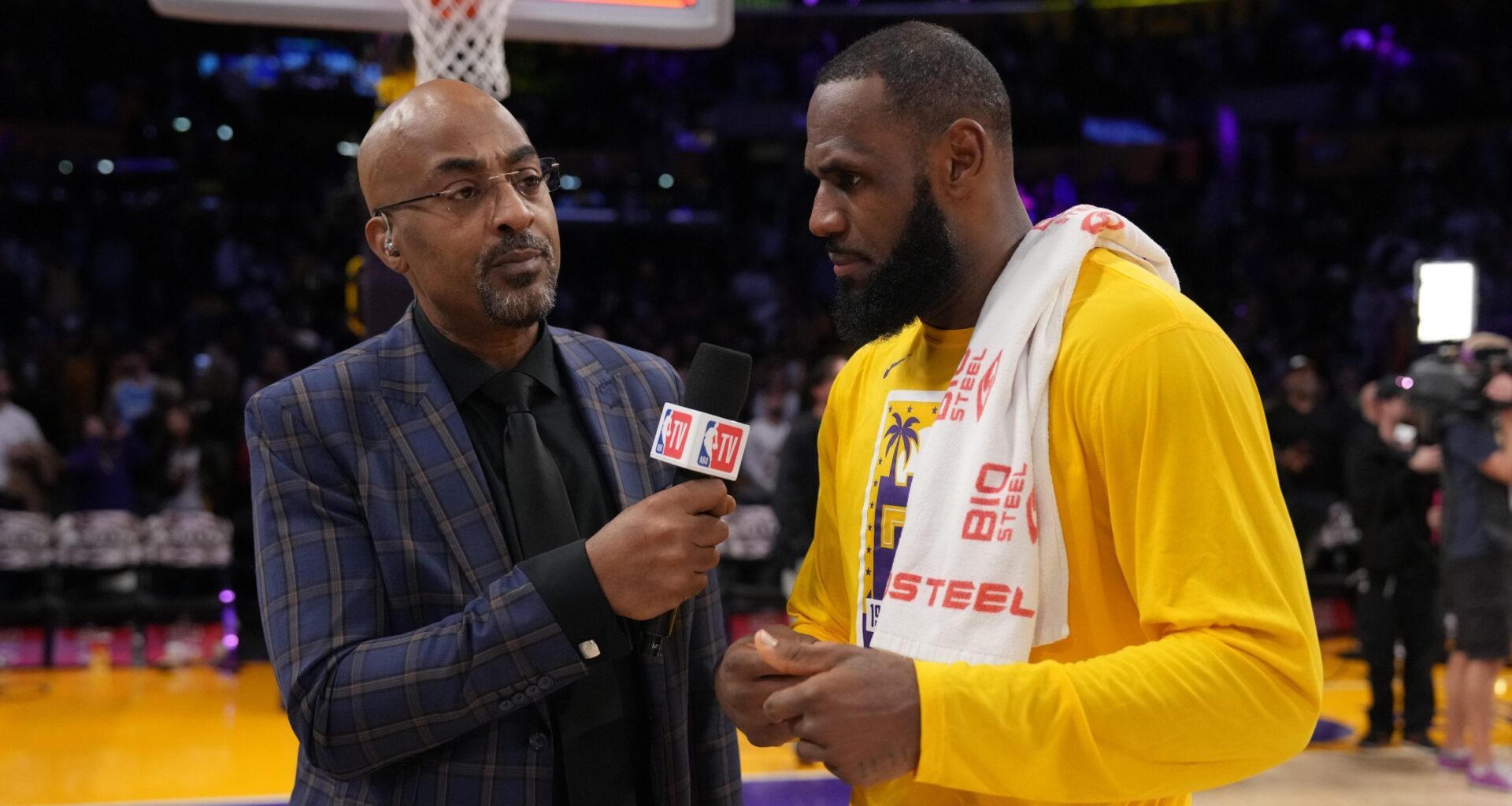
As the buzzer sounded on a Boston Celtic blowout of the Orlando Magic Tuesday night, it marked the end of an era for the NBA on television as the final playoff game on NBA TV. Yet it remains to be seen whether it will be the league-owned network’s final game overall. No decision has been made on that front.
Little is known about what NBA TV will look like next season. As part of a settlement the sides reached last year, the NBA will pay Warner Bros. Discovery $70 million/year over five years to continue producing content for the league’s various platforms — including NBA TV. Will that include WBD continuing to produce studio programming? Could that even include continued production of live games on NBA TV, assuming there are any live games on NBA TV? To say details are scarce would be an understatement.
What is a virtual certainty is that any future version of NBA TV will play a far smaller role in the league’s television strategy. With so much NBA inventory spoken for next season — Mondays on Peacock, Tuesdays on NBC and Peacock, Wednesdays on ESPN, Thursdays on Amazon, Fridays on Amazon or ESPN, Saturdays on ABC, Sundays on NBC and Peacock — any live game presence on NBA TV will surely be a far cry from its current 96-game regular season schedule. Maybe a few Thursday night and weekend games during the football season, before Amazon and the broadcast networks ramp up their schedules.
For a network that has carried games — both regular season and postseason — for more than 22 years, the future is a noticeable step downward. Yet that is the broader trend for league-owned networks, which are losing inventory, subscribers, and relevance.
In 2006, three-year-old NFL Network became the exclusive home of Thursday Night Football, debuting in the plum territory of Thanksgiving night. While its original schedule was limited to eight late season games, the network would expand to a 13-week schedule in 2012 that spanned virtually the entire season from Week 2 to Week 15 (not including Thanksgiving).
When the NFL finally began selling rights to TNF in 2014, NFL Network continued to air all games — simulcasting the games that aired on CBS (and later NBC and FOX) and carrying a handful of exclusive windows. After nearly a decade of broadcast networks paying hundreds of millions for non-exclusive rights, their interest dried up. Not surprisingly, when the NFL sold TNF rights to Amazon as part of the 2021 media rights deal (for double what the broadcast networks were paying) it was a fully exclusive deal.
Today, NFL Network still has live games, but it is a long way from owning exclusive rights to a primetime package. Instead, it carries most of the 9:30 AM ET International Series games from Europe, plus a late season double or tripleheader here and there. NFL Network used to get holiday games on Thanksgiving and Christmas — including a game on the latter just four years ago — but the chances of the league ever again setting aside valuable holiday inventory for its in-house platform are next to nothing.
Much like NBA TV, the future of NFL Network is uncertain. The NFL has been trying to offload its media apparatus for years, and has for months been in on-again, off-again negotiations to cede control to ESPN.
MLB Network and NHL Network, which are both operated by MLB Advanced Media, seem to be on relatively stable ground, but they too have lost key inventory in recent years. The days of MLB Network airing two Division Series games per year ended with the start of the current MLB TV deal in 2022. So have the days of NHL Network getting an occasional Stanley Cup playoff game, also owing to a new media rights deal in 2022.
Even the venerable Golf Channel is faces a murky future, as one of the several NBC Universal networks being spun off into the new venture “SpinCo.” Tennis Channel, which this week hired Amazon executive Jeff Blackburn as CEO, has long been the subject of sale rumors and as of this year no longer has its lone Grand Slam, the French Open. While not analogous to league-owned networks — both channels have always existed independently of the tours they cover — the uncertainty is another indication that sport-specific channels may not be long for the television world.
Some have already gone by the wayside. Speed Channel and Fox Soccer long ago transformed into FS1 and FXX, respectively. ESPN last year shut down the University of Texas Longhorn Network, which has since relaunched as a FAST channel. Pac-12 Network too, the complete collapse of the conference being the culprit.
It is simply the case that setting aside big games for league-owned networks no longer makes sense in an era of shrinking cable subscriptions and rising media rights revenues. Why would leagues reserve quality live game content for their own declining networks when any number of third-party platforms would be willing to pay exorbitant sums for those rights?
That there was ever a time when playoff games aired on NBA TV and MLB Network, a primetime NFL package belonged exclusively to NFL Network, majors aired on Golf Channel and Tennis Channel, and big football games aired on Longhorn Network and Pac-12 Network, may be hard to believe in a decade or so — maybe even sooner.
Absent the biggest live games, these networks can still serve a purpose, offering in-depth, all-encompassing coverage for dedicated fans. What they can no longer do is compete with the rights-paying partners who pay the bills.