
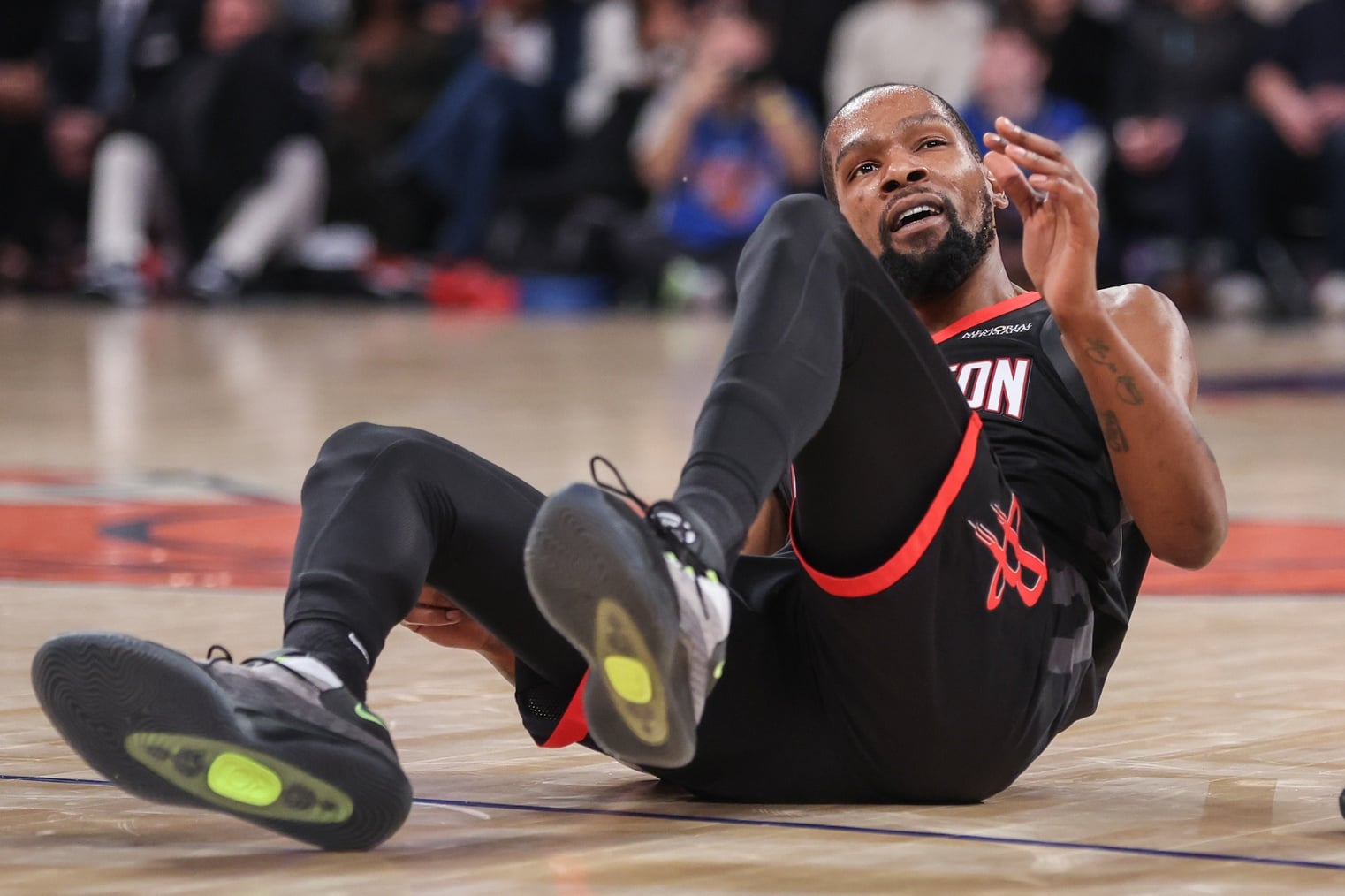
On Saturday night, the Houston Rockets had another clutch-time meltdown, this time against the New York Knicks. Houston’s offensive shortcomings are well-documented. They can’t shoot, and they have no real point guard. Those are roster issues the front office already passed on trying to address. But how is it that a roster full of athletes like the Rockets’ has one of the lowest player speeds in the league?
What Player Speed Tracking Data Says About the Rockets’ Offense
The Rockets lost to the Knicks 108-106 last night. They had led by as many as 18 points but saw that lead slowly whittle away throughout the second half. Finally, in crunch time, the Rockets played at their malfunctioning worst.
Stars Alperen Sengun and Kevin Durant were asked to create from the perimeter, and everybody else stood around and watched. It was a turnover reel – 9 in the fourth quarter alone. The Rockets tried to replicate their questionable small ball success from their last game. It did not work. Jalen Brunson heavily punished Houston’s switch-everything defense. The theoretical extra space on offense didn’t materialize into improved shots either.
Houston is not a good three-point shooting team—they have the second-fewest attempts in the league. Even so, their biggest, or at least most correctable, offensive issue may not be their lack of shooting. It might be their lack of movement. The NBA tracks a useful stat for examining this: average player speed on offense.
Average Player Speed on Offense
The Houston Rockets’ two All-Stars and best offensive players are both bottom-12 in average speed on offense per game. Durant is the eighth slowest offensive player in the NBA this season. Sengun is the twelfth.
Now, there are legitimate reasons why these two players would be so slow. Durant is 37 years old. His game was never predicated on Stephen Curry-style relocation. He gets the ball, does a few dribble moves to get to one of his spots, and then he shoots over whoever is there. That’s his whole game, and he’s very good at it. It does not require a whole lot of running around.
Sengun is only 23, but athleticism has never been considered a selling point of his. He has terrific flexibility and much-improved stamina. But he’s not a track star.
Nobody is mad at 39-year-old Rockets bench veteran Jeff Green being the second-slowest player in the league, either. Houston’s next slowest player after Green and the two stars is Steven Adams. Again, no surprise there. Adams’ best skill is being a brick wall. Brick walls aren’t known for their zero-to-sixty. The problem is, you don’t have to go much further to find several other Houston players.
Josh Okogie, Tari Eason, and Jabari Smith Jr. are all bottom-40 in the league in average player speed on offense. These are some seriously athletic players. They don’t have Aaron Gordon‘s excuse of perpetually hanging around in the dunker spot to catch lobs from Nikola Jokic either. They aren’t slow; they just aren’t moving.
Therein lies the problem. Houston’s offense has a debilitating lack of player movement. It makes them predictable and too easy to defend. It’s what gets them into turnover sprees like against the Knicks.
How Can Houston Get Moving Again?
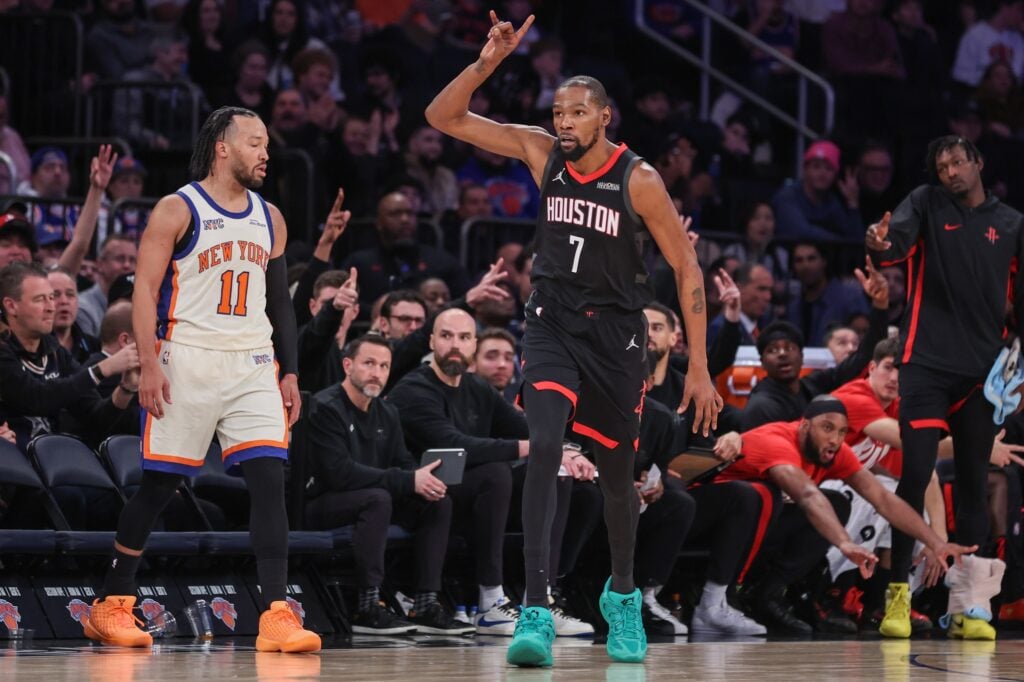 Feb 21, 2026; New York, New York, USA; Houston Rockets forward Kevin Durant (7) gestures after scoring in the third quarter against the New York Knicks at Madison Square Garden. Mandatory Credit: Wendell Cruz-Imagn Images
What Houston can do to fix this problem at this stage is unclear. They could try to implement more movement sets into their offense, but it’s unlikely to be practical. The players simply aren’t used to having to move. A full-scale overhaul of the offense usually requires a training camp’s worth of practice. And, frankly, an equivalent overhaul in the coaching staff.
Short of the Rockets pulling off something remarkable in the postseason, they should probably look to move on from head coach Ime Udoka this summer. Oklahoma City Thunder head coach Mark Daigneault recently bucked the trend of moving on from “development coaches” when it was time to compete. Besides, Udoka himself arguably replaced the “development” coach in Steven Silas, who was saddled with the tanking phase of the rebuild. Even so, it’s been increasingly normalized for NBA coaches to have very limited staying power beyond a few seasons.
Udoka is currently in his third year with the Rockets. He brought defensive integrity and a will to win to a young team in need of guidance. Nowadays, though (or at least once they have a point guard again), the Rockets are looking to win more than just regular-season games. They need an offense that makes its players’ lives easier, not harder, even if it does mean they have to move a little faster.
© Wendell Cruz-Imagn Images