
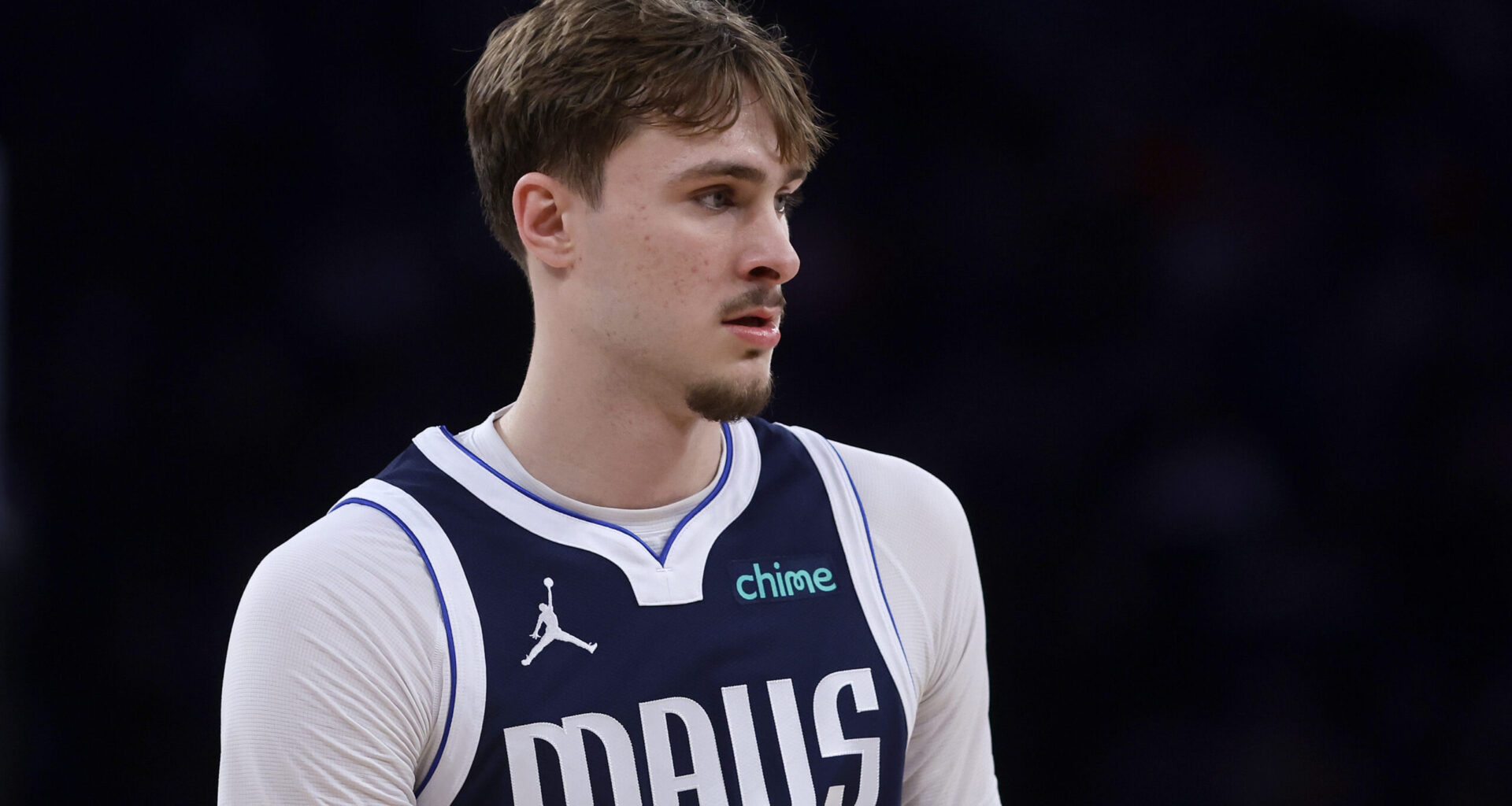
The Dallas Mavericks’ future is set. They’ve got something every NBA team either has or desperately wants: A franchise player. Cooper Flagg is the future of Mavericks basketball. Nobody could reasonably deny that. The question now isn’t whether Dallas has its centerpiece — it’s how the organization builds around him.
That part shouldn’t be overly complicated. Flagg is already a defensive prodigy. He can create his own shot. He can initiate offense. As long as the Mavericks prioritize floor spacing and functional offensive balance around him, they’ll give themselves a real chance to accelerate this timeline.
With that in mind, here are three players Dallas could target moving forward.
Reed Sheppard, Houston Rockets
Flagg is a defensive menace. So is Sheppard — until he isn’t.
Reed Sheppard’s defensive profile is layered. He averages 1.4 steals and 0.6 blocks per game, and his anticipation jumps off the screen. His hands are lightning quick. He disrupts passing lanes. But at 24.6 minutes per game, his size can still be targeted in certain matchups.
Offensively, though, the fit is obvious.
Sheppard is averaging 12.6 points, 3.0 assists and 2.6 rebounds in 55 games this season. He’s shooting 38.5% from three on 6.2 attempts per game. That’s legitimate volume. That’s legitimate gravity.
Even with a 42.7% overall field goal percentage, the perimeter efficiency forces defensive attention. He also keeps turnovers manageable at 1.3 per game while showing secondary playmaking instincts.
Next to Flagg, he wouldn’t need to dominate the ball. Flagg can initiate. Sheppard can space. When defenses collapse, he punishes them. When matchups get tricky, Flagg’s versatility allows Dallas to cross-match defensively.
If head coach Ime Udoka and the Rockets ever shift direction, this is the kind of skill-based addition Dallas should pursue.
Kel’el Ware, Miami Heat
There’s some overlap between Sheppard and Kel’el Ware.
Both would space the floor for Flagg. Both have defensive question marks. But Ware changes the equation because of his position.
He’s averaging 11.4 points, 9.4 rebounds and 1.0 block in 54 games while playing 22.2 minutes per night. He’s shooting 52.8% from the field and — more importantly for this conversation — 40.4% from three on 2.9 attempts per game.
Stretch shooting from the five spot matters. A big who can pull opposing centers away from the rim fundamentally reshapes the floor for a downhill creator like Flagg.
The concern is defensive consistency. A liability at center is more damaging than one in the backcourt. That’s fair. But Ware has the tools — length, mobility, rebounding instincts (3.1 offensive boards per game) — to become at least solid.
If he develops on that end, the fit becomes extremely clean. If he doesn’t fully get there, Flagg’s help instincts and rotational range provide a margin for error.
Michael Porter Jr., Brooklyn Nets
Why not think bigger?
Sheppard and Ware offer functional synergy. Michael Porter Jr. offers offensive scale.
He’s averaging 24.5 points, 7.2 rebounds and 3.3 assists in 44 games this season while playing 32.9 minutes per night. He’s shooting 47.0% from the field, 37.0% from three on 9.4 attempts per game and 85.4% from the free-throw line. His true shooting percentage sits at 60.2%.
That’s high-level scoring efficiency at serious volume.
If Flagg is the engine, Porter Jr. can be the pressure release valve. Defenses would have to pick their poison. Load up on Flagg, and Porter Jr. punishes rotations. Stay home on shooters, and Flagg attacks gaps.
He also rebounds his position at a strong rate and keeps turnovers reasonable at 2.4 per game for a high-usage scorer.
At some point, maximizing your franchise player means giving him someone who bends coverages independently. Porter Jr. does that.
Dallas has its cornerstone. Now it’s about building the right ecosystem around him — spacing, scalability and offensive punch. If the Mavericks get that part right, the rest of the league will eventually feel it.
Latest Dallas Mavericks News & NBA Trade Rumors