
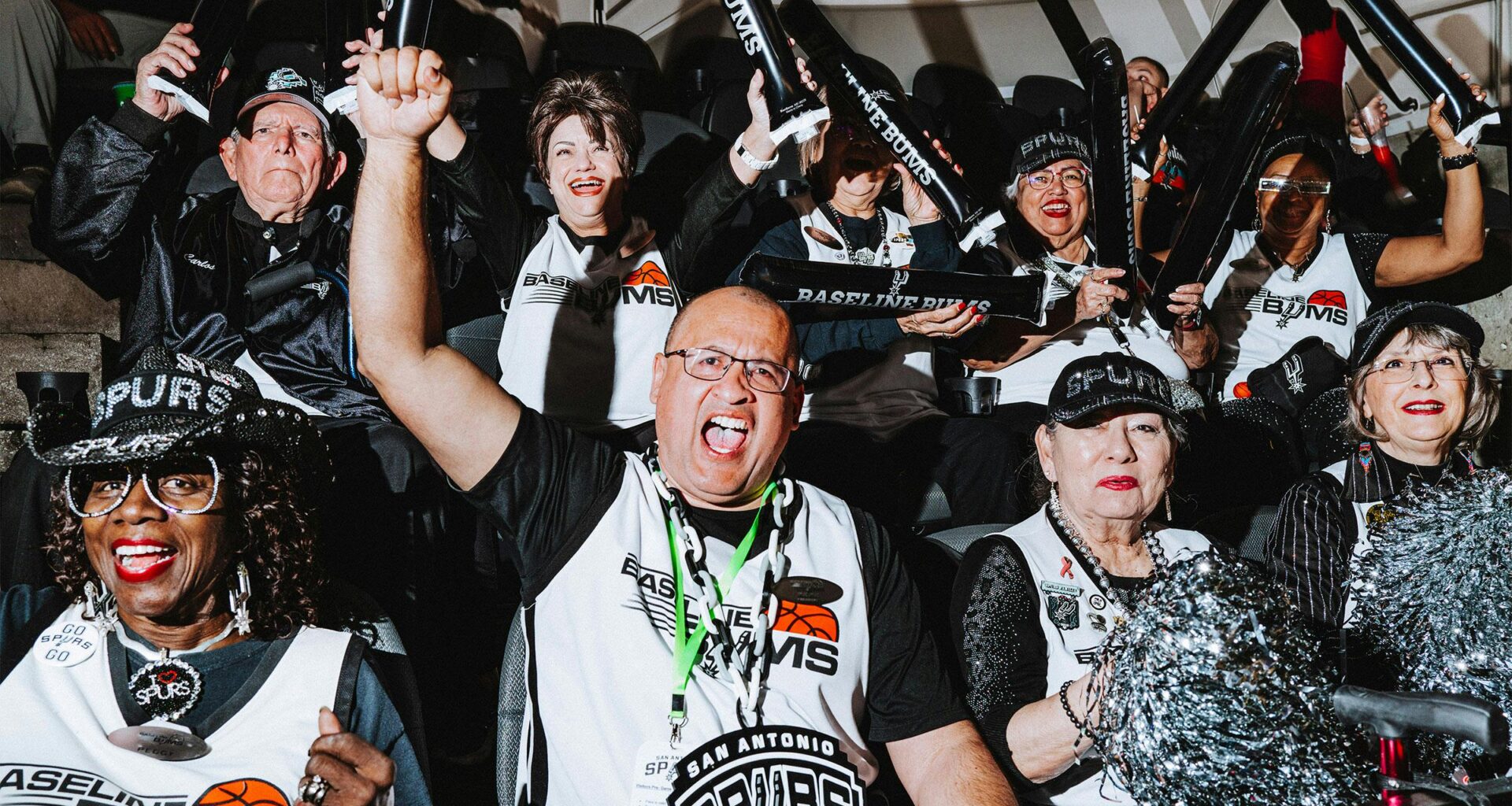
On a Saturday night in February, as the Spurs face off against the Mavericks in San Antonio, the Baseline Bums face off against the Jackals. The Bums are the original Spurs fan group, founded more than fifty years ago. The Jackals, who have existed only since just before the start of the current NBA season, are the supporters squad created by the team’s French phenom Victor Wembanyama, who wanted to bring some soccer-inspired fandom to basketball. Named after the scrappy European cousin of the Spurs’ mascot, a coyote, the Jackals have their own section. Their seats are at the top of the lower bowl on the west side of Frost Bank Center, directly across the court from where the Baseline Bums sit.
The Jackals arrived with some fanfare. In mid-September, more than five hundred Spurs fans turned out for tryouts for the group at Freeman Expo Hall. Like jesters dancing for their king, the hopefuls hollered and chanted as Wemby, on a Spurs-branded throne, smiled and took notes. He selected 75 men and women for the group; in exchange for a steeply discounted $999 season pass, each Jackal pledged to attend at least 75 percent of the season’s home games and be very, very loud. Because of both their volume and their proximity to Wemby, the Jackals have drawn attention in their virgin season—they are another shiny amenity of the Wembaissance. But some longtime fans wondered on social media: What about the Bums?
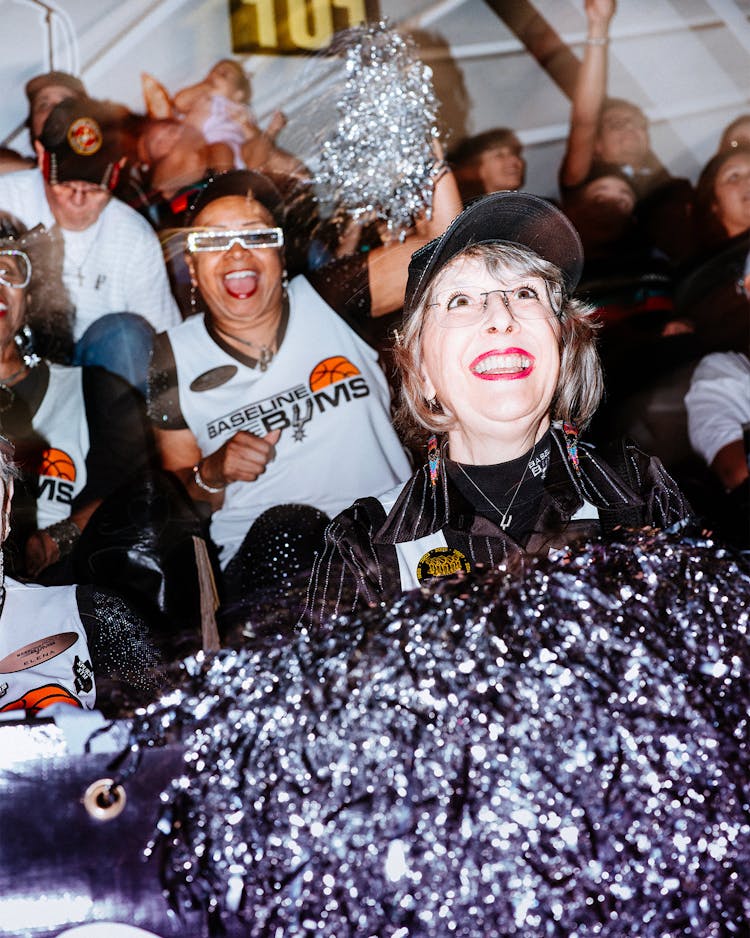 Die-hard Spurs fan and longtime Baseline Bum Susan Grebenor. Photograph by Chad Wadsworth
 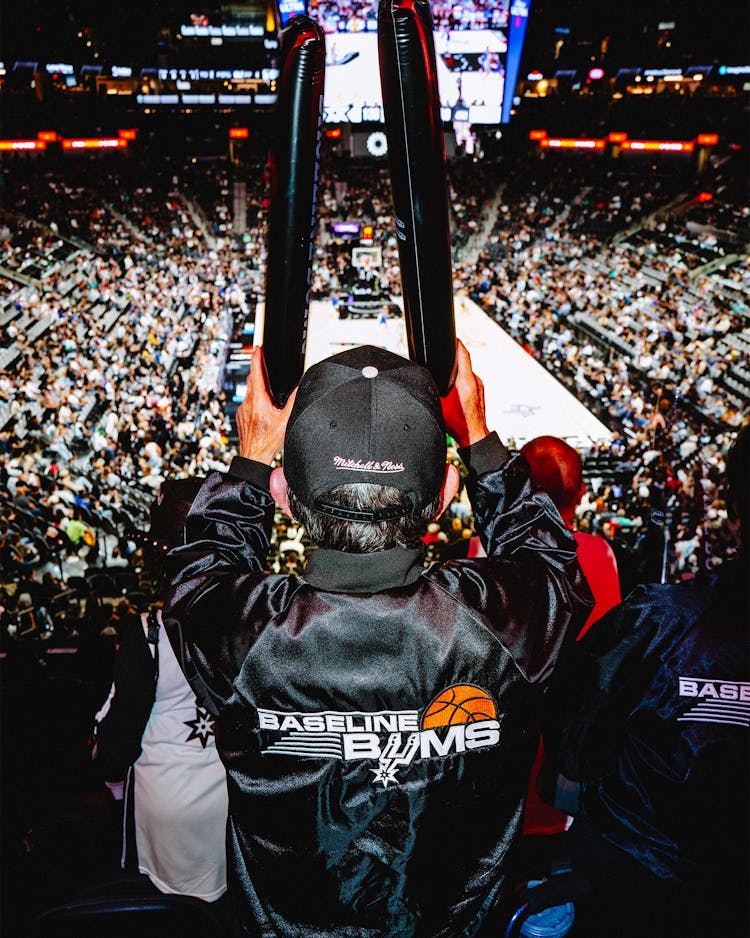 Thunder sticks at the ready. Photograph by Chad Wadsworth
The Baseline Bums date back to 1973, when the Dallas Chaparrals moved to San Antonio and became the Spurs. The ancestral Bums were boisterous. “The only requirements were indestructible lungs and a penchant for guzzling Lone Star,” a San Antonio Express reporter wrote in 1980 in an article titled “The Baseline Bums aren’t beggars. They’re more like hired killers.” The Bums’ antics were legendary, and stories of the group pouring beer—and even, on at least one occasion, guacamole—on opponents are legion. They came to HemisFair Arena in droves in the seventies and eighties, and when the team moved to the Alamodome, in 1993, and then to what is now Frost Bank Center, in 2002, so did the Bums.
Today’s Bums are more organized and more civilized; like the Jackals, they receive discounted season passes, but the Bums also each complete fifteen hours of community service, assisting with Spurs Give, the team’s nonprofit, and other charities. There are far fewer Bums than in the group’s early days. During this February home game, only about twenty of them are sitting in their section, so some seats are empty. The Bums used to occupy several sections, says their president, Pepe Esquivel, waving an arm toward their former territory with “everything the light touches” nostalgia. He wears a giant foam chain with a Spurs medallion and glasses with barely there frames that stretch across his large, friendly face. “We’re smaller in numbers,” he acknowledges, looking over at the Jackals. “But we’re the most dedicated.”
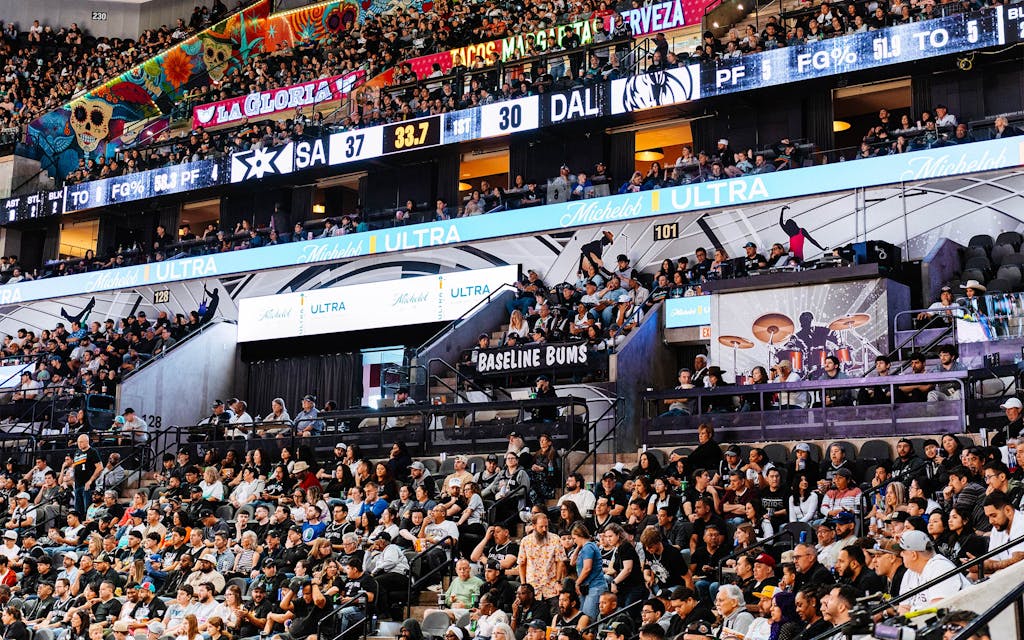 The small but mighty Baseline Bums section at Frost Bank Center.Photograph by Chad Wadsworth
The Bums skew retired, but they are not leisurely fans. They arrive fully bedecked in Spurs gear—any surface that can be bedazzled in silver rhinestones has been thus bedazzled—and they are rabidly focused on the game. There is little chitchat when the ball is in play. During the first half, whenever the Spurs attempt free throws at the basket in front of the Bums’ section, the group sits at attention. “Hands up,” Esquivel says, and the Bums raise their arms, sausage-like inflatable thunder sticks stilled in each hand, and hold them there as if waiting for a drop on a roller coaster. Nobody moves or breathes until the player has (hopefully) made his shot, at which point Esquivel says “Swish!” and the Bums exhale as one. Then they stand and bonk their thunder sticks together and stretch to bonk those out of reach. I’m reminded of the part in some church services where parishioners rise and shake hands with their neighbors, saying “Peace be with you” to all, as though missing someone might doom them. I, not in possession of my own noisemaker, am dutifully booped by a succession of inflatable tubes.
The Bums harbor no rancor against the upstart Jackals—they are on the same side, they say, albeit not literally—but several seem wistful about the Bums’ dwindling numbers. “We’re recruiting,” says Baseline Bum Susan Grebenor, a die-hard Spurs fan since she moved to San Antonio, in 1996. Grebenor, bespectacled and sporting a tidy bob, delivers her assessment of the Bums’ recent bummers with the matter-of-fact intonation of a player being interviewed courtside after a tough game. “We had a lot of longtime Baseline Bums that retired and didn’t have the financial wherewithal to buy the tickets anymore,” she says. “Health issues. Deaths in the family. People moving away. Jobs. All kinds of stuff comes into play.” She empathizes with the fallen Bums and notes the time commitment. “Some people join thinking it’s all fun and games, but they don’t really understand that it’s more than just coming to the game.”
The COVID-19 pandemic hurt membership too, Esquivel says. And the era during which the Spurs weren’t regularly winning didn’t help either. He looks around the arena, whose thousands of seats are occupied by cheering fans. “Now that we’re winning again, the seats are full. But we were here when they weren’t.”
“When they were losing, it was kind of sad,” says Betty Ann Rosales. A Bum for 23 years, including most of the fourteen seasons during which Tim Duncan, Manu Ginóbili, and Tony Parker played together, she understands the rhythms of an NBA team. The Bums have their own rhythms. “We had all those good years, but it takes a while to get going again,” Rosales says.
Pepe Esquivel is committed to recruiting and to preserving the Bums’ long tradition. He admits that he initially joined the group because, as a new father, he was seeking affordable season tickets, but the Bums have become a family to him. He used to bring his two children to games. His daughter is now the girls basketball coach at Stevens High School, in San Antonio. His 24-year-old son, Jacob Esquivel, an electrician, was also a member of the Bums for ten years. Now he is a captain in the Jackals.
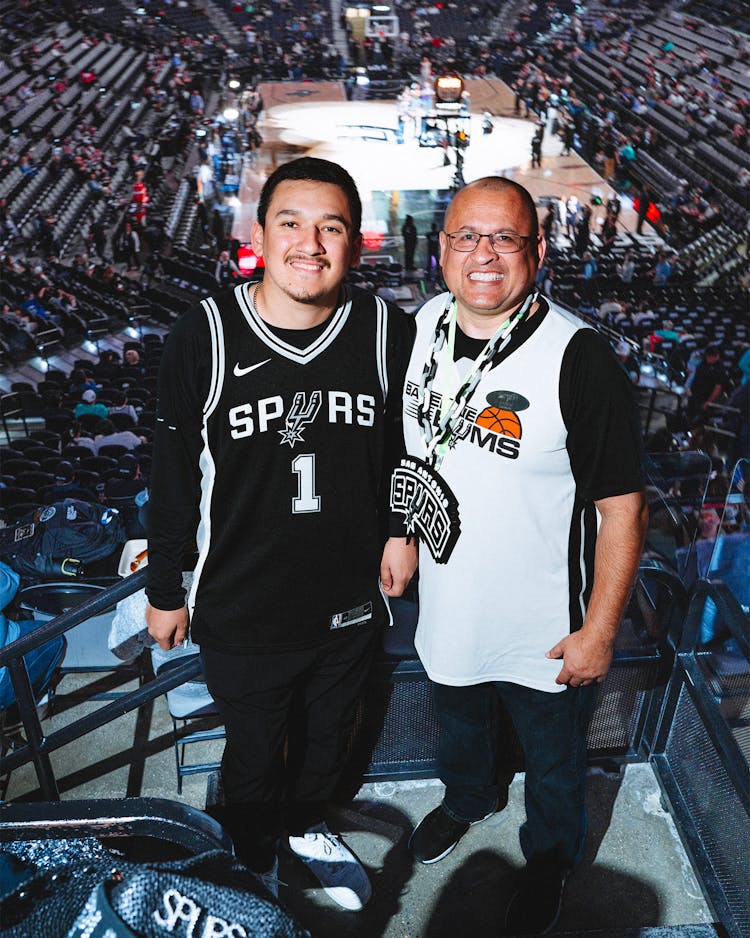 The president of the Baseline Bums, Pepe Esquivel (right), with his son Jacob, who is a captain in the new Jackals. Photograph by Chad Wadsworth
 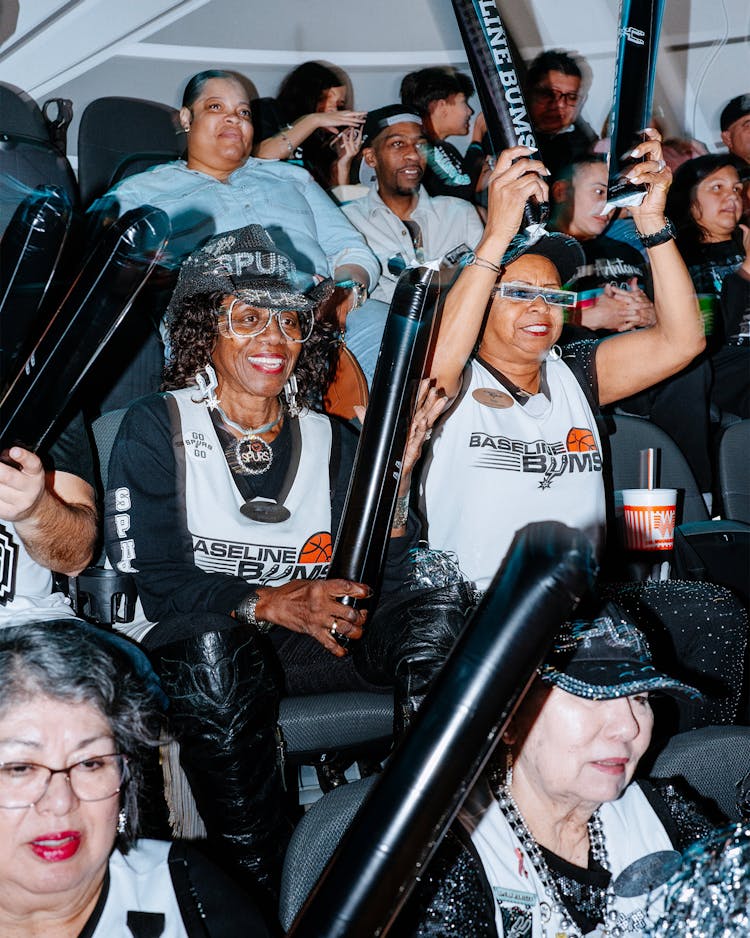 Best friends Peggy Dickerson (left) and Trina Hunt-Scott. Photograph by Chad Wadsworth
Jacob tells me later that he felt a calling when Wemby announced in an Instagram Live broadcast that he would create a European-style supporters section. He went to the tryouts with his face painted. He danced around with a foam finger, chanting and banging on a drum with Spartan ferocity while Wemby laughed and a small crowd of Spurs staffers looked on, their postures professional but their faces smiling. He was selected to be one of seven captains, the consummation of a childhood spent at Spurs games.
At first, Pepe tells me, it was hard not sharing a section with his son. “We’re used to always sitting together,” he says. “But he loves it over there.” He understood the allure of the Wemby-adjudicated tryouts; he might have attended himself, he says, except he already had plans.
Jacob is somewhere in the mass of people across the court, where the Jackals, who stand throughout the game, wave their arms and bang drums. Their chants are simple and contagious, and a Bum behind me sings along quietly: “Olé, olé, olé, olé, go Spurs, go Spurs.”
“People are like, ‘I can’t believe you left the Bums; you’re a traitor,’ ” Jacob says later, laughing. “I’m like, ‘No, no, it’s all good blood! We’re cool!’ ”
Jacob loves the flash and energy of the Jackals, but he misses the tradition of the Bums; he muses that the Bums and the Jackals could join forces somehow, offering tiers of membership like those of the Los Angeles Clippers’ supporter section, the Wall. He knows that the futures of the Jackals and the Bums are up to the Spurs, but he says he will do whatever he can to make sure the Bums are around for another fifty years. “I love them to death,” he says of the Jackals, “but the Bums were literally there from day one at the HemisFair Arena.”
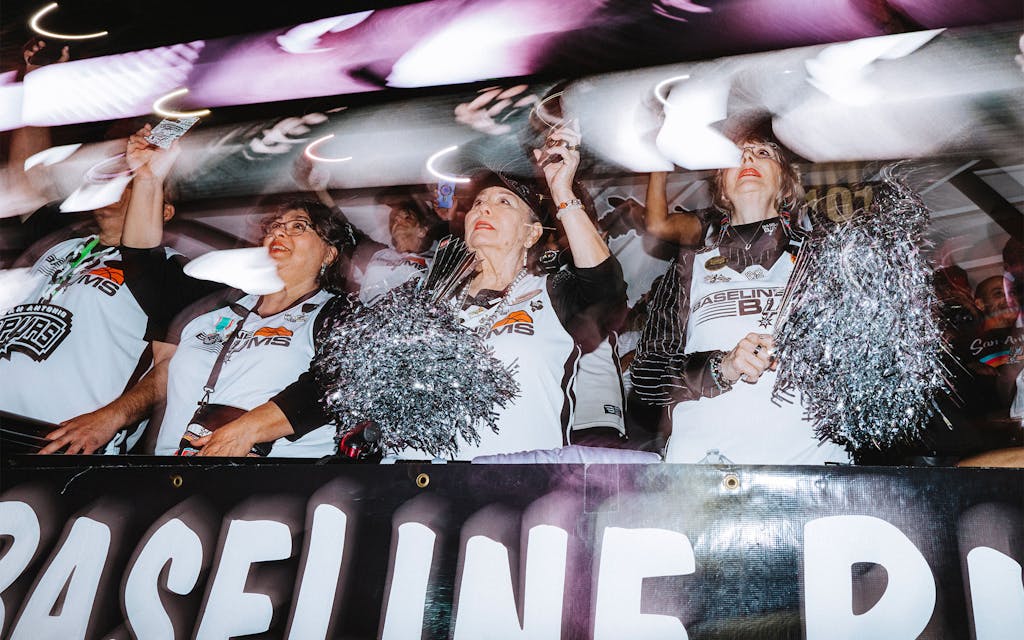 Win or lose, the Baseline Bums remain loyal to their beloved Spurs.Photograph by Chad Wadsworth
Many of the Bums have known one another for decades. In the seat to Pepe’s left is Peggy Dickerson, the longest-serving Bum at this game. (The Bum with the longest tenure is currently hospitalized; her fellow Bums, of course, have been visiting her.) Dickerson joined the Bums after a woman from her church invited her to sit with them for a game. Over sleek black ringlets, she wears a black cowboy hat with a rhinestoned brim. Rhinestones dot the frames of her lensless glasses, too, and large silver Spurs-logo earrings dangle from her ears. “Let me show you something I bought,” she says, reaching down to the floor and emerging with a metal Spurs purse, holding it up with ta-da aplomb.
Dickerson was a Bum long before the Spurs started playing at Frost Bank Center. “When we moved here, it was so gigantic I didn’t think we had enough people in San Antonio to fill it,” she says. Years ago, she recruited her friend Trina Hunt-Scott into the Bums, and they come to every game together; Hunt-Scott has slender tinted glasses, also framed by tiny silver rhinestones, and wears fantastic silver cowboy boots. “I knew I was gonna make her a Bum. This lady right here, she’s my best friend,” Dickerson says. Hunt-Scott’s face is locked on the court, but she has a soft expression.
“I will never leave these people,” Dickerson adds, twiddling her fingers at the rest of the group. “Where they go, I’ll go.”
As the game draws to a close, many of the Bums are already beginning to make their way down the stairs and to the parking lot; across the court, the Jackals are still stamping and hollering. It’s clear the Spurs will win, as they have done for much of the season. But the Bums would still show up even if they weren’t.
Read Next