
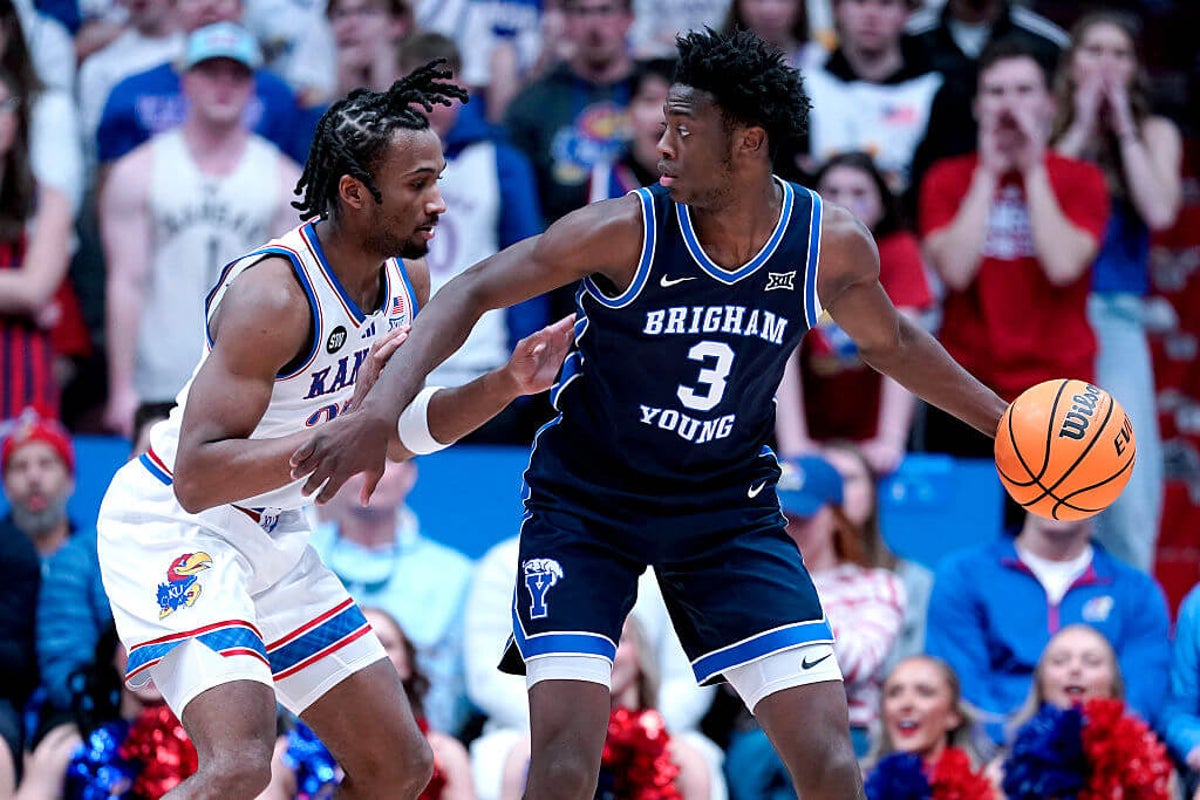
College basketball was supposed to see a dip in talent this year. Along with losing two full classes — traditional seniors, and the final group of players with an extra year of eligibility because of COVID-19 — the sport also waved goodbye to the top members of a strong freshman class led by Duke’s Cooper Flagg.
The incoming freshman class had other ideas.
The class of 2025 has completely altered the landscape of the sport this year. Members of that group will impact the national title race and have a strong presence on All-American and all-conference teams.
Cam Boozer (Duke), AJ Dybantsa (BYU) and Darryn Peterson (Kansas) entered college basketball with elite expectations and as contenders to be the top pick in this June’s NBA Draft. But other five-stars like Caleb Wilson (UNC), Darius Acuff Jr. (Arkansas) and Kingston Flemings (Houston) have exceeded expectations, and more unheralded recruits like Keaton Wagler (Illinois) and Amari Allen (Alabama) have become vital leaders for teams expected to contend in March.
The influx of international newcomers has also been a boon to the sport. Teams like Virginia (Thijs De Ridder and Johann Grunloh), Illinois (David Mirkovic) and Gonzaga (Mario Saint-Supery) have significantly elevated their postseason prospects by seeking overseas talent.
Of the top 12 teams in the NCAA Tournament selection committee’s bracket sneak preview Saturday, five counted a freshman as their leading scorer. The quantity of superstars is higher than ever, but the depth of this class is also staggering compared to its predecessors.
To illustrate, let’s look at an objective measure. Box Plus/Minus is an all-encompassing statistic that boils down the contributions of an individual player into a single number, with 0.0 being average. It is not perfect, but it allows us to compare player impact over different seasons.
Filtering BPM for players hitting certain thresholds paints a stunning picture of the freshman influence on this season. Compared to previous years — especially post-COVID-19 — this year’s class is in a unique stratosphere. (Table updated through Monday’s games.)
Freshman BPM qualifiers (min. 250 mins.)
Year
>12.0
>11.0
>10.0
>9.0
>7.0
>6.0
2025-26
6
6
10
14
34
47
2024-25
1
4
6
10
20
26
2023-24
0
1
2
3
9
13
2022-23
1
2
2
3
14
20
2021-22
1
2
2
3
14
19
2020-21
1
1
2
4
15
27
2019-20
0
2
2
5
12
25
2018-19
2
2
4
4
14
25
2017-18
0
4
7
10
18
27
2016-17
1
1
4
8
28
37
That data is forceful.
Last year’s class — led by Flagg, his former Montverde Academy teammates in Asa Newell (Georgia), Liam McNeeley (UConn) and Derik Queen (Maryland), and others like Michigan State’s Jase Richardson and Baylor’s V.J. Edgecombe — seemed like a wave washing over the sport. But this year’s class blows 2025 out of the water.
In fact, you could combine the last two classes, and it would still fall short of this season in every category.
If you want something simpler than BPM, a pure points per game filter demonstrates the same trend:
Big-time freshman scorers
Year
>18.0 PPG
>15.0 PPG
2025-26
10
29
2024-25
5
15
2023-24
1
9
2022-23
1
10
2021-22
0
6
2020-21
4
9
2019-20
3
18
2018-19
5
19
2017-18
6
25
2016-17
3
22
Particularly in contrast to recent seasons, this class is overflowing with major producers. And nine of those 10 averaging 18 points per game play at the high-major level:
Dybantsa (25.1 PPG)
Boozer (22.7)
Ebuka Okorie, Stanford (22.3)
Acuff (22.2)
Wilson (19.8)
Peterson (19.5)
Mikel Brown Jr., Louisville (18.9)
Kevair Kennedy, Merrimack (18.3)
Wagler (18.2)
Hannes Steinbach, Washington (18.0)
No wonder NBA scouts and teams are salivating over this draft class. In The Athletic’s last NBA Draft big board, nine of the top 11 prospects were freshmen — an indication of the high-end talent. And 17 of the top 25 were freshmen, a sign of the depth.
This class has more top-end stars
Refer back to that chart of BPM qualifiers. The last nine years have had a total of seven freshmen crack 12.0 in BPM: Flagg, Brandon Miller (Alabama), Donovan Clingan (UConn), Chet Holmgren (Gonzaga), Zion Williamson (Duke), Bol Bol (Oregon) and Lonzo Ball (UCLA).
The 2025 group alone has six rookies hitting that lofty measure: Boozer, Peterson, Wilson, Dybantsa, Wagler, and Flemings.
Another way to put it: over the past three years, only two freshmen (Flagg and Miller) landed in the top 10 of KenPom’s Player of the Year standings. This year, four of the top 10 are freshmen: Boozer, Wagler, Flemings and Dybantsa.
You could construct a first-team All-America squad consisting solely of freshmen and be able to defend it. The star power in this rookie class is simply without parallel. The group’s collective explosion on Saturday, Jan. 24, was the stuff of legend: Flemings, Wagler and Dybantsa all scored 40-plus points, while Boozer, Acuff and Tennessee’s Nate Ament had highly productive 29-plus point days as their teams notched key victories.
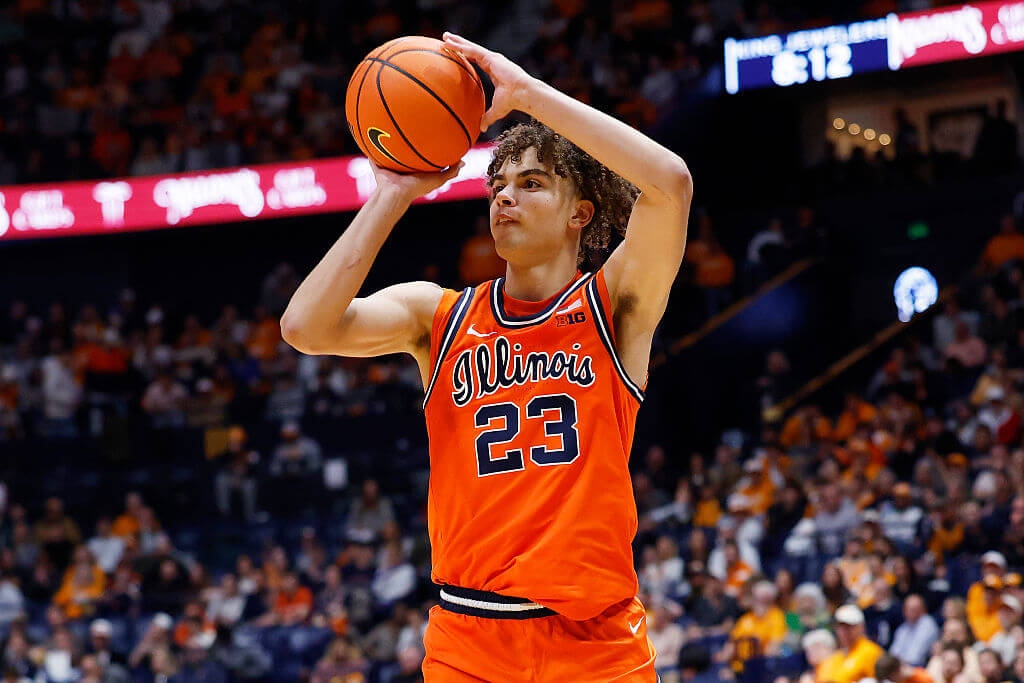
Illinois guard Keaton Wagler’s emergence has added to the freshman class’ historic output. (Johnnie Izquierdo / Getty Images)
It also has more depth
Zooming in on the stars illustrates only a fraction of this freshman class’s effect. A number of teams in the projected NCAA Tournament field or on the bubble are reliant on freshmen as leaders or role players.
Arizona’s duo of Koa Peat and Brayden Burries may not quite reach the productivity heights of Boozer and Peterson, but they are the two leading scorers for one of the best teams in the sport. Top Big Ten teams Michigan and Nebraska both get huge boosts from freshmen sixth men (Trey McKenney for the Wolverines, Braden Frager for the Cornhuskers — though Frager is a redshirt freshman). Arkansas has shown an incredibly high ceiling this year, thanks in large part to its freshman backcourt tandem of Acuff and Meleek Thomas.
At Stanford, Okorie ranks 10th nationally in scoring. Villanova is set to get back to its first NCAA Tournament in four years behind leading scorer Acaden Lewis. At Seton Hall, Najai Hines is a dominant interior defender who is trying to help the Pirates to their first NCAA Tournament bid since 2022. Even Mountain West upstarts like New Mexico (Jake Hall) and Utah State (Adlan Elamin) can point directly to surprise rookies as major reasons for their success.
Crucial contributors from this freshman class are everywhere. Having 47 players above the 6.0 mark in BPM is monumental. Only 2016-17 comes close to that figure in the last decade, and even that group falls 10 short of this year’s class.
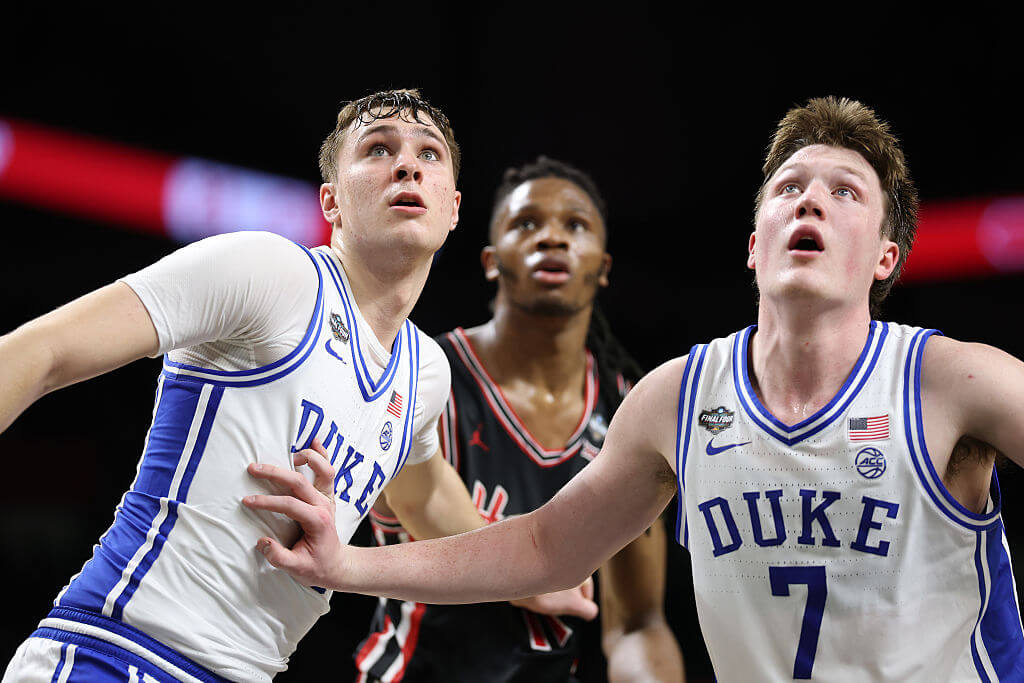
Cooper Flagg, Kon Knueppel and Duke were an outlier in last year’s Final Four for their youth, but this year could be different. (Jamie Squire / Getty Images)
What this means for March
The lasting image of the 2025-26 season will be the overall impact of the freshman class. Even in the NCAA Tournament, freshmen could decide the outcome. Of the top 10 teams per KenPom, half rely heavily on a key freshman (or, like powerhouses Arizona and Duke, on multiple freshmen). Add in Kansas, Louisville, Arkansas, Virginia and Tennessee, and half of the top 20 function via freshman engines.
That is in stark contrast to recent seasons, when fifth-year seniors and experienced squads ruled the postseason. Zero freshmen played in last season’s title game between Florida and Houston. Duke’s freshman-laden lineup (Flagg, Kon Knueppel, Khaman Maluach) was the exception at the Final Four, as Auburn had five senior starters, with only one freshman (Tahaad Pettiford) in the rotation.
UConn’s Stephon Castle was the only freshman starter in the 2024 championship, while the Huskies’ Alex Karaban was the only rookie contributor in the 2023 title game. KJ Adams’ three minutes off the bench marked the only time logged by a freshman in the 2022 title game, and Gonzaga’s Jalen Suggs was the only freshman contributor in the 2021 championship.
In the past 40 years, only four freshmen have been named Most Outstanding Player of the Final Four: Louisville’s Pervis Ellison in 1986, Syracuse’s Carmelo Anthony in 2003, Kentucky’s Anthony Davis in 2012, and Duke’s Tyus Jones in 2015.
There’s a good chance that the 2026 MOP recipient will be a fifth such freshman. Unlike the rarity of recent seasons, this class will be heard from in March.