

The NBA had a down-sizing moment, and the big man seemed to be going extinct with exceptions. As the kids say though, the NBA big man is so back.
The skill with size caught up, enabling teams to return to lineups with two seven-footers in it. The possessions game has been of utmost importance in today’s NBA, so coaches aren’t afraid to sacrifice quickness in space if it meant grabbing extra rebounds. Obviously, certain matchups won’t fare well for them, but as long as there is functional use of size and length with some scheme versatility — or simply scheme excellence — then they can survive defensively. Finally, teams are running a lot more actions with screening involved, increasing the utility of giant bigs that play with force.
As the giant archetype is becoming more prevalent, I want to focus on a possible prospect in the 2026 NBA Draft: Michigan junior Aday Mara. Doing this scouting process for a few years now, it’s cool to see how information changes. He had intrigue as a passing, play-finishing big man in international play, but he started out slow at UCLA, as the game just looked too fast for him — he looked lost. He got his footing as a small-sample analytics darling in his sophomore year, but he’s found himself after transferring to Michigan. While he has real concerns that will hamper his NBA ceiling, Mara stacks real skills at a borderline-elite level that make him a fascinating giant prospect.
Can Aday Mara join the next wave of impactful NBA giants?
About a decade ago, if anyone 7’2” or taller was on a roster, it was either a unicorn or a situational fringe rotation player. Now, those players hold more relevant roles and impact winning to a significant degree.
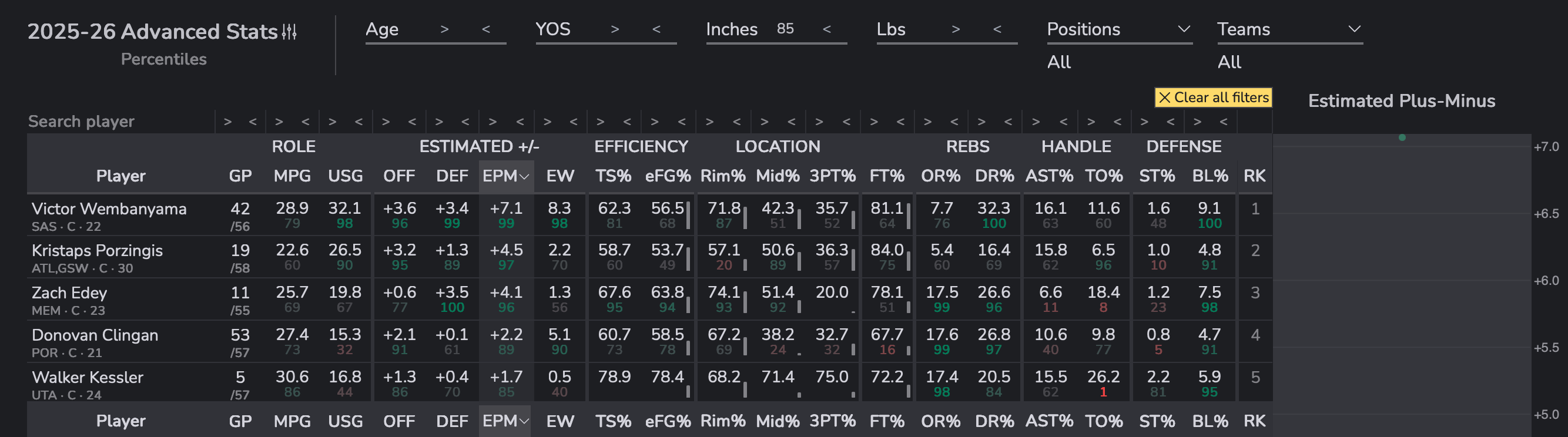 dunks and threes, numbers for players taller than 7’1” (2025-26)
The list of current players 7’2” or taller is incredibly impressive. Their impact is multi-faceted, but also the concerns that come with building with this archetype.
There’s not much to say about Victor Wembanyama except that he’s a Basketball Frankenstein that dwarfs his opposition and the conceptions around what players his size are capable of — it’s like if Kevin Durant and Anthony Davis fused together and became a 7’5” basketball purist. Kristaps Porzingis bends defenses with his logo range, which enables closeout attacks, and he’s a strong rim protector. Donovan Clingan’s size activates his rebounding, rim protection, and screening, but he stretches his game out with three-point willingness and passing. Walker Kessler is essentially a rebounding, shot-blocking machine. Zach Edey is an imposing presence that leverages his size and strength to crush the glass, patrol the paint, set hard screens, and finish plays easily.
As you can tell from the games played out of total games split, the only thing capable of slowing these guys down is injury. Edey had an offseason ankle injury and has been dealing with a stress reaction. Wembanyama has had various ailments throughout his career. Kessler and Porzingis are different cases. Kessler is out for the season after elbow surgery, not usually synonymous with big man injuries, but this path was also smart with his free agency and the Jazz’s season outlook. Porzingis has had numerous lower body injuries throughout his career, but over the last year, he’s dealt with POTS.
Needless to say, as long as health doesn’t get in the way, these NBA giants have a resounding impact due to offering an intersection of perimeter skill and shot-blocking, or for effectively shoring up space in multiple capacities.
Is it a foregone conclusion that giant equates to great production? Not entirely. Let’s expand the sample over the past few years.
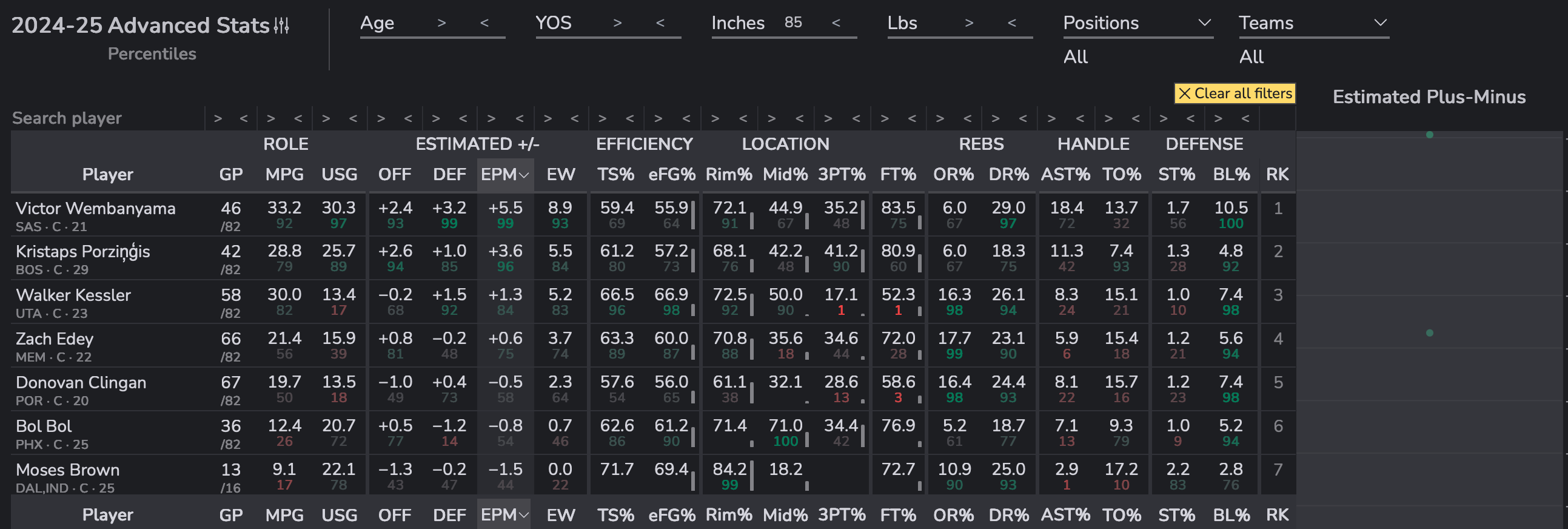 dunks and threes, numbers for player 7’1” or taller (2024-25)
Stronger, healthier sample prevails for Kessler and Edey. Even as a rookie, Edey walked into being a productive NBA starting big man. With Bol Bol and Moses Brown, multiple factors exist here. For Bol, he doesn’t have the mass to anchor a defensive end nor the mobility to hang on the perimeter defensively — a low motor doesn’t help. He’s an automatic play-finisher that can stretch the floor. However, his warts defensively have him out of the league. Brown has key skills for a big man with his stellar rebounding and finishing production, but his inactivity as a rim protector leaves him as a fringe NBA player.
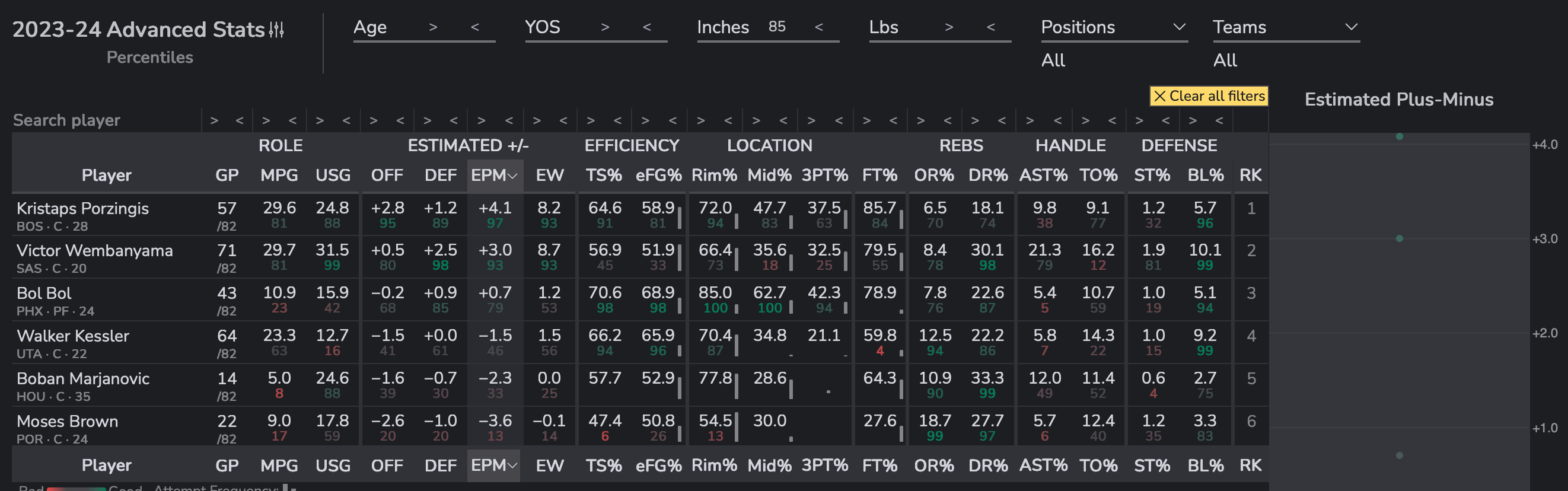 dunks and threes, numbers for players taller than 7’1” (2023-24)
Boban Marjanovic had always been an end-of-the-bench, fringe-rotation guy. His viability as a rotation player — what hindered him to limited minutes — was his immobility and his low rim-production numbers.
So what are the common denominators for the giant archetype — at least with this baseline of statistics? Elite rebounding, automatic play-finishing, and stellar shot-blocking. Not shown in these statistics, screening is valuable as well.
How does Aday Mara fare in this trend? Quite well.
When assessing pre-NBA production, Mara is producing at similar levels to three aforementioned giants.
Let’s run comparisons here — from a statistical point of view. Mara’s rebounding takes a hit, but his context hurts him more than it did for these counterparts. Morez, Johnson, and Yaxel Lendeborg also crash the glass. Mara is a superior passer, but his riskiness with his passes translates into more turnovers. He passes the test for blocking shots, but his willingness to chase blocks can lead to fouls.
If you think the 12 box plus/minus is nitpicking, let’s shrink the number to 10. The players involved here: Ryan Kalkbrenner (three times), Roy Hibbert, Jay Huff, Zvonimir Ivisic (Illinois junior, likely NBA player), and Hasheem Thabeet.
So, the list consists of productive NBA big men, a promising rookie, a potential NBA big man, and one draft bust.
Where can Aday Mara fall within this giant trend?
Now let’s look at the film.
Aday Mara stacks a lot of important skills with his size that should translate to being a rotation player in some capacity.
Starting with the defense, Mara is a potent shot-blocker, boasting a 12.8 block rate. In conference play, he has averaged 2.9 blocks in 22.8 minutes per game. Opposing players also shoot 46.2 percent when he’s the primary defender at the rim. He leverages his sheer size to keep a lid on the basket and lock down the paint. His presence also deters drives from the basket, forcing them into Nash dribbles. He’s a massive rim protector that blocks, alters, and deters shots — checking every single box for a strong NBA anchor.
One trait I try to look for with college bigs is their scheme versatility. In the NBA, they can’t park in the lane and just wait for drivers to come into their vicinity, because of the “defensive three seconds” rule. They will have to step out and defend in space, even just a little bit. Don’t get it twisted, Mara won’t be switching much. He’s likely going to be a drop — or high-drop — defender. Some moments won’t look pretty, primarily with his foot speed and processing, but he keeps his arms active to cut off passing lanes for rollers and cutters. He also shows that with good positioning and sheer size, he can avoid getting absolutely fried defensively. It’s a testament to the work he’s put in on his mobility.
One note to add with his defense: he loves the Kornet contest.
Mara’s rebounding is vital for Michigan on both sides of the ball. Offensively, he creates new possessions. Defensively, he ignites transition offense with his outlet passing. Two key components of today’s possession game are the ability to create second-chance points and to generate offense before the defense can set up. Mara’s rebounding helps accomplish those goals.
The biggest value add for Giants offensively is to simply finish plays. Mara has improved his two-point percentage from 59 percent to 67.4 — if you account for his freshman year, his baseline was a putrid 43.2 percent. In the halfcourt, he’s converting on 75.8% of his rim attempts. His finesse and touch have improved inside, as the former shows with his post moves — developing a shoulder turn that’s become lethal. Because of his size, he provides vertical spacing with his catch radius, although he still needs to improve with his hands. He maximizes his catch radius and size by keeping the ball high. Through these skills, he’s money off the roll (74.3 eFG as a pick-and-roll roller) and off cuts (82.1% off cuts).
I will say with his finishing that needs to go up a little bit stronger at times. He’s getting better at simply just slamming it home, but going up stronger is vital as he looks to improve his touch and hands.
The real differentiator for Aday Mara among the giants is his playmaking. I’m in awe of his passing. There’s a blend of creativity and utility to his passing. With his creativity, he can drop behind-the-back passes, wraparounds, skips, and bounce passes. Because of his size, he can see over the defense, which fuels his utility as a passer — post, short roll, elbows, slot, or offensive rebounds. For these reasons, I’m not spooked by his turnover rate. Playmaking in the frontcourt is a vital trend in today’s NBA, and Mara’s passing will warrant a look at rotation minutes in the league.
Mara has drawbacks that could hamper his likelihood of becoming a full-time NBA starting center. He needs to add more muscle to his frame. He fouls frequently as an anchor. His defense will be tied more to how good he is in a drop coverage rather than his scheme versatility. He’s averaging 22.6 minutes per game, which is a career-high. Does he have the stamina to play NBA starter minutes? It’s a fair question.
However, Mara’s intrigue lies in his proficiency in key giant skills paired with an intriguing differentiator. He’s a strong rebounder, rim protector, and play-finisher that flashes his skill level with exquisite passing through various actions as an absolute giant. While Mara will have concerns with his speed and fouling, he adds value in the possessions game — creating second-chance opportunities and igniting early offense. He adds spacing with his screen-setting, and does so vertically with his play-finishing.
Will he be a starting NBA center? Maybe, as the conditioning element looms for that role. Will he meet the value of the current NBA giants roaming and dominating the NBA? It’s a high bar, but his strengths typically yield positive results in the analytics. The more likely scenario is he becomes a part of a platoon for strong center play for 48 minutes — serving as a big man a team can win their minutes with due to his size, value in the possessions game, and playmaking.
Given his intersection of his size and skillset, Aday Mara is a bonafide first-round prospect that can yield top-20 value and become another productive giant in the modern NBA.
If you choose to support my Substack, SubTsakalidis — aka “SubTsak” — follow this link to my Allie’s Allies St. Jude fundraiser page. If you choose to subscribe, all proceeds will go towards St. Jude Children’s Research Hospital.
Follow me on X and Bluesky. Subscribe to my YouTube channel, SubTsakalidis Scouting.