
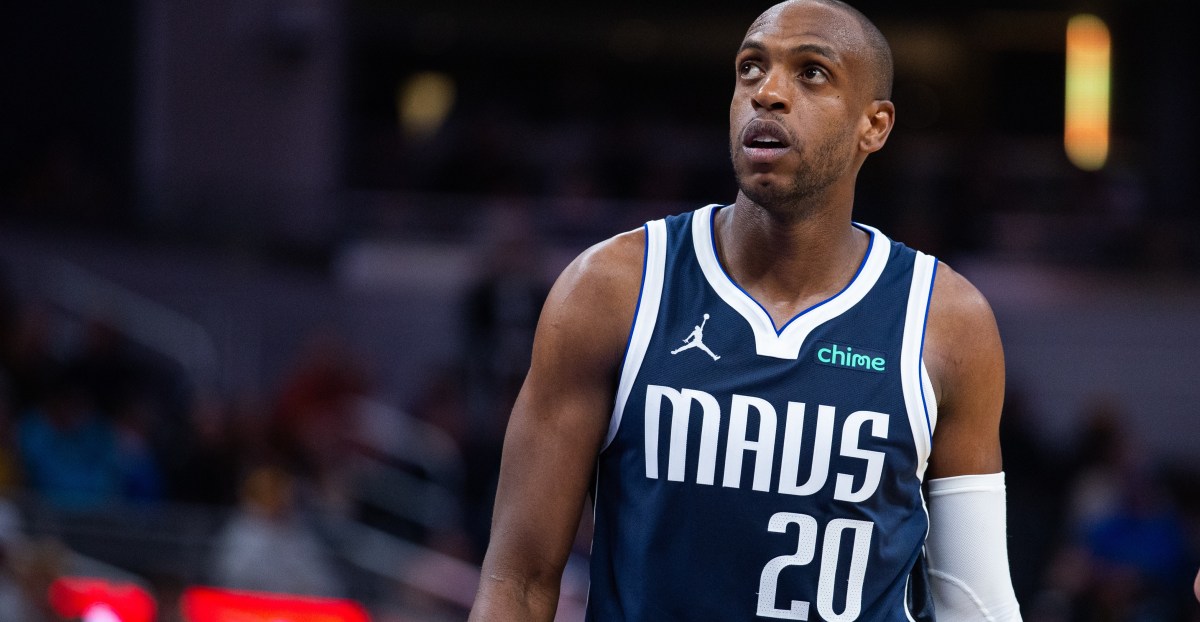
His IQ was described as beyond his years already back in high school. Khris Middleton, one of the new additions to the Dallas Mavericks roster in the Anthony Davis trade to the Washington Wizards, is not just any NBA veteran.
Second star at his peak in Milwaukee, once fighting for the top spot with later NBA MVP Giannis Antetokounmpo, battles with multiple serious injuries and the resulting psychological toll, reliable number two on a championship team, averaging more than 20 points in 80 playoff games through his career. Khris Middleton’s story is one of extreme ups and downs.
It includes being one of the best players on the best team in the world for a while, but also being accused of being too fearful and soft for the NBA. The rollercoaster career of the 6’7 forward is important to know if you want to understand the player who just had his first 25 point game as a Mav earlier this week.
Back in high school, John Pearson, Middleton’s coach at Porter-Gaud School, favored positionless basketball. He encouraged him to play all over the court, even in the post, Zach Lowe wrote in 2019 in a piece about the second star in Milwaukee.
According to Pearson, however, Middleton resisted. “But I wasn’t going to pigeonhole him,” he said later. It was a strategy that has proven beneficial to Middleton later in his career, and a gift in the NBA.
Another gift, which we see with the new, young franchise player in Dallas, rookie Cooper Flagg, as well, is the incredible mastery of being able to finish with both hands. Almost ambidextrous with a basketball, Middleton was forced to go left as a kid by his dad so often that he sometimes prefers it now. Just like we see with the younger Flagg.
Famously a Texas A&M alumni, Middleton was already a first-round NBA prospect after two years at the historic college, but they convinced him to stay another year. Unfortunately, he tore his meniscus that fall. He returned a month later, but wasn’t the same, his coach at the time, Billy Kennedy, remembered. “He was skittish. He played not to get hurt.”
After this, Middleton’s draft stock fell. Then scouts heard rumors Middleton was soft. The Detroit Pistons ended up picking him at 39 in the 2012 draft. Reportedly, that was nine picks after Middleton and his father stopped watching, because they were upset that he fell out of the first round.
But the Piston’s GM Joe Dumars didn’t see soft, Zach Lowe describes in his piece. He saw something more in Middleton. “I saw a guy who played at his own pace.”
People saw his unhurried style and thought he had a low motor, and he was misunderstood often. But the psychological toll on players after returning from serious injury was still affecting Middleton. He kept playing tentatively in his first summer league, because he hadn’t regained full strength in his knee.
That made Dumars react. “This isn’t college,” Dumars told Middleton. “Turn it up.”
Piston’s assistant coach Steve Hetzel agreed and told Middleton: “Your physicality has to change. You’re playing soft. You’re not making contact plays.”
Middleton couldn’t seem to move beyond the fear of injury. The experiences of getting injured had affected his mental approach. This is how he described the psychological toll of coming back from serious injury later in his career, himself. As reported by Marc J. Spears on Andscape in 2024:
“People say I was scared to play mentally, or whatever the case may be. It was just I wasn’t ready to play physically, mentally. When you go through injuries, when you go through surgeries, you have to make sure physically you feel fine and mentally you’re there. All the way around, you have to be ready to play.”
Opening up about how vulnerable it can feel, Middleton described the anxiety of getting back on the hardwood:
“The toughest day [mentally] was my first day of playing. You have a lot of questions about yourself. You worry about your wind and how you feel. Those type of things. What is going to happen if you take a hard fall or a hard hit?”
It seems like if there’s one thing he has learned through his struggles with multiple injuries, it’s the importance of positive self-talk.
“I tell myself, ‘You got to get yourself through it.’At the end of the day, you’re going to survive and you’re going to be all right.”
In 2013, Khris Middleton was traded to the Milwaukee Bucks. He spent almost 12 seasons there until leaving for Washington in 2025, which means that he was there for the entirety of Jason Kidd’s tenure in Milwaukee from 2014-18. According to Zach Lowe, Kidd immediately targeted Middleton as someone who could do more.
During a December practice in 2014, Kidd went straight at Middleton in front of the team, telling him he “sucked,” according to both Middleton and Kidd.
“That was our first encounter,” Kidd told Lowe. “You always remember your first encounter.”
But Middleton fired back, which Kidd didn’t mind because he wanted Middleton, who he saw as an introvert, to speak up. An early example of the type of coaching Kidd seems to favor in order to try and push players out of their comfort zone.
But Kidd reportedly sensed that Middleton could take it, and he was spot on in this case. “I loved it,” Middleton told Zach Lowe. “He fired me up.”
And then the hard and intense coaching, which Kidd was known for in Milwaukee, began, which turned out to be exactly what Middleton needed at that point in his career.
He pushed Middleton to get better at everything, they both recalled. Defense, passing, post play, get more comfortable going right again (he may have overdone the lefty thing), shoot more threes. And the experience of positionless basketball in high school had ensured that he was versatile enough to do it all.
Middleton had a great competitive spirit, which came out in a 2015 roster battle. Against none other than the future NBA MVP, Giannis Antetokounmpo, for alpha status in Milwaukee. Sounds crazy now, but back then, it was a reality. It was still unclear who was the best player: Khris Middleton or Giannias Antetokounmpo.
At that point, Kidd – always aware of these things – sensed tension, as Middleton, Antetokounmpo, Monroe, and Jabari Parker were trying to find their place in the hierarchy, according to the Lowe piece. Kidd wanted the unspoken tension out in the open and interrupted a film session to ask every player on the roster, one by one, who was the best player among them.
“It was awkward,” Middleton said about the episode. Most of the team nominated Middleton, but Antetokounmpo refused to go along. “He was stubborn,” Monroe says.
“Khris was better then,” Antetokounmpo admits.
And then Middleton and Antetokounmpo got more physical on defense toward each other during practice. “We were fighting for that top spot, and we were almost actually fighting,” Antetokounmpo recalls. “I would come home with bruises and scratches.”
Kidd’s firing in Milwaukee
A lot has been said and written about Jason Kidd’s last days in Milwaukee. High expectations, disappointing results, chemistry issues. Players were tired of his confrontational style.
Kidd was apparently not oblivious to this. Two days before his firing, he asked Middleton, “Do you need another coach?” Both Middleton and Kidd recall.
Middleton would do his job regardless, he replied, but you could tell the team was moving away from him, as Middleton put it. “I couldn’t pin it all on him. It is never all one person’s fault. Jason and I had a great relationship.”
That relationship is now getting rekindled, as Khris Middleton has returned to Texas as a Mav and to Jason Kidd as a player. At least for now.
According to Marc Stein, the Mavs are leaving it up to Khris Middleton to decide whether he wants to stay with the team or negotiate a buyout. They have reportedly conveyed to him that he could have a place on next season’s team, if he decides to stay.
And perhaps Kidd could get something special out of Middleton once again. Peak Middleton was a complement to Antetokounmpo on a championship team: a great shooter, who can space the floor, score late in the shot clock, and defend multiple positions. Imagine veteran Middleton doing just some of that next to Cooper Flagg.
And with Middleton, the ceiling is very high still. As his former assistant coach in Detroit, Steve Heyzel, said: “There is beauty in a player who falls, and grows from it.”
Find more Beyond Basketball pieces here.