
DETROIT — The NBA can be an unforgiving league. Even for lottery picks.
On my swing through the Great Lakes region, I saw the San Antonio Spurs’ four successful lottery picks combine for 70 points to lead them to a huge win in Detroit. One night later, I saw Jeremy Sochan, late of the Spurs, play five scoreless minutes in the New York Knicks’ loss to the Cleveland Cavaliers.
So it goes for premium draft choices. They spend the first year or two of their careers in a protective cocoon that guarantees them some combination of minutes, starts and touches regardless of their performance, but situations can devolve quickly if results don’t follow. Sochan, the ninth pick in the 2022 draft, was the Spurs’ opening-day starting point guard in the fall of 2023 and played 30 minutes a game that season. By the fall of 2025, he was getting DNPs.
Mileage may vary depending on the team and players’ particular situations, especially if a lottery pick ends up with a team that isn’t rebuilding (or overtly tanking). Detroit’s Ronald Holland II, for instance, was the fifth pick in 2024 but has had to carve out a role on a Pistons team that has the NBA’s best record.
“Normally, a guy who’s drafted in his spot gets 38 minutes to make mistakes,” Pistons coach J.B. Bickerstaff said. “He’s had to learn through a role.”
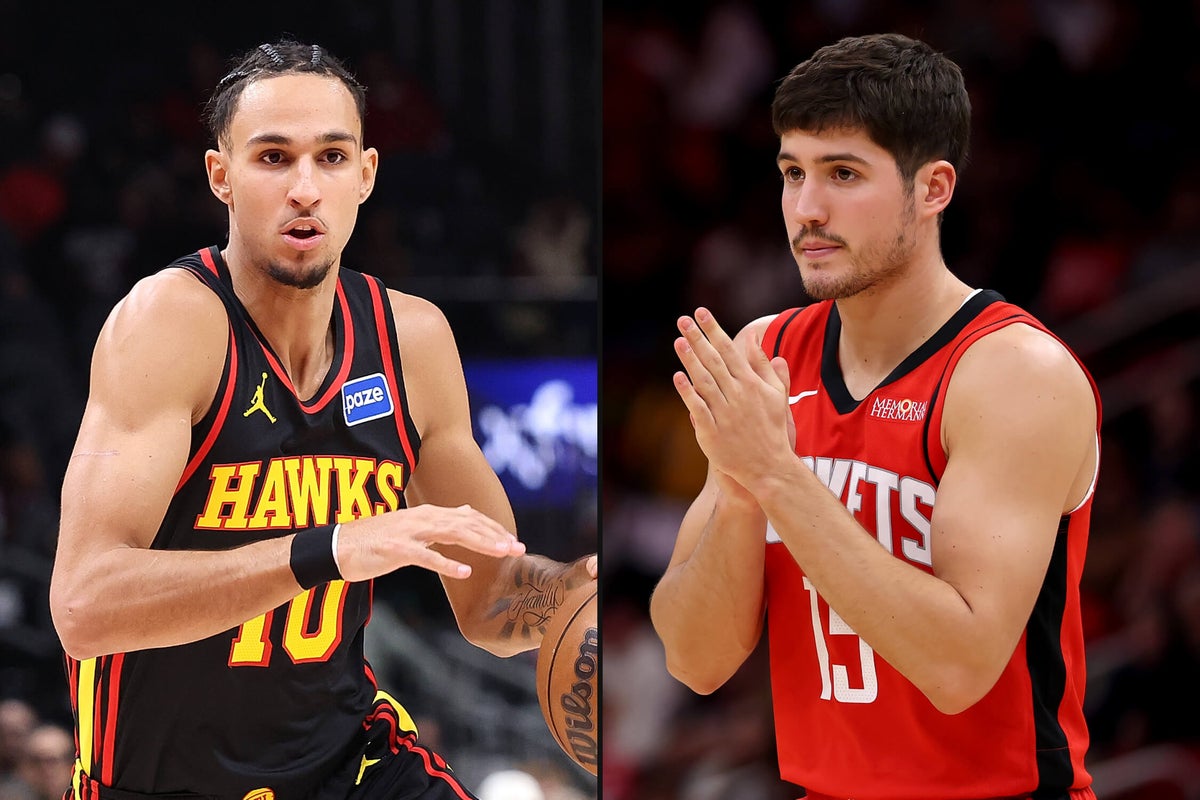
Nonetheless, it’s amazing how often the cocoon’s insulation starts wearing thin right around this point, just after the trade deadline of a player’s second season. This week’s move by the Atlanta Hawks to pull Zaccharie Risacher — the top pick in the 2024 draft — from the starting lineup was a perfect example.
At a micro level, it was a decision by one team about one player, and it has nothing to do with what the Pistons or Utah Jazz or whoever decide to do with their young players. At a macro level, however, it was a larger statement about where we are on the timeline. After 18 months, the only reason to continue starting Risacher was if he was actually good enough to start. He wasn’t.
For the largely disappointing 2024 draft class, nearing the end of their respective second seasons in the league, the move represents a wider acknowledgement that we’re done with charity minutes and gifting starting roles. After roughly 140 NBA games, it’s time for them to put up or shut up, and for their teams to worry a whole lot less about the sunk cost of where a player was drafted.
Take a look at that 2024 group: Risacher is hardly alone in delivering production that falls short of his draft position. It’s been a rough go, especially if you focus on the top 20 picks where most of the upside lies. Only two players from that group — Stephon Castle of San Antonio and Alex Sarr of Washington — could reasonably be named as one of their team’s three best players.
Setting the bar lower, just four others — Portland’s Donovan Clingan, Miami’s Kel’El Ware, Cleveland’s Jaylon Tyson and Oklahoma City’s Ajay Mitchell — have established themselves as starting-caliber players. Of them, only Clingan was picked in the lottery. (Memphis’ Zach Edey will join this list if he can stay healthy, but that looks like an Edey-sized “if” at the moment.)
Other first-rounders, such as Holland, have had moments, but it still feels like their careers are on a knife’s edge, ready to tip either way. And if a few of them don’t emerge soon, the top of that 2024 draft is looking … yikes.
Of the 37 picks before Mitchell, it’s amazing how many of them are already at some kind of career crossroads. Less than two years in, picks Nos. 8, 16, 17, 23, 26 and 33 have already been traded, waived or both. (Dalton Knecht’s trade was rescinded, but still.) The 10th pick, Cody Williams, has been bad enough that his team was fined for playing him in a fourth quarter. Twelve of the top 37 picks have seen fewer than 1,000 NBA minutes — including the eighth, 12th and 13th picks — and none of the 12 seem likely to increase that total next season appreciably.
That total would be far greater if it weren’t for charity minutes from tanking or rebuilding teams. With nearly all those teams pivoting toward genuinely trying next season, those minutes seem highly endangered. That list notably includes Williams, above, but also Washington’s Bub Carrington (leading the class in minutes despite ranking in the bottom five in BPM) and a few others.
If there’s a positive, it’s that 2024 was an unusually fertile draft for late-blooming role players who left school as upperclassmen. In addition to Mitchell above, Toronto’s Jamal Shead, Miami’s Pelle Larsson, Phoenix’s Oso Ighodaro, Golden State’s Quinten Post and Memphis’ Cam Spencer and Jaylen Wells all have delivered after being picked in the second round. Also in that vein were the undrafted Daniss Jenkins of Detroit (a rotation player on the East’s best team!) and Spencer Jones of Denver.
However, those guys are on a different timeline from the (mostly) one-and-dones who populate the top half of the draft’s first round each year. And those are the guys I want to discuss, because so many of them — like Risacher — are at a crossroads. It’s late in their second season, and it behooves them to establish starting-caliber, long-term value by the end of their third season, when they become extension-eligible.
Take Holland, for instance. The top player on my board that year (errrr …), he went to a Pistons team that A) already had a similar player in Ausar Thompson and B) turned the corner immediately and became an elite team this season. An iffy shooter on a team full of iffy shooters, Holland is at 23.4 percent from 3 for his career and is left unguarded from the corners.
And yet, his best moments come with a supercharged energy, with Holland defending, rebounding and flying down the court in transition. His 15 points and 11 rebounds Monday in a loss to San Antonio was one of Detroit’s few bright spots (“I thought he was awesome,” said Bickerstaff); he has the rebound rate of a power forward, the league’s sixth-highest steal rate and is still only 20 years old.
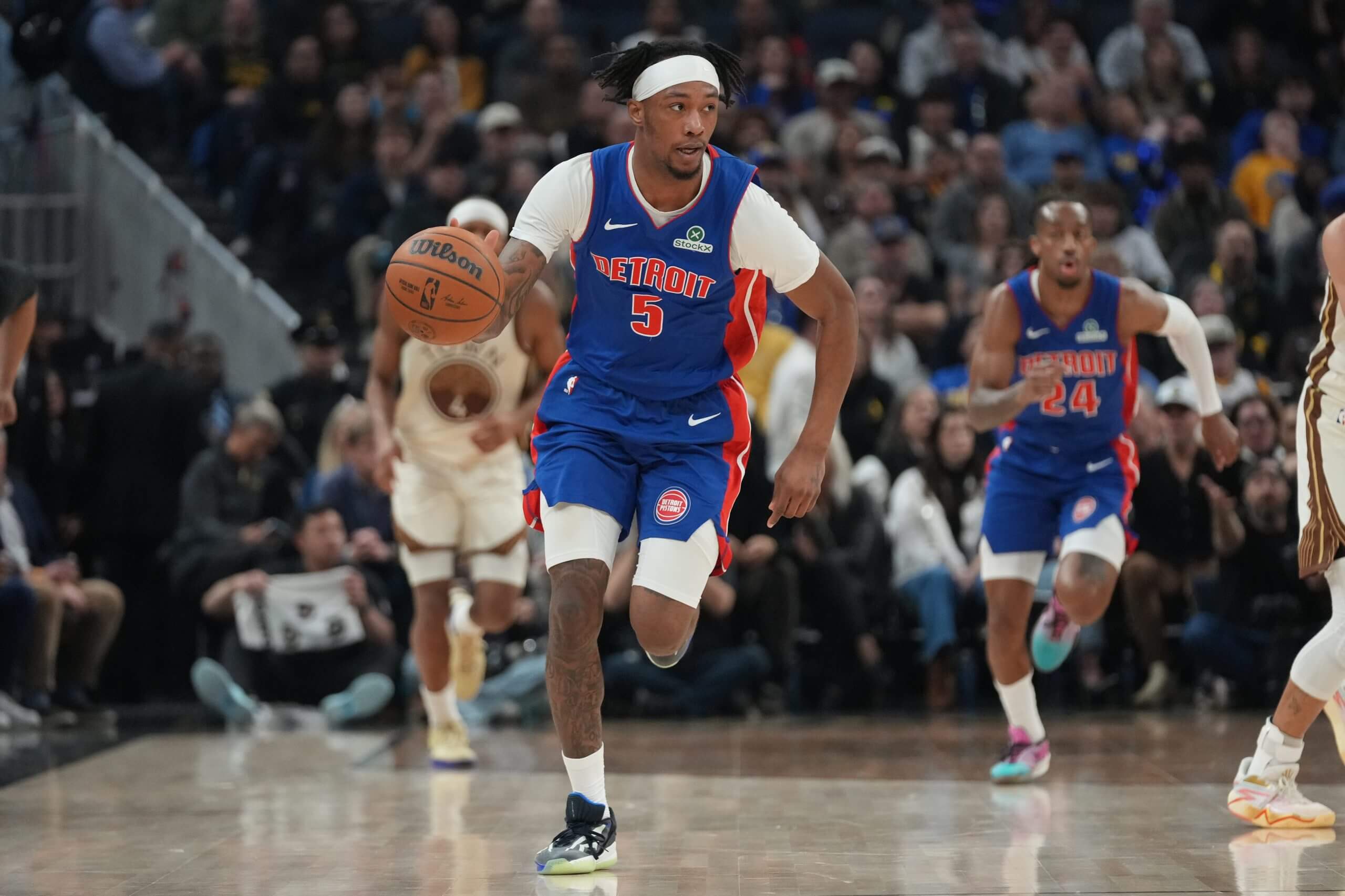
Ronald Holland II initiates a fast break against the Golden State Warriors last month. (Cary Edmondson / Imagn Images)
“We believe he’s an elite transition attacker,” Bickerstaff said. “Even in the half court, when he gets his space and finds those gaps, he can get downhill, he makes his free throws [80 percent this season]… He’s always putting forth effort (and) energy on the defensive end.
“For him, it’s finding that niche on offense and how he can be impactful and how teams defend him. I think his cut game can be elite because of the way that team is defended and just learning to read those and be more consistent at that.”
Can Holland get to that point on the Pistons’ timeline? Is there a starter in here, or perhaps, is there enough trade value to bring a starter back who is more complementary with Thompson? So much seems to depend on the progress Holland can make in the coming months before the next trade deadline.
Holland is a guy I’m focused on because I was so high on him on draft night, but at least seven other one-and-done 2024 first-rounders are in similar straits. (Stats are entering Thursday’s games.):
The Houston Rockets’ Reed Sheppard, the third pick, hardly played his rookie year on the West’s second seed and had to earn bench minutes this season on a club with title aspirations. Sheppard is undersized at 6-foot-2, not a natural point guard and struggles to finish in the paint. On the other hand, his 3-point bombing (39.0 percent on 12.7 attempts per 100 possessions) is desperately needed on a spacing-starved Rockets squad, and his defensive anticipation gives him a steal rate that nearly matches Holland’s. He’s a rotation player based on his shooting threat alone, but can he reach a level beyond that where he succeeds Fred VanVleet as Houston’s starter?
The Charlotte Hornets’ Tidjane Salaun, the sixth pick, had a rough rookie season as a teenager coming over from Europe — much rougher than Risacher’s, actually — but has low-key blossomed as a sophomore. Making 43.6 percent from 3 while crashing the glass, running the floor and being generally huge for a forward, Salaun is certainly a rotation piece of some kind. However, he doesn’t offer much shot creation and may top out as a “3s-plus-energy” combo forward. Also, the Hornets are ready to win, and he’s been buried in a deep forward rotation, only playing 570 total minutes this season; the recent return of Grant Williams doesn’t help. Salaun is only 20, but will his best shot come on this roster or a different one?
The Chicago Bulls’ Matas Buzelis, the 11th pick and Holland’s former G League Ignite teammate, can now explore the studio space on a Bulls team that leaned into a rebuild at the trade deadline. He has double-figure shot attempts in nine straight games and scored 32 while the Bulls were getting obliterated by Charlotte 131-99 on Tuesday. At 36.7 percent from 3, he’s also shooting more consistently, and for a non-center, his secondary rim protection is phenomenal (4.5 percent block rate). Buzelis also has the best pathway to being a long-term starter of anyone on this list. If he can just draw fouls with some consistency as his body fills out and add a dose of playmaking in between the highlight dunks, he can be one of the five best players from this draft.
The Oklahoma City Thunder’s Jared McCain, the 16th pick, had an electric first 23 games in Philadelphia before a season-ending meniscus injury and struggled when he returned to the Sixers this season. He can definitely shoot (39.2 percent from 3 this year), but he struggles to score inside the arc, where he has to rely on difficult floaters and runners, and is caught between positions as a 6-3 non-point guard. A recent trade to the Thunder has given him a defined role off the bench, and he’s had two 20-point games this week while Oklahoma City navigates a series of backcourt injuries, but once the cavalry comes back, it’s not clear what his long-term role can be on such a loaded roster.
The New Orleans Pelicans’ Yves Missi, the 21st pick, looked like a long-term starting center at points in his rookie season, but the Belgian big man’s warts have become more apparent over time. He liked to attack opposing bigs off the dribble in college but doesn’t have enough in his bag yet to play that way as a pro. He also can’t shoot and doesn’t have much of a post game, resulting in a limited offensive impact mostly confined to rim-runs and put-backs. The rim-protection is electric (6.8 percent block rate), but there isn’t enough physicality or rebounding alongside it to stamp him as more than an energy backup right now.
The Washington Wizards’ Kyshawn George, the 24th pick, has taken a major step forward for the doormat Wizards in his second season, with per-100-possession rates of 23.8 points, 8.5 rebounds and 7.4 assists. Now the question is how much of that owes to the ample opportunity he gets on such a bad team and what his game looks like once Trae Young and Anthony Davis dominate possession. The 6-8 George is huge for a wing and can shoot (37.1 percent from 3 this year on decent volume) and pass, and that could make him a potent weakside player next to the two stars; he also struggles to complete plays inside the arc and might have an easier time with more assisted baskets. Defensively, the tools are there, but he still fouls with abandon and seems bewildered every time he’s whistled.
Finally, there’s the Utah Jazz’s Isaiah Collier, the 29th pick, who was a tank commander for much of his rookie season before turning the corner late in the year. He looks like a rotation piece even now, albeit a wild one, but he’s a starting-caliber player if he can make a third of his 3-pointers and stop throwing the ball into Row 17. Collier is only a 26 percent career 3-point shooter, but he can get downhill and create havoc with his size and has improved his finishing ability (56.2 percent on 2s) substantially in his second year. A three-to-one rate of assists to turnovers is a sign of progress on the ball security front, but Collier makes way too many bad passes for a secondary player, with wayward lobs a particularly glaring issue.
For the moment, let’s forget stardom for these guys and set our sights slightly lower: How many of them can turn the corner into extension-worthy core pieces or long-term starters? For that matter, can any of them shake off slow starts to their careers and emerge in the next year or two, much as 2023 draftees Keyonte George (Utah) and Anthony Black (Orlando) have this season?
With the tide of free “developmental” minutes quickly receding for this 2024 class, it’s now time to deliver. In a dog-eat-dog league, Risacher, Holland and their classmates must either earn their minutes and roles or cede them to better players.