
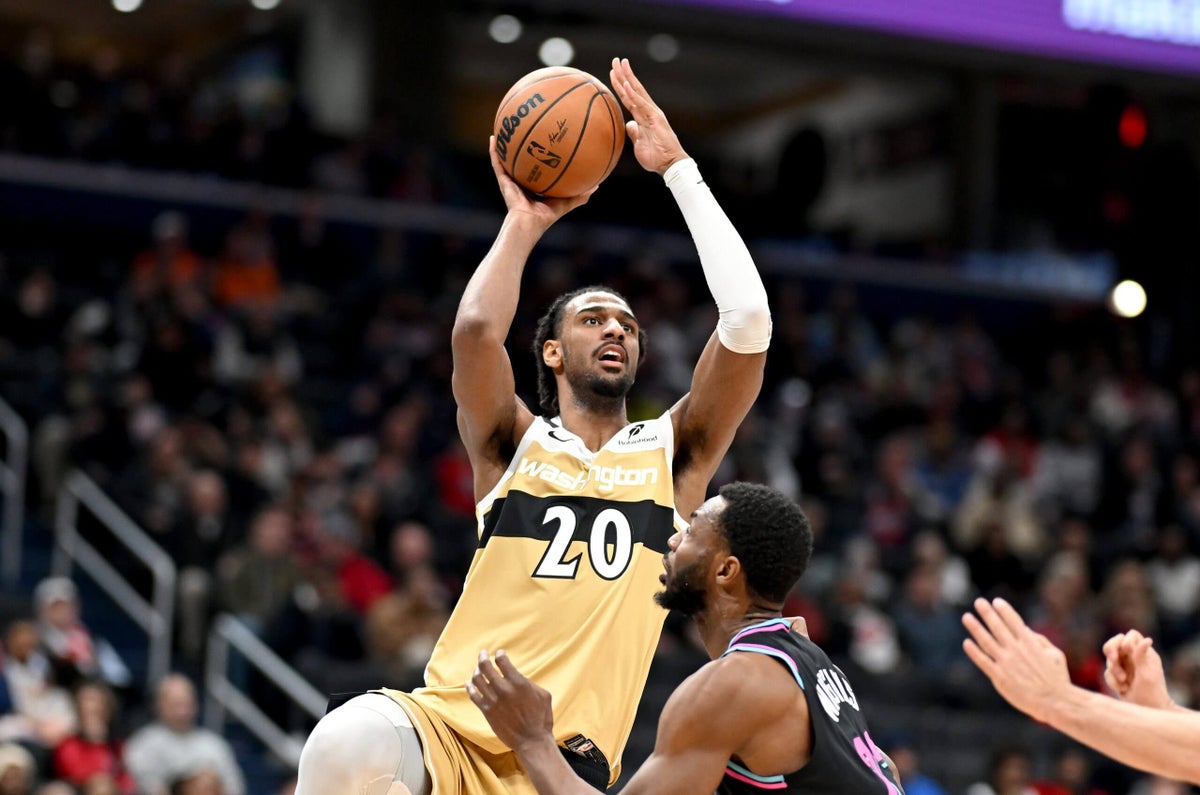
One second-year center has stopped jumping. Another, for the first time, is forcing the opposition to leave its feet. And a sophomore wing’s cross-court cuts are a ruse.
Let’s open the notebook to run through three NBA trends that have caught my eye over the past week.
Alex Sarr’s second jumps
Let’s attempt the impossible.
It’s time to discuss the Washington Wizards without once mentioning them as a vehicle for tanking. Instead, we’re delving into a new theme in D.C.: Alex Sarr, the second jumper.
The No. 2 draft selection in 2024 has followed up a disappointing rookie season with an encouraging one, not just because his offense has come around, a progression that’s included an off-the-dribble leap and, most importantly, softer hands. There’s also his work on defense.
Sarr’s promise came initially in his defensive versatility. If all went well, the 7-footer would be able to switch onto all types of players, from the bigs who were his primary assignments to the perimeter guys. What’s materialized in Year 2 is a different type of resourcefulness. Sarr isn’t just some switchy big man. He’s also emerging as someone capable of executing all types of coverages.
He can switch. The Wizards have blitzed pick-and-rolls with him more this season than they did as a rookie. They will use him in different types of drops now, some where he sinks deep near the basket and others where he ventures within whispering distance of the screener.
Washington funnels drivers to him. No one contests more shots at the rim than Sarr does, 8.8 per game, two more than anyone else in the league. The guys atop the NBA in that stat tend to play plenty of drop coverage. They sag into the paint and wait for drivers to approach. Yet Sarr doesn’t fit that description. On top of scrambling every which way, trying to make up for porous perimeter defenders, which juices the numbers, Sarr is creating contests out of nowhere.
He’s an aggressive helper. He’s blocking more shots than ever. He’s allowing only 55 percent shooting on dunks and layups when he is the closest defender, a massive leap from his rookie season, according to Second Spectrum.
“It’s definitely the reps,” Sarr told The Athletic. “Also, (it’s) watching film of times where I could have blocked the shots, but I wasn’t (getting to my spots) early enough.”
And it’s what he’s done once he arrives in those spots.
Sarr’s patience stands out most during his second NBA season. He would lunge at the basketball last season. Now, he’s a composed second jumper.
When a dribbler comes in Sarr’s direction, don’t watch the ball or either of the bodies of the players involved. Instead, look down at their feet. An opponent takes off for a shot, then Sarr follows. He’s not anticipating a jump; he’s reacting to one.
Sometimes, he doesn’t leap at all.
“If I have my hands up in the air, that’s enough to block a shot,” Sarr said. “I don’t have to jump every time.”
A few weeks ago, Portland Trail Blazers guard Jrue Holiday caught himself in no-man’s land, picking up his dribble on the left block with Sarr draped over him. He tried to shoot the ball up, but it only went down. Sarr stood there, two hands raised, soles still nailed to the court and engulfed the rock.
It was Sarr’s sixth block of the game. The other five looked nothing like the one on Holiday. On one, he let All-Star speedster Deni Avdija blast past him only to pin a layup against the backboard. Not long later, he did the same thing to Sidy Cissoko. On another, he absorbed a shoulder from 7-foot-2 behemoth Donovan Clingan only to leap for an emphatic swat. On another, he jammed a Clingan layup against the backboard. Another block came in help on a cut from agile guard Caleb Love.
Sarr was the second jumper to leave the court on five of those six blocks. The Love layup, in which he flew at the guard and readjusted his right arm midair to get a hand on the ball, was the one exception.
The blocks came in help defense. In pick-and-rolls. In drives. On the ball. Off the ball.
When versatility shows in coverage, it can emerge in results, too. The Wizards might be playing in silence, going through the motions in most ways as they conclude another losing season. However, Sarr’s development should lend them an ounce of hope, because beyond the numbers is a newfound composure and a good chance that no matter their future identity, his skill set will help him fit it.
The wrap on Clingan
There are steps to becoming a floor spacer.
First, you learn how to shoot. Still, the league doesn’t catch on right away. Defenses might leave you open at the beginning. As you sink more and more jumpers, they will close out with increased urgency. Then, especially if they have no faith in your dribbling ability, they’ll try to run you off the 3-point arc. At this point, if you keep nailing 3s, maybe they never leave you alone to begin with.
That last step is the peak level of spacing.
Blazers center Donovan Clingan isn’t there yet, but in recent games, he has officially reached a new stage on the spacing spectrum. He can thank the Minnesota Timberwolves for paying him the greatest of compliments: They respected his shot.
Clingan has been chucking 3s all season, most commonly with no one around him, receiving passes on pick-and-pops or kickouts, then taking his time with a draw-bridge release before finally letting go of the jumper. Opponents usually stand still waiting for the shot. Some supply a gratuitous closeout, as if they’re hoping not to offend him.
A subtle change occurred a couple of weeks ago.
The Timberwolves faced Clingan and the Blazers just before the All-Star break and then again this past Tuesday. In those games, they guarded the second-year center in a way he hadn’t yet experienced. Rudy Gobert, a four-time Defensive Player of the Year who isn’t just freelancing on the court, closed out on Clingan hard, rushing his way, sometimes stutter-stepping, sometimes leaping in the air, but always hoping to disrupt the 22-year-old.
A Clingan 3-pointer, for the first time, was not just a defensive concession.
Now, there are a few reasons the Wolves could take this approach. The first is that they have one of the sport’s greatest ever defensive centers. Yet, it’s not like Gobert was the only one who was supposed to sprint to Clingan. Julius Randle closed out on him, as did Anthony Edwards — albeit, without as much urgency as Gobert had, which was more of a commentary about the quality of those closeouts than it was about the intended strategy.
The second is that Clingan doesn’t put the ball on the floor or attack off the dribble, which means there aren’t many repercussions for darting past him. And the third, most importantly, is because of a wonderful run from Clingan, who barely shot 3s as a rookie and started hoisting more this season but didn’t get hot until a month ago.
Heading into Thursday night’s action, Clingan was 19-of-41 (46 percent) from deep in February.
He’s taking those baby steps to becoming a spacer.
He didn’t shoot 3s; now, he does. He didn’t make 3s; now, he does. He didn’t command respect from the defense, but a disciplined, top-notch squad in Minnesota is showing signs that may change over time, too.
The next step for Clingan, if it’s not quickening his release, will be figuring out how to react once the defense takes away the jumper. Can he learn to attack a closeout with a drive? Can he develop a side step?
Growing takes time, but Clingan looks like he’s worth the wait. The seventh pick in the 2024 draft is progressing even faster than the Blazers could have hoped. He’s a 7-foot-2, 280-pound wall down low who blocks shots, alters others, has improved at contesting without fouling and gobbles up rebounds.
He’s still adding to his game. And the rest of the league is slowly starting to notice.
Tiptoe Tyson
Watch out for Jaylon Tyson. That dude creeps.
There isn’t another player in the league who smoothly turns a cross-court cut into a crash of the offensive boards. Defenses don’t often notice it until it’s too late.
During a Cleveland Cavaliers’ blowout win over the Brooklyn Nets last week, the second-year up-and-comer, maybe the most underrated player from his draft class, cut from the right wing to the left elbow. The possession was becoming frantic. Evan Mobley controlled the basketball on the right block, and Tyson, one of the Cavaliers’ smartest cutters, was hoping to open up a lane.
He did — just not for himself.
Tyson’s takeoff cleared a passing lane to former MVP James Harden for a wide-open 3. Only Tyson didn’t stop moving. The spacing cut, which takes precision and intellect, is his forte. Even so, the following is his greatest secret.
Tyson will use the momentum from his cuts to set up in an ideal rebounding position, specifically when he knows a 3-pointer, and thus a higher chance for a long rebound, is coming. Once Harden missed the shot, Tyson was in prime position to chase down a ricochet that went into the corner, and the Cavs received a second chance to score.
Tyson has put up numbers in Year 2 after a modest rookie season — 13.5 points on outrageous efficiency, including 54 percent shooting on 2-pointers and 46 percent on 3s. It’s coming on a winning team. The Cavs have a chance to climb to second in the Eastern Conference after a slow start. And yet, it’s the small things that have turned the 23-year-old into someone who is already a high-impact performer.
He is opportunistic in a way most second-year players — heck, most veterans — are not.
Turning a cut into a crash is one of his go-to moves. He has crashed the glass on a higher percentage of his team’s 3-point shots than all but three NBA players, according to Second Spectrum. (Fun fact: The crash-obsessed Boston Celtics employ the guys who are first and second on this list, Jordan Walsh and Hugo González.)
Tyson is a young 6-foot-6 wing, and he’s recovered at least one offensive rebound in 18 of his past 19 games. He’s opening lanes for others to grab them. And if that weren’t enough, he’s scoring in bunches, too.