
A younger version of myself used to read the “A Series of Unfortunate Events” novels and later viewed the film adaptation starring Jim Carrey as Count Olaf. While the details of the books have faded over time, the title always stuck with me.
For years, that phrase encapsulated the Charlotte Hornets as a franchise.
Bad ownership. Bad drafting. Finally getting good players who could not stay healthy together. Outdated schemes in a rapidly modernizing NBA. It always felt like a series of unfortunate events defined the organization year to year.
Fast forward to March 2026.
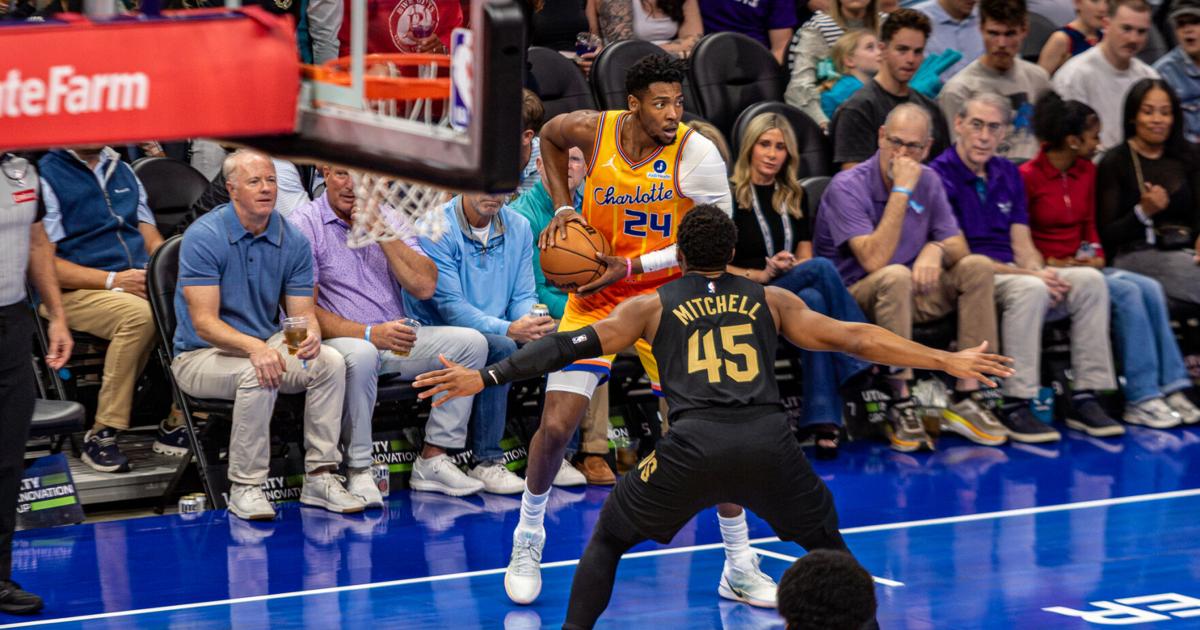
It has been nearly 10 years since the Hornets last played in a playoff game. But since the new year, statistically and by the eye test, this is the best basketball this Charlotte club has played since that last postseason year in 2016.
It is a well-run operation with a talented roster being maximized by the coaching staff, and the most hope this fanbase has had in quite a while.
So when those same fans ask me at games or online why the Hornets are good now, my most common answer, funny enough, is: a series of fortunate events.
In 2026, Charlotte owns the best offense in the NBA, a top-five defense and the top net rating in the league. The Hornets are 18-2 with their fully healthy starting five. They have won 14 of their last 17 games and are 18-9 since the new year.
After opening the season 6-16, they now have a chance to play meaningful basketball for the first time in years.
To be clear, a series of fortunate events does not mean luck. It is a collection of best-case scenarios unfolding at once for this franchise.
The players
It starts with star guard LaMelo Ball.
Ball has played 51 of a possible 61 games this season, the most he has played since his second year. Health cannot be overstated. It is one of the main reasons this group has performed at such a high level, and Ball, in particular, has not just been healthy but extremely impactful.
Offensively, his impact has been rivaled statistically only by superstar center Nikola Jokić. The Hornets score 14.9 more points per 100 possessions when Ball is on the floor, a 100th percentile mark. Their efficiency differential jumps by plus-15.4 with him in the game, a 99th percentile figure.

Star guard LaMelo Ball warms up before a previous matchup.
Kaitlyn Fankboner/Niner Times
He leads the NBA in on-off offensive rating at plus-13.3 among players with at least 200 minutes played. His impact projects to 34 expected added wins, all according to Cleaning the Glass.
This is the superstar offensive engine the franchise paid him to become.
Rookie guard Kon Knueppel is putting together one of the most efficient rookie seasons in NBA history. He broke the NBA rookie record for three-pointers made with 22 games to spare and now leads the league in three-point makes.
He has been everything Charlotte could have hoped for from a rookie, a home run draft pick who is elevating the franchise’s standard.
Forward Brandon Miller has led the team in scoring despite returning from last season’s season-ending injury and battling a left shoulder subluxation earlier this year. He has responded by playing strong two-way basketball and has been a major positive whenever he is on the floor.
Over his last seven games, he has averaged 24 points, five assists and four rebounds. He has taken a leap as a decision-maker and still has another level to reach when asked to be the primary creator without Ball or Knueppel.
Charlotte has its legitimate big three.
Forward Miles Bridges has smoothly transitioned into a fourth or fifth option, cutting down on isolation play and embracing Charlotte’s quicker, decision-driven offense.
Center Moussa Diabaté, who signed a three-year, $5.69 million contract in February 2025, has emerged as a top-10 to 12 center in the league this season.
His lateral foot speed and defensive range allow him to switch, play at the level or operate in drop coverage. He protects the rim, rebounds relentlessly on the offensive glass and makes the right reads in short-roll situations as a connective piece.
Diabaté has been one of the most important players on the roster and has helped Charlotte establish a defensive identity.
Second-round picks center Ryan Kalkbrenner and guard Sion James have contributed from the start of the season and remain solid rotation players. Guard Josh Green and forward Grant Williams returned midseason from injuries without missing a beat.
Even forward Tidjane Salaün has gone from one of the least productive rotation players in the league by numbers last season to a reliable contributor when called upon.
Again, best-case outcomes.
The coaching
Charlotte also had to answer a major question: did it have the right head coach?
It does.
Head Coach Charles Lee has installed a modern, math-driven system rooted in three-point volume and possession dominance. The Hornets take the No. 4 most threes in the NBA and make the No. 2 most.
Rookie guard Kon Knueppel in a previous matchup against the Cleveland Cavaliers.
Emmanuel Perkins/Niner Times
They own the best defensive rebounding percentage in the league and rank in the top two in both offensive and total rebound percentage. Charlotte also allows the fewest free throws in the NBA to opponents. Simply put, they are winning the math battle every night.
Lee has drilled the system so thoroughly that the reserves play the same way as the starters. The scheme travels night to night and gives the Hornets a chance even when the shots are not falling.
Lee currently sits fourth in Coach of the Year odds and has a case to be higher.
Charlotte has found its franchise head coach.
The front office and ownership
President of Basketball Operations Jeff Peterson has been nearly flawless as the lead decision-maker since taking over less than two years ago. The only questionable move might be the Salaün pick in the 2024 draft, and even that is trending in the right direction.
The trade deadline move of flipping guard Collin Sexton for guard Coby White was a strong example of identifying what the team needed midseason and filling that void. White is a better shot-maker, defender and driver than Sexton was. He is an overqualified sixth man, a reliable three-level scorer with good size who strengthens the bench significantly.
Though he has only played a handful of games for Charlotte, he already looks like one of the best bench players in the NBA.
Peterson’s drafting has also been superb. The rookie class of Knueppel, Kalkbrenner, James and forward Liam McNeeley is as strong as any in the league. The fanbase should have full confidence in Peterson going forward.
Ownership matters too.
Since Co-Chairmen and Principal Owners Gabe Plotkin and Rick Schnall took over, analytics have moved to the forefront. Charlotte is no longer operating as a reactive franchise. It is modern and aligned from the top down.
The organization is maximizing player health, maximizing scheme and operating the way Schnall described as a “premier NBA franchise.”
For the first time in a decade, the Hornets feel like a sustainable winning product. An ascending product. A team building something special.
In the final pages of “A Series of Unfortunate Events,” the Baudelaire orphans leave the island aboard a boat named Beatrice, returning to the mainland with a future no longer defined solely by misfortune.
For years, the Hornets felt stranded in their own story.
Now, after a series of fortunate events, they are sailing toward something better.
And this time, it does not feel temporary.