
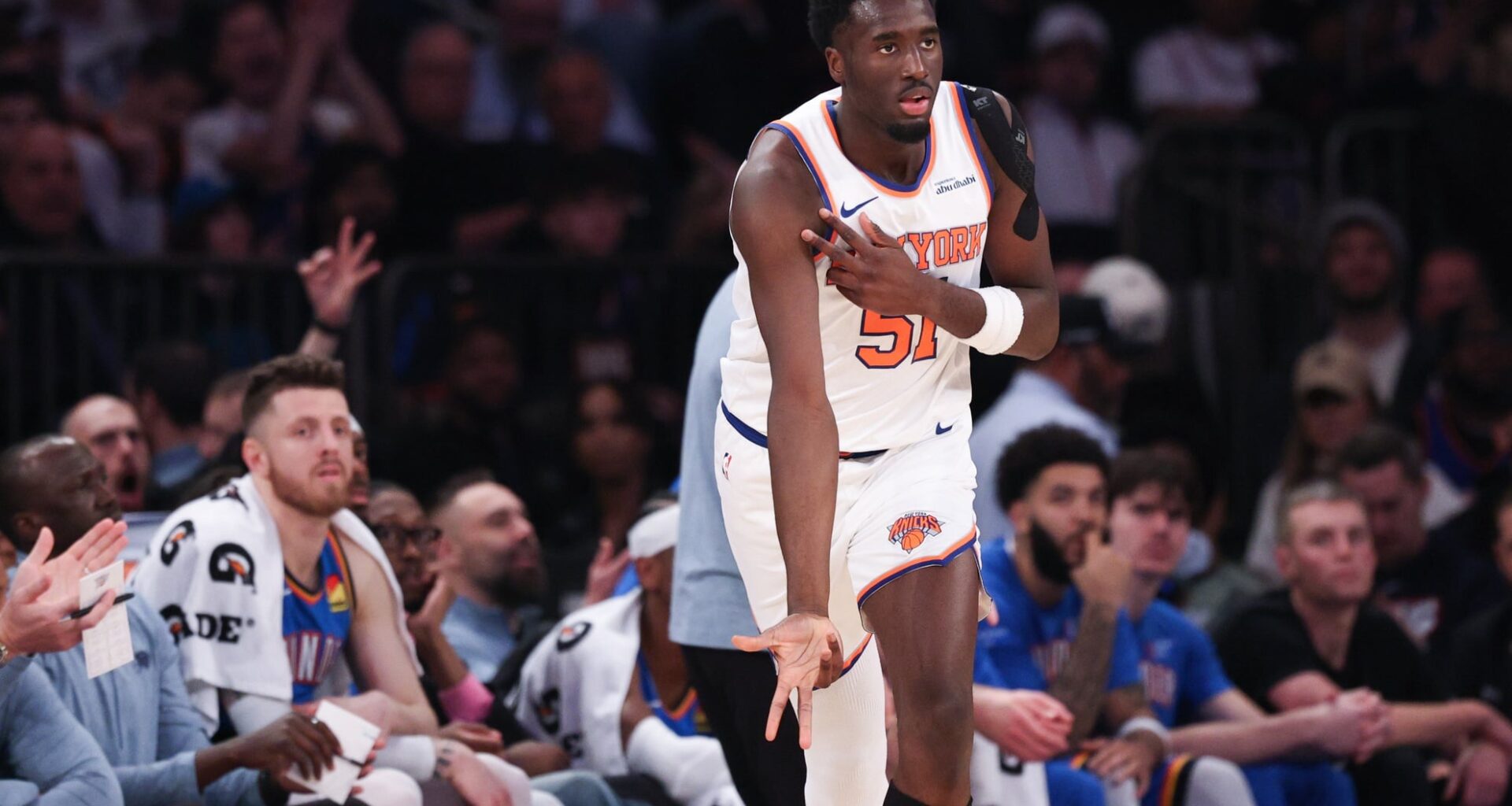
NEW YORK —The New York Knicks are reeling from a close 100–103 loss to the Oklahoma City Thunder at Madison Square Garden. Despite the loss to the defending champions, New York still had a few positives to take away. One was the continued improvement in rookie Mohamed Diawara’s production. The Knicks have also quietly reversed their earlier decision to play Jeremy Sochan ahead of Diawara.
Knicks Quietly Reverse Mohamed Diawara Decision After Low-Stakes Move
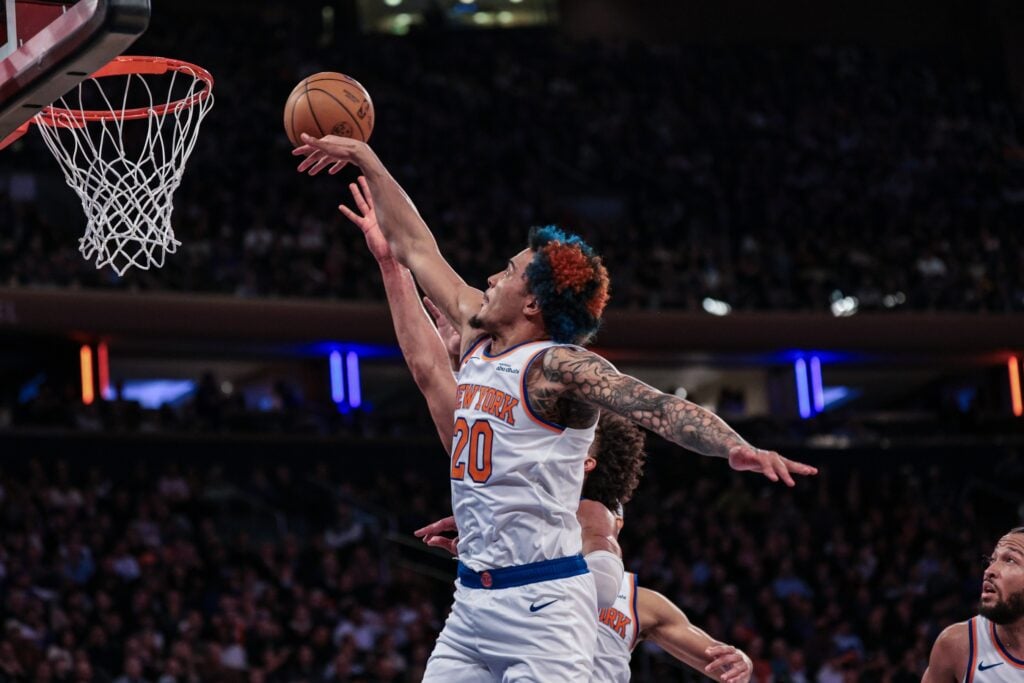 Feb 19, 2026; New York, New York, USA; New York Knicks forward Jeremy Sochan (20) blocks a shot by Detroit Pistons guard Cade Cunningham (2) during the second half at Madison Square Garden. Mandatory Credit: Vincent Carchietta-Imagn Images
When the Knicks selected Diawara with the 51st pick in last year’s draft, many expected him to barely see the floor this season. After all, this Knicks team replaced Tom Thibodeau with Mike Brown to consolidate its championship aspirations. However, the Abu Dhabi preseason games quickly revealed something else. The Frenchman turned heads among the coaching staff almost immediately.
Second-Round Development Continues Paying Off
The Knicks have recently found success drafting in the second round to build around their core. Diawara follows the same path as Miles McBride and even the longest-tenured Knick, Mitchell Robinson. In the apron era, cheap and controllable contracts remain crucial for building a complete roster. These scouting and development wins carry significant value.
Through 52 games, Diawara averages three points and one rebound. He shoots 45.3 percent from the field, 41.8 percent from three, and 70 percent from the line. Those numbers may not jump off the page. However, his per-36-minute production tells a stronger story. He averages 15 points, six rebounds, three assists, and one steal on that scale.
Diawara also lifts the team’s offensive efficiency when he plays. The Knicks’ effective field goal percentage rises by 3.2 percentage with him on the floor. That impact ranks in the 93rd percentile league-wide. The 6-foot-9 forward continues to prove he can influence both ends of the floor. He scores efficiently and defends multiple positions. Diawara also does all that while earning less than $1.3 million this season.
Some Knicks fans pointed to this growth when the team added Jeremy Sochan. Many argued that Sochan’s arrival could slow Diawara’s development. Their concern proved justified at first. Before the trade, Diawara enjoyed a purple patch. He averaged 21.5 minutes across four games. Once the Knicks inserted Sochan into the rotation, Diawara’s minutes fell sharply. He averaged only seven minutes across the next four games. He even received a DNP during that stretch.
Knicks Reevaluate Rotation After Sochan Struggles
Sochan’s well-documented shooting problems soon surfaced in New York. He has made only three field goals across eight games in orange and blue. The coaching staff responded quickly. They reduced his minutes and reopened opportunities in the rotation.
Diawara seized that opportunity. Over the last four games, the Knicks have expanded his role. The rookie has rewarded that faith. The 20-year-old is shooting 45.8 percent from three on high volume. He attempts six threes per game during that span.
Diawara also etched his name into the record books during a 14-point performance against a surging San Antonio team. The 6-foot-9 forward attempted the most three-point shots per minute in a game in NBA history with at least 10 minutes played. He launched 13 attempts in that outing. Meanwhile, Sochan has yet to make a three-pointer in a Knicks uniform.
Head coach Mike Brown deserves credit for adjusting quickly. The staff gave Sochan a fair opportunity to claim a rotation spot. The move itself made sense. The Knicks needed point-of-attack defense, and Sochan provided an elite defensive profile. The experiment simply did not work. The Knicks responded by prioritizing development. They returned minutes to a promising young forward. And that decision looks like the right one.
Credit:© Vincent Carchietta-Imagn Images