
Welcome back to “On the Air,” in which Sports Media Watch Podcast co-host Armand Broady will offer in-depth breakdowns of broadcasters, on-air performance and career journeys, plus chronicle broader trends in the industry.
Without the presence of stars Joel Embiid and Paul George to put up a fight against the remarkable Victor Wembanyama, there was little chance the 76ers would be competitive against the Spurs Tuesday night. San Antonio scored the game’s first basket and never trailed, at one point leading by 49 points.
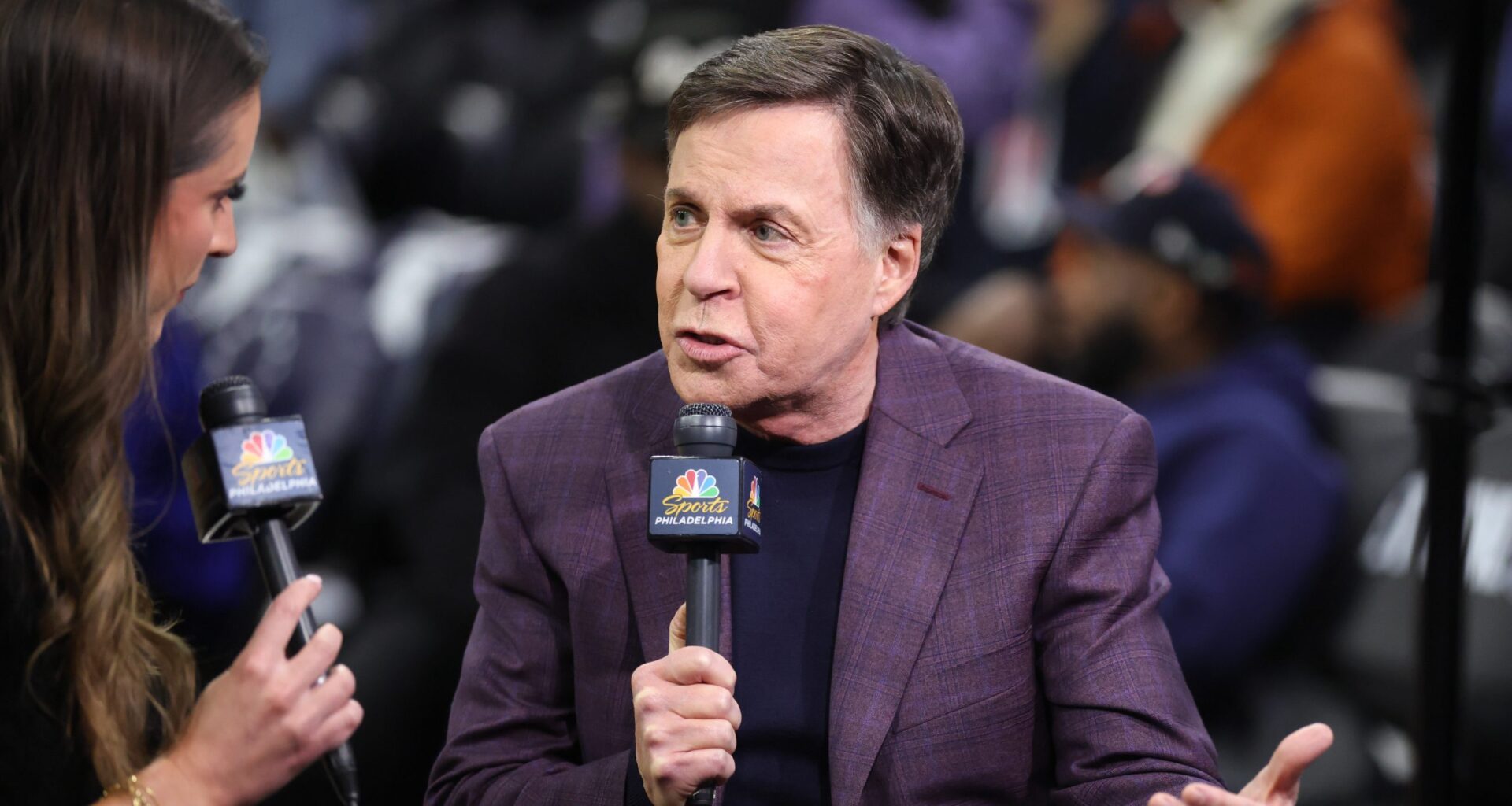
But the Spurs’ rout did little to dampen the spirits of the game’s announcers or the network producing the telecast. NBC pulled out all the stops for a special throwback broadcast, from mid-1990s graphics to the return of former “NBA on NBC” personalities Hannah Storm, PJ Carlesimo, Isiah Thomas, Bob Costas, Mike Fratello, Doug Collins, and Jim Gray.
NBC has leaned heavily into nostalgia since it regained broadcast rights to the NBA, but Tuesday night was its most concentrated effort.
Storm opened “NBA Showtime,” hosting with the same grace that has characterized her lengthy career. Carlesimo and Thomas joined her, weaving in and out of various clips from the 1990s and early 2000s. While the presentation was nothing spectacular, Storm’s warmth and enthusiasm brightened the pregame show.
Though the hairs are grayer and the wrinkles more pronounced, game announcers Costas, Fratello and Collins proved they could still carry an enjoyable broadcast. Costas, working his first NBA game broadcast since a Mavericks-Timberwolves first round playoff game in 2002, wisely paced himself, speaking in measured captions, leaving plenty of room for his two analysts.
The NBA’s breakneck tempo worked to Costas’ advantage, forcing him to be more direct in his play-by-play and temper his pontificating, a frequent criticism during what he readily admits was a flawed stint working Major League Baseball games for TBS. Though many remember his time as host of “NBA Showtime,” Costas was the lead NBA play-by-play for NBC from 1997-2000, forming a strong partnership with Collins for nearly all of that tenure.
Before Tuesday, Collins’ last broadcast was nearly nine years ago — Spurs-Rockets Game 3 in the second round of the 2017 playoffs for ESPN — but at no time did he show signs of rust. Collins left ESPN to become a senior advisor within the Chicago Bulls’ front office. But his performance proved that he still belongs on television, and that were he to return, he would be strong enough now to claim a prominent game analyst role.
A credible argument can be made that Collins is the best NBA game analyst in television history. One of his greatest strengths is his ability to describe action and discuss strategy intelligently and succinctly without going over the head of the viewer.
Midway through the first quarter, 76ers guard Tyrese Maxey misfired on a fadeaway jumper. Collins quickly pointed out that Maxey, the league’s fourth-leading scorer, took the pull-up jumper instead of a drive to the basket due to Wembanyama’s towering presence in the lane. Comments like those helped frame a theme around the broadcast — that Wembanyama’s impact goes beyond his 23.4 point-per-game average.
Collins was often the first analyst to speak, touching various storylines and setting up Fratello to follow up his commentary.
While Fratello seemed, at times, a bit subdued, he sprinkled in some sharp analysis and colorful observations, with one of his best moments coming in the first half. Returning from a late second quarter break, he broke down how San Antonio puts pressure on defenders by using Wembanyama in ball screen action.
“Let me show you the mental effect that Wemby can have on you if you’re the defender,” Fratello began. “[Sixers center Andre] Drummond, up close to him, says ‘I’m not leaving him,’ but guess what happens — the guard goes all the way to the basket.”
In the next clip, Fratello explained that because Drummond went under a screen, Wembanyama was left alone at the top of the key to take and make an uncontested three-point shot. It was the kind of breakdown that earned Fratello, still working regularly today as an analyst on Clippers games, the nickname “Czar of the Telestrator” from longtime broadcast partner Marv Albert.
Midway through the third quarter, Wembanyama caught a pass in traffic and nailed a dunk while twisting his body, eliciting an “Oh My!” from Collins. Costas used the reference to pay tribute to former NBA on NBC voices Albert, Greg Gumbel, Tom Hammond, Bill Walton, Steve “Snapper” Jones, and Dick Enberg, the announcer for whom “Oh My” became a signature. That brief sequence captured the true intent of the broadcast — to remind viewers of the network’s stellar coverage of the NBA from 1990 to 2002.
With the average age of NBA players falling between 25 and 27, few NBA stars today have an emotional attachment to the 1990s iteration of the “NBA on NBC.” While the memories remain fond for those of a certain generation, NBC would be wise to pull back on some of the reminiscing. One would hope that after this season, the network would devote more attention to the game as its played today. This is not to suggest that the emphasis on storytelling, the iconic theme or many of the signature touches should go away. The key is for the network to resist the temptation to become self-involved, a tendency TNT indulged too much in its final season broadcasting the NBA one year ago. That approach would be an offense to the 1990s presentation so many fans and sports media followers still affectionately remember.
The throwback broadcast is a nice touch as a yearly event. But NBC’s coverage of the NBA in 2026 and beyond must be shaped by its connection to today’s audience and not just its homage to the past.
Plus: NBC’s need for a lead MLB analyst
Few were surprised on Wednesday when NBC Sports named Jason Benetti the new lead voice of its “Sunday Night Baseball” package that begins later this month. The 42-year-old was the voice of Peacock’s “MLB Sunday Leadoff” package in 2022 and is one of baseball’s most beloved announcers.
While the play-by-play voice will be the same, the analysts will change each week. As was the case with Sunday Leadoff, Benetti will be paired with analysts who have “connections to each participating team.” Though this kind of approach is not new to sports broadcasting, it is the wrong approach for NBC now.
On television, sports broadcasting is the analyst’s domain. One of the most important jobs of a TV play-by-play announcer is to set the analyst up to elevate the broadcast experience. Using a different group of analysts each week not only makes Benetti’s job more difficult, it robs the network of a true face — a voice of authority that viewers consistently look to for insight and perspective.
John Smoltz’s gripes about the current state of the game may irk many viewers, but his presence as Fox lead analyst still carries weight. Whether one agrees with him or not, Smoltz understands his place within the game and his position as primary analyst give his commentary a certain noteworthiness.
In January, ESPN confirmed co-lead analyst David Cone would be moving on from the network. For years, Cone has been one of the most respected personalities in the sport. A Benetti-Cone booth would instantly become one of the strongest on television. Why not pull the trigger?
MLB has a dearth of true top-level analysts, but this decision is by choice, not by circumstance. The SNB brand, Benetti, and the viewers deserve a consistent voice to color this primetime package.