
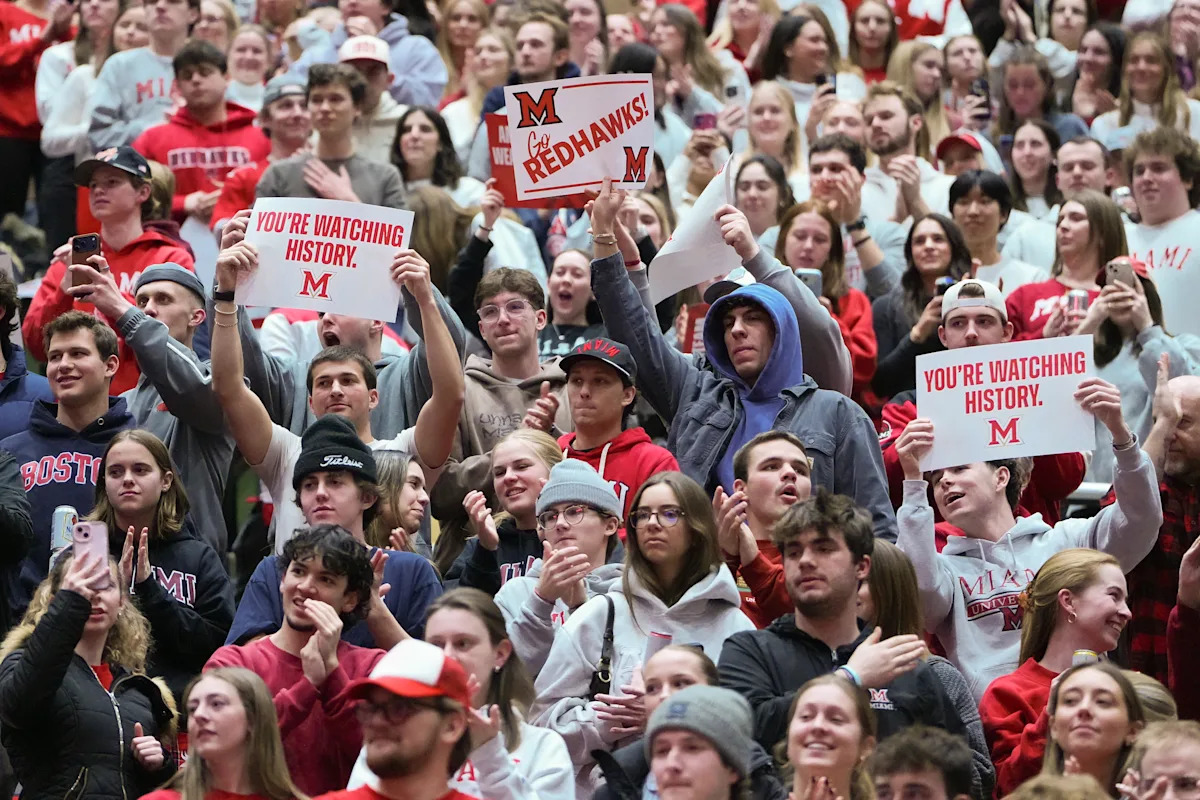
Three months after he started trying to assemble a non-league schedule that would challenge his battle-tested roster, Miami (Ohio) associate head coach Jonathan Holmes recognized that the Redhawks had a problem.
No one wanted to play a sneaky-good mid-major that won 25 games the previous season and retained six of its top nine players.
Advertisement
Holmes spread word last spring that Miami was willing to travel to two or more power-conference opponents with no expectation of a future return game in Oxford. Coaches who responded to Holmes’ messages told him they only wanted marquee matchups against top-tier opponents or low-risk games against small-conference pushovers ranked 275th or worse.
The feedback was similar when Holmes lowered his sights and began targeting elite teams from the Atlantic 10, Mountain West and other top mid-major leagues. Some coaches saw no benefit in scheduling Miami. Others didn’t have open dates available. The few who initially expressed interest got cold feet when Holmes sent contracts for them to sign.
[Enter Yahoo Fantasy Bracket Mayhem now for your shot at $50K]
By the end of the summer, Holmes became desperate enough to call some of his best friends in the business and beg them, “C’mon, man! Do me a solid! Help us out!” They each apologetically told Holmes that they couldn’t help him because Miami was exactly the type of opponent they sought to avoid, projected to finish outside the top 100 nationally yet plenty dangerous enough to dish out a damaging loss.
Advertisement
Miami intentionally kept slots open on its schedule into the fall, hoping in vain that some name-brand team would have a game fall through and would call in a panic. Only in early October did the Redhawks finally give up and unveil a non-league schedule featuring three NAIA opponents and an array of matchups against the dregs of Division I.
“I was told no by probably 75 to 90 teams, from obviously all your power conferences, to your A-10s, to your Mountain Wests,” Holmes told Yahoo Sports. “I guess you could say we were in scheduling no man’s land. We didn’t fit the profile of what anyone was looking for.”
The unwillingness of top teams to schedule Miami has taken on greater significance this winter as the unbeaten Redhawks have emerged as college basketball’s most compelling story. Miami is one win away from an undefeated regular season, yet there is still spirited debate whether the Redhawks could miss the NCAA tournament if they lose Friday night at Ohio and then fall again during their conference tournament.
Glance at Miami’s gaudy 30-0 record, and you might assume this team would be ranked higher than 19th in the latest AP Top 25. The Redhawks are one of eight teams in the last 50 years to start 30-0, joining 1976 Indiana, 1976 Rutgers, 1979 Indiana State, 1991 UNLV, 2014 Wichita State, 2015 Kentucky and 2021 Gonzaga.
Advertisement
And yet scan the underwhelming list of teams Miami has beaten, and you might wonder why this team cracked the Top 25 at all. Half the Redhawks’ 30 wins this season have come against non-D-I opponents or teams ranked 250th or below in the NET. Their lone top-100 victory is a three-point home win over Akron. Their next-most impressive result is an early-season road win at a Wright State team ranked 137th.
Complicating the NCAA tournament selection committee’s evaluation of Miami is the fact that the Redhawks did not play the 364th-ranked non-conference schedule by choice. Their Charmin-soft schedule is a byproduct of a system rigged against small-conference teams trying to punch above their weight class.
“When they’re looking at our profile, I hope they take that into consideration,” Holmes said. “We held out until October to try to build the best schedule we could build. It’s part of our story. You can only play the teams that would agree to play you.”
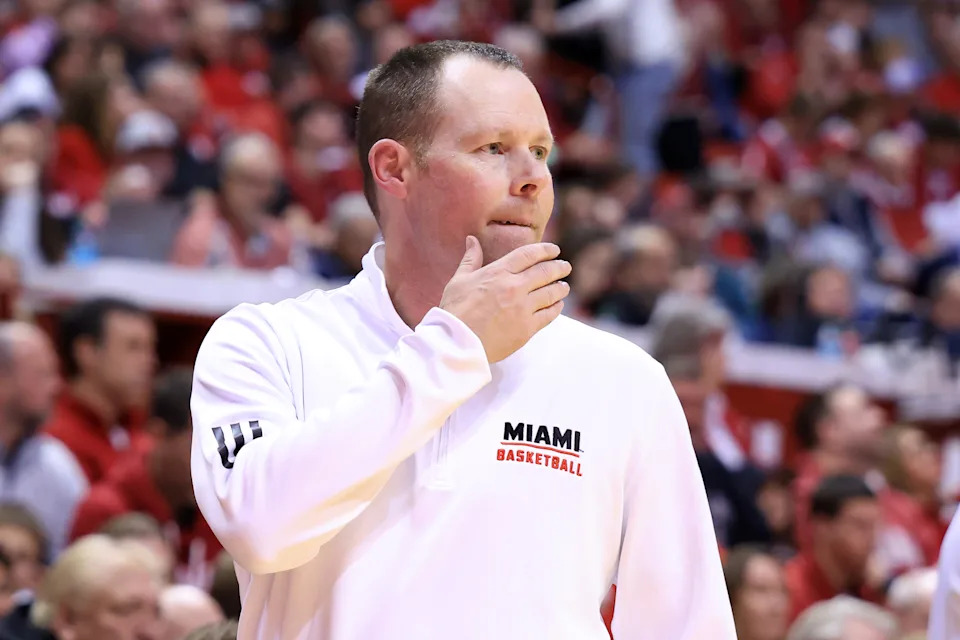
In his four seasons at Miami, Travis Steele has compiled an 82-46 record. (Photo by Justin Casterline/Getty Images)
(Justin Casterline via Getty Images)Finding the right coach
Before Miami became the best story of this college basketball season, the Redhawks’ glory days were in the distant past. They last won an NCAA tournament game in 1999 when Wally Szczerbiak dragged them to the Sweet 16. They last made the NCAA tournament in 2007. They went 11 straight years without a winning season from 2009-2020.
Advertisement
The turnaround began when Miami athletic director David Sayler put his faith in a coach who was more of a reclamation project than a rising star. In March 2022, Travis Steele had just been fired by Xavier for failing to keep that program humming at the level it had been under his predecessor Chris Mack. The Musketeers went 70-54 under Steele but endured their longest stretch without an NCAA tournament appearance since the early 1980s.
When Sayler first contacted Steele about the Miami opening, the coach was vacationing in Naples, Florida, trying to decompress and spend some quality time with his wife and kids. Sayler asked Steele if he intended to take a year away before getting back into coaching. Steele scoffed that he couldn’t bear to be without a team that long.
“Man, I’m getting bored,” he told Sayler.
Once Steele confirmed his interest in the job, Sayler moved quickly. Sayler was already familiar with Steele from interviewing him back in 2018. He liked that Steele was a tireless worker, that he had longstanding relationships with high school and grassroots coaches across Ohio and neighboring states and that he seemed to have learned a lot from his bumpier-than-expected tenure at Xavier.
Advertisement
“I think at Xavier, because he was there so long as an assistant and he took over from someone else, I don’t think he was ever able to fully change things to how he wanted it,” Sayler said. “He was always doing things within a structure that was already in place. I think Miami was the first chance he had to really just do it the way he wanted to do it and 100% put his stamp on it.”
At a time when many coaches are valuing proven transfers over high school prospects, Steele chose to gradually build Miami the old-fashioned way. He found overlooked teenagers and developed them into a cohesive team, going from 12-20 in his debut season to 15-17 in Year 2 to last season’s 25-9 breakthrough.
Only days after Miami’s 2024-25 season ended with an agonizing two-point loss to Akron in the MAC title game, the coaching staff held individual meetings with players to assess who intended to transfer, who intended to return and who was on the fence. Right away, first-team all-MAC guard Peter Suder set the tone by telling Steele and his staff without prompting, “Hey, I’m not sure what this meeting is about, but I just want you guys to know I’m coming back.”
That was a huge boost for Miami in an era when one-bid leagues often serve as a farm system for high-majors. Of the six 2024-25 first- and second-team all-MAC players with eligibility remaining, Suder and Akron’s Tavari Johnson were the only ones not to leave for bigger NIL paydays at power-conference programs.
Advertisement
“Arguably, the best player in the league is like, ‘Hey, I love it here. I just had the best year of my basketball career. I love my teammates. I’m getting better. Why would I leave?” Holmes said. “I think he felt like there was this idea of unfinished business. We got to the doorstep of the NCAA tournament and he wanted to come back and try to get us there.”
Once a foundational piece like Suder pledged to return to Miami, his decision had an instant trickle-down effect. Reigning MAC freshman of the year Brant Byers came back. So did returning starters Eian Elmer and Antwone Woolfolk, as well as key reserves Evan Ipsaro and Luke Skaljac.
That was a strong enough returning core to cement Miami a preseason MAC contender … and to turn Holmes’ offseason task of assembling the Redhawks’ non-conference schedule into a six-month nightmare.
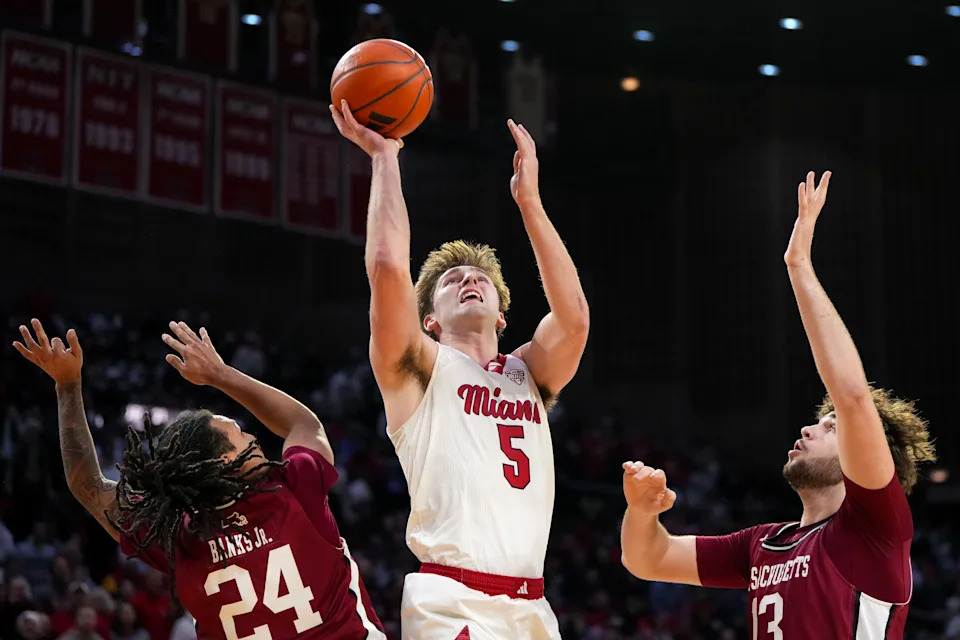
Peter Suder’s decision to stay at Miami has helped boost the Redhawks to a thus-far undefeated season. (Photo by Dylan Buell/Getty Images)
(Dylan Buell via Getty Images)College basketball’s risk-management problem
Believe it or not, none of the Miami coaches blame all the name-brand teams that refused to play the Redhawks this season. They each would do the same thing if they were coaching at the power-conference level.
Advertisement
“Those coaches are just doing their jobs,” Holmes said. “They’re trying to put their teams in the best possible position come March.”
The NCAA’s quadrant system sorts a team’s wins and losses into four categories based on the opponent’s NET ranking and the game’s location. High-upside Quad 1 matchups against top-tier opponents offer teams the best chance to boost their NCAA tournament seeding or their chances of getting selected.
Since losses against Quad 3 and Quad 4 teams are considered damaging to a prospective NCAA tournament team’s résumé, high-major programs have sought to play their guarantee games against the lowest-ranked Division I teams they can find. Those low-risk matchups allow power-conference teams to pad their win totals. Massive margins of victory also help those high-majors improve their standing in the NET, KenPom and other predictive metrics used by the selection committee.
Left with scant options are mid-majors who don’t fit neatly into either one of those buckets, teams like Miami, High Point, Belmont or Liberty. Power-conference teams perceive those types of dangerous matchups as having plenty of downside and little reward.
Advertisement
“It’s very challenging if you’re not Quad 1 or Quad 4,” Sayler said. “Nobody wants to play you if you’re Quad 2 or Quad 3 because you can do nothing but damage to them if you beat them or if the game is closer than people think it should have been.
“I think we all need to be honest about what non-conference scheduling has become in college basketball. It’s not competition. It’s really risk management. The current system incentivizes avoiding risk rather than rewarding competitive courage.”
That system is part of the reason that Miami will be one of the most challenging evaluations that the NCAA tournament selection committee has faced in years. Is this a really good team that didn’t get enough chances to show it against name-brand competition? Or is this a top-tier MAC team that benefited from playing an atrocious non-league schedule?
Result-based metrics are impressed by Miami’s 30-0 record, sub-par competition or not. The Redhawks rank No. 30 in Wins Above Bubble, ahead of the likes of projected NCAA tournament teams like Clemson, UCLA, Iowa and TCU.
Advertisement
Predictive metrics are far more skeptical. Part of the reason the Redhawks are still languishing in the 80s at KenPom and Torvik is that eight of their victories have either gone to overtime or been decided by three or fewer points — including a two-point win over Toledo on Tuesday.
The NCAA tournament selection committee would have to break with historical precedent to leave the Redhawks out even if they lose at Ohio on Friday night and again in the MAC tournament (thus not securing the automatic bid). Since the NCAA tournament expanded to 64 teams in 1985, an eligible team with two or fewer losses has never been snubbed. You have to go all the way back to 2004 Utah State to even find a three-loss team that missed out.
Advertisement
Bracketologists don’t seem quite as confident that the Redhawks are safe if they suffer a loss in conference tournament play and fail to secure the MAC’s automatic bid. ESPN currently projects Miami as a No. 11 seed. CBS has the Redhawks as a No. 12.
All that Holmes can ask is that Miami’s non-conference scheduling challenges are part of the committee’s evaluation.
“I can’t force somebody to play us if they don’t want to play,” he said. “I can’t make somebody sign a contract and send it back. I would love it if they would take that into consideration.”