
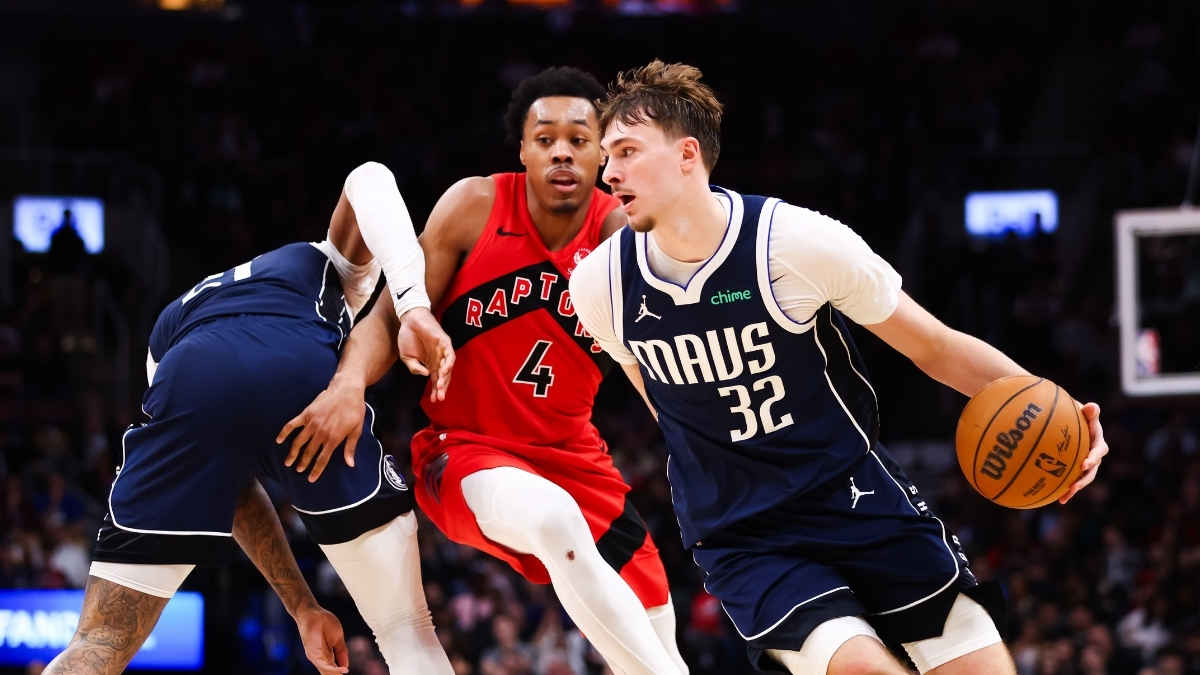
Jason Kidd emphasized before tip-off that taking care of the ball was the number one priority against a Toronto defense built to pressure and push pace. His team turned it over 19 times. The Dallas Mavericks fell 122-92 to the Toronto Raptors on Sunday night at Scotiabank Arena, the largest margin of defeat in franchise history against Toronto.
The Raptors converted those miscues into 21 fastbreak points against Dallas’s four, turned a competitive first quarter into a 13-point halftime deficit, and never looked back. Dallas dropped to 21-43 on the season and 7-24 on the road.
Kidd had flagged the concern explicitly in his pregame availability, warning that Toronto’s aggressive pressure defense and second-chance offense made ball security the defining priority of the night.
“They’re playing well in second-chance opportunities — scoring and rebounding,” Kidd said. “You’ve got to take care of the ball against a team that will pressure you. Getting back on defense is the number one point.”
His team heard the message, but the Raptors managed to set the tone. In his postgame interview, Kidd offered a blunt accounting of what went wrong.
“I stopped counting after nine there early,” he said. “We talked about how they were going to be aggressive. I talked to you guys about the way they play defense. That’s an area we have to get better at. When you have turnovers against a team that likes to get out on the break, that puts you in a bad position.”
RJ Barrett Hits Milestone as Toronto Raptors Blow the Game Open
RJ Barrett did the most damage, finishing with a game and season-high 31 points on 13-of-19 shooting to lead all scorers. In doing so, he passed the 8,000 career points mark, becoming the eighth Canadian to reach that milestone and the 54th player aged 25 or younger in NBA history to do so. He scored 10 or more points in each of the final three quarters as Toronto steadily extended its lead.
Cooper Flagg has known Barrett for years — the two followed similar recruiting and developmental paths, and Barrett attended Duke practices during Flagg’s freshman season. After watching him up close on Sunday, Flagg did not downplay what he saw.
“Yeah, I’ve known him for a while,” Flagg said. “Obviously, we followed very similar paths and whatnot. But he played incredible tonight. He was really efficient and really effective on both sides of the ball for them and just playing at a high level.”
Jakob Poeltl finished with 16 points and a game-high 10 rebounds for his fourth double-double of the season, adding two blocks and a steal. He has posted at least two stocks in five of his last six games. Immanuel Quickley orchestrated Toronto’s offense with a game-high eight assists and was central to the first-half pressure that produced Dallas’s early turnover avalanche.
The Raptors finished with 39 assists to Dallas’s 22, shot 50.5% from the field, outscored the Mavericks 64-52 in the paint, and held Dallas to 10-of-36 (.278) from three-point range. Toronto leads the league in fastbreak points this season at 18.8 per game. Sunday’s margin reinforced why.
The Dallas Mavericks’ Turnover Problem Predated Tip-Off
Dallas turned it over six times in the first quarter alone, with Quickley picking off two passes in a 90-second span midway through the period that helped Toronto build a seven-point lead by the end of the frame. The second quarter was worse. The Raptors opened on a 9-0 run to push the lead to 12, reached 16 before intermission, and went into halftime leading 57-44. The Mavericks shot 28.6% from the field in the quarter while committing five more turnovers. Toronto’s bench unit, anchored by Sandro Mamukelashvili‘s 13 second-quarter points and Barrett’s nine, did most of the damage.
Flagg had a front-row view of how Toronto manufactured the chaos — pressed full-court, forced early decisions and made it nearly impossible for Dallas to run anything organized in the half court before the damage was already done.
“Yeah, they were just being physical,” he said. “High-level pressure, full court, speeding us up and being really physical. We just didn’t do a great job of being organized.”
Gafford arrived at the same conclusion from a different angle, acknowledging that Toronto had successfully disrupted Dallas’s half-court process from the opening possessions.
“Honestly, they sped us up quite a bit in certain possessions, and it felt like we had to score quickly,” Gafford said. “I think the message from Coach was just to stay poised and find ways to get past their defensive pressure and then make them guard multiple actions. We had a lot of good looks and a lot of good shots that either failed or didn’t fall for us.”
The third quarter answered whatever slim hope remained. Toronto outscored Dallas 31-22, pushed the lead to 22, and emptied its bench. The final margin was 30.
Toronto Raptors’ Scheme Took Loaded Up on Cooper Flagg
The Raptors arrived with a detailed scouting plan and the personnel to execute it. On half-court possessions, Toronto loaded up at the nail and sent an early low man — pre-rotating off weaker perimeter threats like Caleb Martin, who finished scoreless in 15 minutes and fouled out — to collapse any driving lane before Flagg could attack downhill. The idea was straightforward: take away the gap before he could use it. The Mavericks, who started the night without a traditional point guard, never found a consistent answer to the defensive wall being built in front of their primary creator.
To his credit, Flagg adapted. He used his size to make live-dribble reads — passing over the top of the collapsing defense to hit Gafford rolling or spraying the ball to the perimeter for open looks. The problem was that the open looks often didn’t fall. With Max Christie in the middle of a shooting slump and Dallas’s perimeter options going cold, Toronto was never made to pay for its aggressive rotations. That scheme only holds together if the offense can punish it from the outside. Sunday night, Dallas’s couldn’t.
Flagg acknowledged that facing a coverage designed specifically to take away his strengths served as a useful teaching moment, even inside a blowout.
“It’s a good learning experience,” he said. “We haven’t played a ton of teams like that, so it’s good for us to see it, feel it, and then have the film to go back and look at how we can improve. It helps us learn how to stay organized and have the correct spacing.”
Klay Thompson finished with five points on 2-of-10 shooting, going 1-of-7 from three in 21 minutes — a reflection of how thoroughly Toronto neutralized him. The Raptors top-locked him off the ball throughout the night, denying him clean looks above the arc to prevent Dallas from comfortably running actions for him. Kidd had anticipated the coverage coming in and said he felt Thompson moved well enough to generate backdoor opportunities. The problem was converting them.
“Yeah, they top-locked him,” Kidd said. “We expected them to top-lock. I thought Klay did a great job of movement and being able to go backdoor. He got a couple good looks and a layup. Understanding using his gravity — when teams play like that, we have to be able to move the ball and not just sit and look for Klay. But I thought his movement got him some looks that he’s been making on this road trip. Unfortunately, they didn’t go down tonight. His ability to move and his gravity is going to help others.”
Christie went 1-of-11 from the field and 0-of-7 from three, unable to reward the open looks he earned against Toronto’s rotations. Flagg framed it as a slump to outlast rather than a problem to diagnose.
“I think we trust Max,” Flagg said. “Early on in the year, we had to force him to take more shots. But it happens — shots aren’t always going to fall. For me, with Max, as long as he’s confident and doesn’t second-guess it, I’ll live with any shot he’s taking out there all day long. I just want him to be confident and let it fly. If he does that, everything will work out.”
Gafford echoed the patience, noting that Christie was visibly affected by the misses and that the group needed to keep pushing him back toward confidence.
“I feel like it’s just a slump that everybody has to go through in their career,” Gafford said. “I’m sure he’s learning from it as the days go by and as every possession goes by. I try to tell guys to keep their heads up because I know guys would tell me the same thing. He missed a good amount of shots tonight and you could tell he was holding his head down. But we’ve got another game coming up in a couple of days. We’ll take those shots again, lock in on the process, and see what happens.”
Brandon Williams led the Dallas bench with 16 points, two blocks, and an assist in 19 minutes. It was the 25th game this season that Williams has scored 15 or more, with 15 of those performances coming as a reserve.
Daniel Gafford Posts Season-High in Losing Effort, Tweaks Ankle
The most complete individual performance on the Dallas side came from Daniel Gafford, who finished with a season-high 21 points and a game-high 11 rebounds for his eighth double-double of the year. His 11 boards pushed him past 300 rebounds for the season — the fifth consecutive year he has reached that mark — and he is now 108 points shy of 4,000 for his career.
Beyond the counting stats, Gafford served as the primary relief valve against Toronto’s aggressive scheme. With defenders loading up at the nail, pre-rotating early, and hedging hard to cut off Flagg’s path to the basket, Gafford was frequently the target on Flagg’s live-dribble reads — receiving passes thrown over the top of the collapsing defense and finishing at the rim on the roll. And when shot attempts came up empty, he was already behind the defense, timing his release on the offensive glass and converting putbacks before the Raptors could recover.
With the Mavericks’ perimeter shooters unable to convert and Dallas repeatedly coming up empty on possessions where needing points, Gafford’s work on the offensive glass became less of a bonus and more of a survival mechanism — turning missed shots into second chances rather than letting Toronto run the other way.
“It’s really important because when guys miss shots, it can take a little bit of the load off their shoulders if somebody’s going down there to grab the rebound,” he said. “Either you go right back up with it or you kick it back out so they can shoot another one. That helps everybody.”
Kidd zeroed in on both threads — the putback work and Gafford’s availability as a roll man — when explaining how a perfect shooting night came together in a losing effort.
“Offensive rebounds were big for us — being able to get the miss and the putback,” Kidd said. “And then also just the pick-and-roll. Our guys were able to find him. He had one of those Gaff nights where he was perfect.”
Gafford attributed his recent strong performances to getting his body back to where it was before an early-season injury interrupted his rhythm.
“Honestly, just being patient,” Gafford said. “As I’ve been trying to stay throughout this season, with the injury I had at the beginning of the year, it’s about finally getting my legs back under me and trusting the guys to find me. Just doing the things I’m used to doing. I feel like I finally got my wind back and got my body back in shape the way it was at the beginning of the season before I hurt myself.”
Late in the fourth quarter, Gafford appeared to tweak his left ankle going hard to the offensive glass. He downplayed the concern in the locker room, drawing a direct comparison to the right ankle he played through earlier in the season.
“Yeah, I’m good,” he said. “It’s going to be sore a little bit, but other than that I’ll just put some ice on it and keep pushing. If the right one couldn’t hold me back, the left one for sure isn’t going to hold me back right now.”
Cooper Flagg Picks Up First Career Technical
Flagg logged 17 points, eight rebounds, six assists, three blocks, and two steals in 30 minutes, recently becoming the third player since the 1976-77 merger to reach 1,000 points, 300 rebounds, and 200 assists through his first 50 career games. But the sequence most discussed after the final buzzer came at 9:28 of the fourth quarter, when Flagg was assessed his first career technical foul following a series of drives to the paint that went uncalled.
Kidd had framed the challenge of sustaining two-way effort and composure broadly before the game, but his words applied directly to what Flagg encountered Sunday night.
“That’s extremely hard when you talk about the offensive talent we have in this league,” Kidd said. “For a guard or anybody, it’s just a matter of your mindset. Do you want to? It seems like Cooper wants to, and that’s where it starts. It’s all right if someone scores on you or gets you that night. The question is what you do next — are you going to fall for the trap of not playing defense and just be like everyone else, or continue to have that mindset to be a two-way player?”
In the locker room postgame, Kidd acknowledged the frustration behind the technical but drew a distinction between expressing it and letting it derail the performance.
“I think he’s attacking,” Kidd said. “I think he just has to play. He has a right to express his feelings to the officials, and he did that. I don’t mind that. But I also understand we’re on the road, and frustration can set in. You’ve got to keep your composure and continue to keep attacking until they blow the whistle. That’s just part of the game. He received his first tech — it won’t be his last. But understanding he is driving and some of them might be fouls — if the whistle doesn’t blow, you’ve got to keep playing.”
Flagg, who said he never received a technical during his year at Duke, was straightforward about what happened and what comes next.
“Yeah, it is what it is,” he said. “I’ve got to do better just slowing down a little bit. I’ve been playing a little too fast since I got back. But yeah, I don’t know — I was frustrated and kind of let it out. I’ve just got to move on.”
Gafford framed the moment as a sign of growth rather than a lapse, pointing to how rarely Flagg had reached that breaking point before this season.
“I think he’s getting the full effect of what the league is all about at the end of the day,” Gafford said. “He’s learning on a day-to-day basis for sure. Of course, the frustration was there tonight, and as a team, I felt like we all could’ve come together more and tried to push each other to keep our heads up. But I think it was just one of those nights. Just seeing the way he holds himself — he’s now getting to that point where he might blow up on the refs. I feel like he’s in the right spot because now he can learn from that. He hasn’t been doing that too much throughout the season where he just goes off the rails. So this was kind of his first game doing that. I feel like he’s taking a step in the right direction because he’s voicing his opinion. He’s the No. 1 pick, so there’s going to be a lot thrown at him. At a young age, he’s holding himself to a high standard.”
The timing added a layer of context worth noting. Before the game, Kidd had been asked to compare Flagg to young versions of Giannis Antetokounmpo and Luka Dončić — two players he coached through their early years — and responded by singling out Flagg’s maturity as a remarkable quality. Hours later, Flagg picked up his first career technical. That it took until March to get there speaks to how consistently he had kept his composure through everything the league had thrown at him before Sunday night.
“Those two names you mentioned are very special when they’re young, and as they’ve gotten older, they’re still special,” Kidd said. “When you look at Cooper, at the age of 18 — turning 19 — just his maturity, the way he plays the game, and how much he loves competition. He’s played on the biggest stage at a young age in college, and also with Team USA — being able to go against LeBron and Steph and those guys. He understands what he has to do, and as a 19-year-old, he’s doing it at the highest level. When you mention him with LeBron and MJ in their first season, it’s just amazing what he’s doing, and he continues to get better each day.”
Dallas Mavericks Face Chemistry Work Ahead
Sunday marked one of the first games this season with the roster approaching full health. Kidd indicated he plans to use the film session before Tuesday’s game in Atlanta to evaluate lineup combinations, including potentially reshuffling the starting group.
“Yeah, we’ve got to look at some different combinations here as we go forward,” Kidd said. “Just to understand — maybe looking at the starting group, maybe different combinations there in that first quarter. We’ll look at that. So when we get to Atlanta, we’ll review it. But again, we just didn’t shoot the ball well and we didn’t take care of the ball. It’s hard to win at any point in this league if you don’t do those two things well.”
Sunday came as close to a full roster as Dallas has had in weeks, with Khris Middleton, Marvin Bagley III and others all available. The assumption was that more bodies would mean better basketball. Instead, it revealed how little time the group has actually spent playing together, and Flagg didn’t sugarcoat it.
“Tonight was one of the first times where almost everyone who could be available was available,” he said. “That would be great, honestly. We’ve been unfortunate throughout the year dealing with a lot of injuries. It’s always better when you have a consistent lineup and can get comfortable playing with each other. Even with me and Khris and [Bagley], we really haven’t played that many games together. So we’re still figuring out that continuity and learning how to play with each other. But yeah, it would definitely help to get a consistent lineup out there.”
Communication came up as a separate thread, with Flagg crediting the older players for trying to fill the void while acknowledging the group still has ground to cover.
“I think it can get better,” Flagg said. “That’s something the coaches have talked a lot about throughout the year. We’re young. We’ve got a lot of young guys, and that’s usually a big thing with young teams — learning how to communicate and do it effectively. We’ve had some of our older guys step up and help with that, but we’ve still got a long way to go in terms of communicating at a high level.”
Dallas continues its six-game road trip Tuesday night in Atlanta against the Hawks.
Latest Dallas Mavericks News & NBA Rumors