
Philadelphia is called the “City of Brotherly Love” because the name originates from the Greek words “philia” (love) and “adelphos” (brother).
Maybe we should rename the city Somaponos, the “City of Bodily Pain?” “Sóma” is Greek for body and “pónos,” the personification of hard labor, suffering and pain.
Injuries have ravaged Philadelphia this season. Paul George has played only 27 games while Joel Embiid has suited up for 33. Kelly Oubre missed 22 games at the end of last year and is now out for at least two weeks with an elbow injury. Tyrese Maxey is now out for at least three weeks with a finger injury. Even Adem Bona and Andre Drummond have been added to the injury report. Pain!
The show continues, though, and one player’s misfortune is another’s opportunity.
Maxey was the heart, brain, limbs, tendons and cartilage of this iteration of the 76ers, garnering a usage rate of 30% on the season while playing a whopping 38.3 minutes per game. His absence leaves a usage sinkhole of epic proportions.
Embiid will likely return this weekend, and he has a 34% usage rate on the season, so the offense will flow through him when healthy. Philadelphia has 17 games remaining in the regular season, which includes three back-to-backs, so Embiid will probably miss at least three games since he hasn’t played in a back-to-back yet this season.
In his first nine games with the 76ers, Cameron Payne averaged 13.6 minutes per contest. In the two games with Maxey out, Payne averaged 29 minutes, 22.0 points, 4.6 rebounds, 7.0 assists, 1.5 steals, 1.0 blocks and 5.0 treys with an 18.7% usage rate. Payne is more of a distributor than an alpha scorer, but he can still put the ball in the bucket. His jumper looks funky with an initial sideways delivery, but Payne eventually swings his arms back to get the arm and elbow into perfect position. Throughout his 11-year career, Payne started 72 games and averaged 11.9 points, 3.1 rebounds, 5.9 assists, 1.8 treys and 0.9 steals in 28.1 minutes per contest.
Sixers Cam Payne career-high 32 PTS (9-10 FG, 8-8 3P, 127% TS), 10 AST, 3 REB, 3 STL, 2 BLK, 0 TO, +22 (+/-) vs. Grizzlies https://t.co/ofWo7tx8ls pic.twitter.com/oby66jvLpa
— Role Player Performances (@BenchHighlights) March 11, 2026
Oubre had an 18% usage rate on the season, but injuries pushed him into a bigger role, and his usage rate surged into the high-20s and was 34% on Tuesday. With him sidelined, Quentin Grimes is the biggest beneficiary. At the end of last season, Grimes was a league-winner, averaging 23.0 points, 5.2 rebounds, 4.6 assists, 1.6 steals and 3.1 treys over 25 games. Both Maxey and Embiid were out during that stretch, so expecting a replication of those heights is unwarranted, especially since VJ Edgecombe is in the mix as well. But Grimes will play a ton and be fantasy viable for sure. With Embiid, Oubre, George and Maxey off the court this season, Grimes saw an 8.2% usage rate bump to 26.6%. Edgecombe saw a 6.5% usage rate bump to 26.3%.
With only Oubre, George and Maxey off the court, Embiid garnered a whopping 43.1% usage rate while Grimes and Edgecombe were at 24%.
Ajay Mitchell, cream rises to the top
The New York Knicks selected Mitchell in the second round of the 2024 NBA Draft; however, the Oklahoma City Thunder acquired his draft rights in exchange for the rights to the 40th pick (Oso Ighodaro) and cash considerations. There were questions about Mitchell’s jumper, as his 3-point prowess was erratic in college (33.2 3P%). In addition, playing at UC Santa Barbara didn’t afford the highest level of competition. Getting traded to the Oklahoma City Thunder was a blessing and a curse because Mitchell joined a great organization, but one that was already stacked.
The UCSB product showed that the game wasn’t too big for him during his rookie season, then absolutely balled out in Summer League. Jalen Williams’ injury opened up a window of opportunity for this season, and Mitchell rushed through like the Kool-Aid Man and thrived. Unfortunately, Mitchell missed the past 20 games due to injury, but he’s back!
On Monday, Mitchell received 30 minutes off the bench and finished with 24 points, two rebounds, three assists, a steal and one trey, with a massive 28.6% usage rate. He shot 9-of-16 from the field. Most importantly, though, he played the bulk of the fourth quarter and was in the closing lineup in a competitive game against a tough Denver Nuggets squad.
There’s no timeline on Jalen Williams’ return yet, so Mitchell should continue being a key offensive cog for the Thunder. Even when Williams returns, Mitchell is just too good to be shelved.
Achilles is the new high-ankle sprain
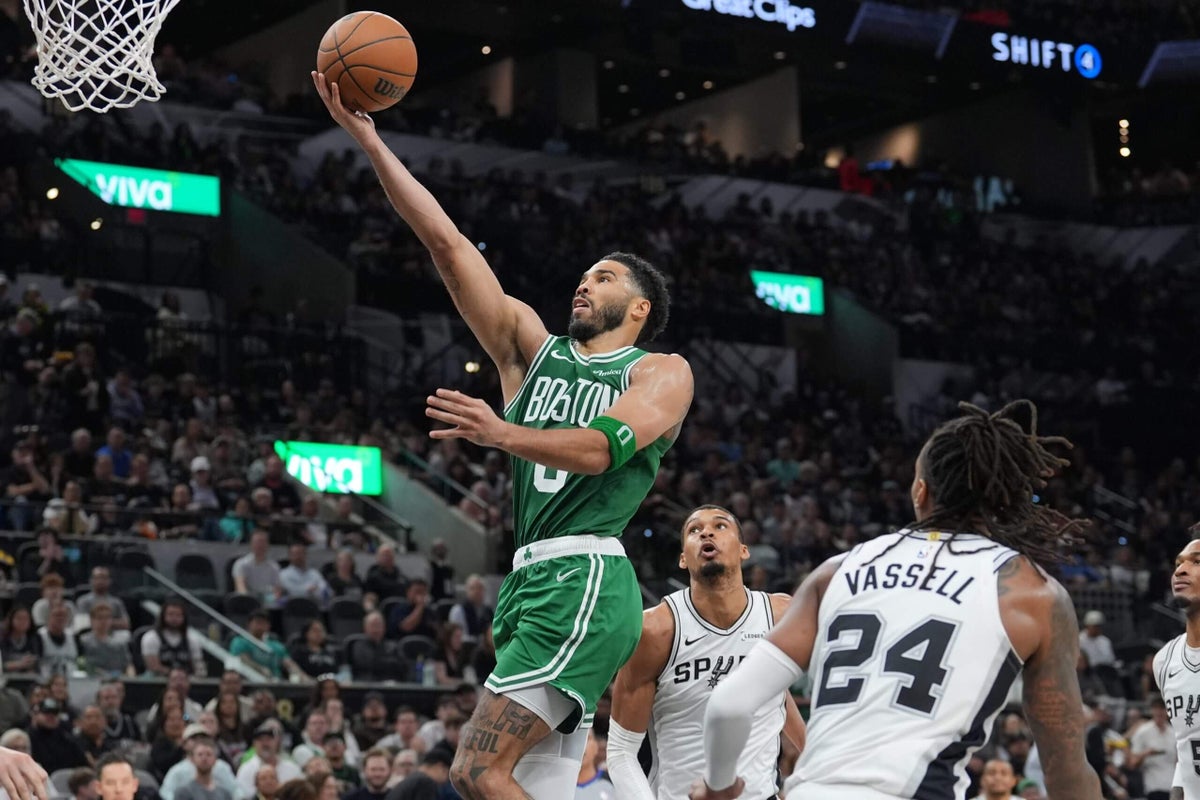
Hyperbole alert! It’s truly amazing how Jayson Tatum and Dejounte Murray have looked since suffering Achilles injuries a year ago. Sure, Tatum missed a dunk, hoisted up an air ball, is only shooting 39% from the field and averaging 27 minutes through three games, but he’s still been a top-100 player for fantasy. The usage rate is 33%, and he’s averaging 19.7 points, 6.7 rebounds, 3.7 assists, 1.0 steals and 3.0 treys. As he gets more comfortable, the efficiency should increase and the playing time could get up to 30 minutes.
Murray averaged 24.3 minutes during his first three games back. Since then, he’s up to 28.3 minutes per contest and broke through the 30-minute barrier on Wednesday, playing 32 minutes. Murray has been a top-50 player for fantasy on a per-game basis, averaging 17.6 points, 5.3 rebounds, 5.4 assists, 1.9 steals and 1.3 treys while shooting 50% from the field with a 28% usage rate.
It’s a tight race up top in the Eastern Conference, so Tatum should continue to play with his eye toward the playoffs. Boston has two back-to-backs, so he will likely sit some, and the Celtics have already decided to sit Tatum for Thursday’s prime-time matchup with the Thunder.
New Orleans is out of the playoff picture but has no motivation to tank as well after trading its first-round pick. The Pelicans are playing to win, so Murray should continue seeing over 30 minutes of run a night. I don’t get it, especially since Derik Queen and Jeremiah Fears are now seeing their minutes sit in the teens off the bench, but that’s why my team-building prowess is only appreciated by my PlayStation.
Dieng it!
Ousmane Dieng has always intrigued because of his height, length and skill. Dieng is 6-foot-9 without shoes and has a 7-foot wingspan. He can shoot over defenders and has a handle package to get off his shot or break down defenses. Prior to being drafted, Dieng was compared to Paul George and Michael Porter. He could not crack a stacked Thunder roster, though, and was eventually traded to Milwaukee.
Dieng has been with the Bucks for 14 games but has seen his role increase over the past five contests, starting all five and averaging 10.4 points, 5.4 rebounds, 4.0 assists and 2.0 treys. He’s shooting 44% from the field and 38% from downtown. His usage rate has only been in the teens, but that can happen playing alongside Giannis Antetokounmpo.
Milwaukee has lost six of the past seven games and is now 5.5 games out of the 10th seed in the Eastern Conference. The chances of Antetokounmpo getting shut down are high, which opens up a massive usage-rate void. Dieng could soak up some of that vacated usage and showcase what he can do down the stretch.
Keon Ellis, a marauder in plain sight
Ellis has been a member of the Cleveland Cavaliers for 14 games. While he was part of the rotation immediately, playing around 20 minutes, his role has since expanded. Over the past six games, he’s received 28 minutes a night and finished with 31 minutes on Wednesday, even closing out the game for the Cavaliers.
Ellis is a career 41% shooter from downtown and is converting 38% of his attempts from beyond the arc with Cleveland, albeit on a low volume of 3.7 attempts per game. His ability to space the floor is great, but it’s the versatility and thievery that have been most welcome to Cavaliers fans and fantasy nerds across the globe. Ellis has racked up 22 steals and 17 blocks since arriving in Cleveland. On the season, he’s played 72% of his minutes at small forward and 21% at power forward, so he’s on the floor alongside James Harden and Donovan Mitchell. Minutes are half the battle.
Brice, Brice, baby!
Brice Sensabaugh is and always has been a professional bucket-getter, but his playing time has been volatile during his career. There were stretches when Sensabaugh was playing close to 30 minutes only to revert to 20 minutes. Over the past two games, though, he’s started and played 29.5 minutes, averaging 25.0 points, 3.5 rebounds, 4.0 assists. 1.0 blocks and 4.0 treys. To close out last season, Sensabaugh started the final seven games and averaged 31.4 minutes, 17.4 points, 4.9 rebounds, 3.3 assists, 1.3 steals and 4.3 treys. Something similar could happen again, especially with Keyonte George suffering an injury last game, which could increase the possibility of George being shut down for the rest of the season.