
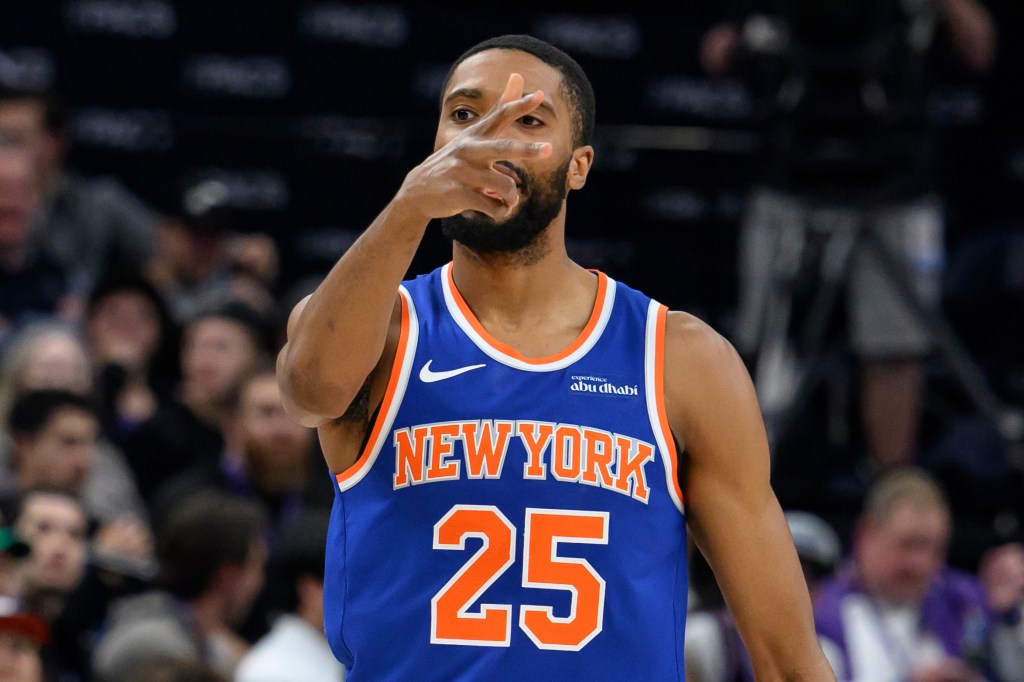
In a perfect world, this is the time of year the Knicks would be sharpening their edge.
Not searching for it.
With just over 10 games left in the regular season, this is supposed to be the stretch where rotations tighten, chemistry solidifies and key pieces lock into form ahead of the playoffs. Instead, the Knicks are still trying to get one of their most important players going.
And not just anyone.
Mikal Bridges.
“You hope that you can get everybody in rhythm but there’s 15 different guys,” Knicks head coach Mike Brown said. “Sometimes that may not happen.”
For the Knicks, it has to happen with Bridges.
There may not be a more important swing piece on the roster — not with the price they paid, not with the role he’s supposed to play, and not with the expectations attached to this season.
The Knicks traded five first-round picks to the Nets two summers ago to acquire Bridges, a move that signaled a clear shift: This was a franchise pushing its chips in, building a contender around his Villanova connection with Jalen Brunson and Josh Hart.
Now, as the Knicks head into the final stretch of a season ownership expects to end in an NBA Finals appearance, Bridges is stuck in one of the worst extended offensive funks of his career.
The numbers tell it plainly.
Bridges is averaging 14.8 points per game on 48.8% shooting from the field and 37.3% from three — his lowest scoring output since the 2021-22 season in Phoenix.
And in March, it has cratered.
Bridges is averaging just 10 points per game on under 40% shooting from the field and 30% from beyond the arc. He scored fewer than 10 points in five of the six games entering Tuesday’s matchup against the Indiana Pacers, including a zero-point outing in 27 minutes in a loss to the Los Angeles Lakers.
The shot isn’t falling. And lately, the opportunities have followed.
“More than anything else, you hope that everyone’s playing the right way. So if my shot’s not falling, what does that mean?” Brown said, asked about getting players in general — not Bridges — rolling entering the playoffs. “Maybe I try to get to the rim, or I try to go get an offensive rebound, or I try to get out in transition and get an easy one just to see it go in.
“So those types of things you hope guys realize and try to embrace to help get a rhythm while we’re trying to help them, too.”
The concern isn’t just the misses. It’s the role.
Bridges, who led the NBA in total minutes last season, has played fewer than 30 minutes in five of his last nine games. He still leads the team in fourth-quarter minutes per game on the season, but that leash has shortened on nights when the shot isn’t there.
In other words: when the Knicks need offense late, Bridges has not consistently been part of the answer.
That’s a problem — because Bridges is supposed to be a release valve. The two-way wing who punishes defenses for loading up on Brunson and Karl-Anthony Towns. The player who can swing a quarter, or a game, without needing the offense built around him.
The player the Knicks thought they were getting when they sent their monster Giannis offer to the Nets.
Right now, he’s searching for that version of himself. The Knicks can live with that — to a point.
Because Bridges still gives them something most teams can’t replicate: a defensive stopper capable of taking on the toughest assignments when it matters most.
Just ask Cade Cunningham.
Bridges came up with a critical isolation stop in crunch time of the Knicks’ Game 6 elimination win over the Detroit Pistons in last year’s first round. And against Boston, he delivered key defensive possessions against Jaylen Brown in Games 1 and 2 of the second round.
That part isn’t in question. It never is, even when he struggles as the Knicks’ go-to regular season point of attack defender.
Bridges will defend. He will compete. He will take on the most dynamic perimeter matchup every night.
But defense alone won’t justify the investment. Not with the stakes this high. Not with the Knicks chasing more than just a playoff appearance.
They need his offense. They need his spacing.
They need the version of Bridges who can score 20 without forcing it and 30 when the moment demands it.
And they need it soon.
Because what the Knicks are seeing right now is a player expending so much on one end that there may not be enough left on the other — and a coaching staff still searching for ways to pull him out of it before the games start to matter more.
“It’s about embracing the details,” Brown said, “focusing the right way, and playing with a sense of urgency while making other teams feel us at this point in the season.”
The Knicks have time — but not much.
And if Bridges doesn’t find his rhythm before April, they may find out the hard way just how thin the margin for error really is.