
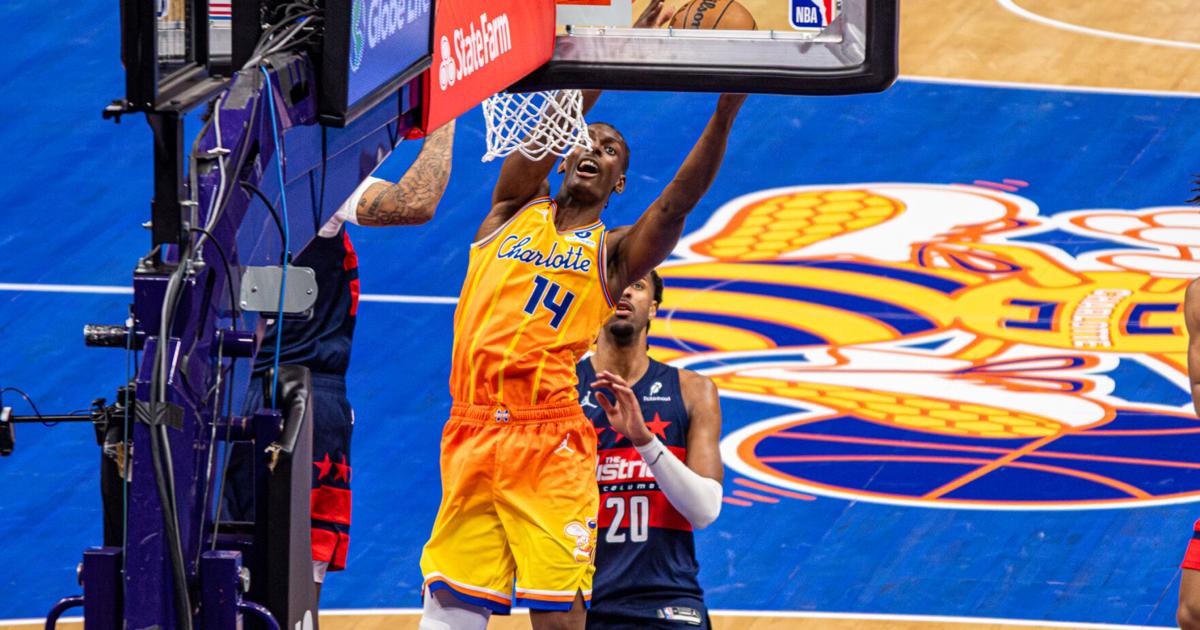
Hornets centers Moussa Diabaté and Ryan Kalkbrenner opened the year with many doubters claiming the Hornets would need to make a move to succeed this season. Preseason concerns centered around the lack of proven depth and questions about whether either player could contribute enough scoring or rim protection to anchor the paint.
Skeptics pointed to Diabaté’s inexperience as a starter and Kalkbrenner’s adjustment to the NBA as potential trouble spots that might leave Charlotte weak in the middle. With 13 games remaining in the NBA regular season, the center rotation has become a strength for the Hornets.
Diabaté’s rise to fan favorite
The aptly named ‘Moose’ has been a revelation for a center-needy Hornets squad. In 2025, Diabaté’s two-way contract was converted to a two-year deal worth $4.6 million.
Since Charlotte acquired Diabaté, he has made an immediate impact as an energetic offensive rebounder, a positive defender with a knack for passing andflashes of offensive versatility.
Diabaté’s rebounding is his calling card this season. Despite being listed at 6-foot-10 and 210 pounds, he averages 8.7 rebounds, including 3.7 offensive rebounds, in 25 minutes per game. That production places him at No. 10 in total rebound percentage and No. 2 in offensive rebound percentage.
Diabaté’s energy and relentlessness are reflected in his No. 5 rank in box outs, and his ability to create extra possessions has been a key reason for the Hornets’ success from beyond the arc when he is on the floor. Charlotte’s 39.5% shooting from three-point range underscores how his effort translates into additional perimeter opportunities.
Defensively, Diabaté uses that same energy to make an impact. Although he averages 1.0 blocks per game, he contests 26.4 shots and is the closest defender on 11.7 rim attempts per 100 minutes.
Diabaté’s defensive activity has been a clear positive, as the Hornets are 1.5 points better than the league average defensively when he is on the floor.
Kalkbrenner’s steady rookie season
Kalkbrenner was the No. 34 overall pick in the 2025 NBA draft. He opened the season making 90.0% of his shots, a mark he could not sustain, but his 74.1% field goal percentage remains highly efficient for a rookie.
Thanks to the rookie’s 7-foot-1 frame and long college career at Creighton University, he has carved out a consistent role in Charlotte as a roll man, rebounder and paint deterrent.
Offensively, Kalkbrenner’s size makes it difficult for defenses to cover both him and the ballhandler in pick-and-roll situations. He converts on 75.2% of possessions as a roll man and 78.3% as a cutter.

Emmanuel Perkins/Niner Times
Kalkbrenner does not provide much spacing, attempting 97.2% of his shots within 10 feet of the rim, but his dunk-heavy shot profile and 71.6% assisted two-pointers help offset those limitations.
His size also plays a major role defensively. Kalkbrenner’s presence in the paint makes scorers hesitant to attempt shots within six feet, where opponents shoot just 39.7% against him compared to 54.6% overall.
When he is on the floor, opponents score 6.2% less, while attacking the rim 4.2% more when he is off. When challenged in the paint, Kalkbrenner averages 1.5 blocks and contributes 5.8 rebounds per game.
Kalkbrenner brings a different build and skill set to the Hornets. As the backup center behind Diabaté since the new year, he provides more size as a traditional big man, adding lineup flexibility.
Why this rotation works
As Charlotte’s primary centers, Diabaté and Kalkbrenner have helped the Hornets rank in the top 10 in points allowed at 113.0 per game and top five in total rebounds at 55.7 per game.Despite a four-inch difference in height, both rebound effectively, allowing Charlotte to maintain a strong presence on the glass at all times.
Both players started games early in the season. The Hornets finished 2025 with a 14-22 record. Since 2026, Diabaté has started 29 games, resulting in a 21-8 record, including a nine-game win streak.
Diabaté is part of the Hornets’ most-used lineup at 360 minutes, which holds a +22.9 points differential. In a similar lineup with Kalkbrenner replacing Diabaté, the differential drops to -2.8 across 86 minutes. Diabaté’s lineups have performed significantly better, reinforcing the decision to move him into the starting role.
Despite those lineup differences, Kalkbrenner’s season has been a positive development for Charlotte. As a second-round pick on a deal worth less than $8 million over two years, he provides valuable minutes at a low cost.
Ultimately, the Hornets have found two affordable and reliable centers on strong value contracts. Diabaté and Kalkbrenner have become key contributors for Charlotte as it pushes toward a playoff berth without needing to address the center position.