
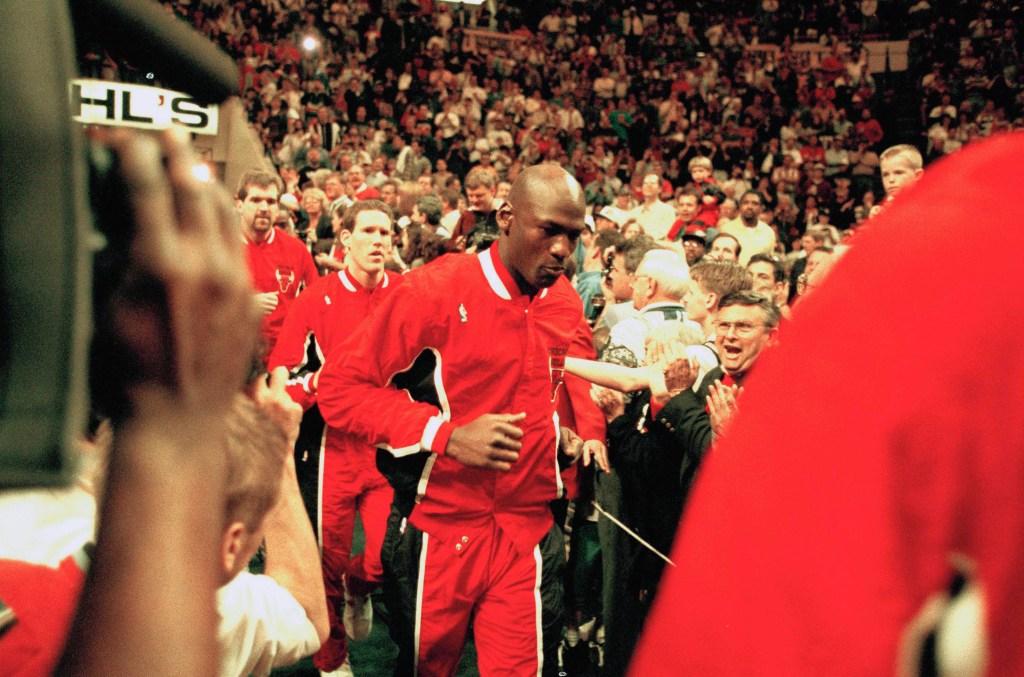
Here’s a look back at what happened in the Chicago area on March 19, according to the Tribune’s archives.
Is an important event missing from this date? Email us.
Front page flashback: March 20, 1995
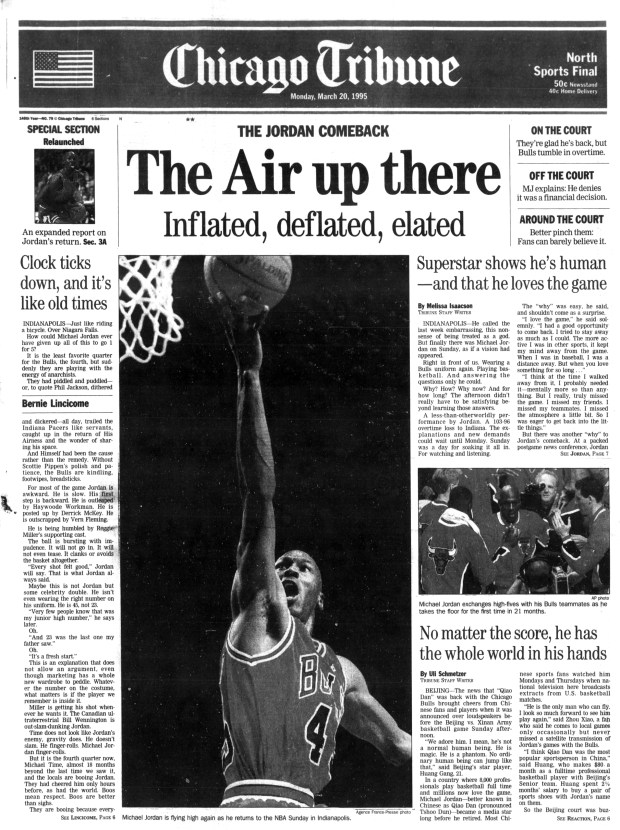 In his first game back with the Chicago Bulls on March 19, 1995, Michael Jordan scored 19 points in 43 minutes. The Bulls lost to the Indiana Pacers 103-96 in Indianapolis. (Chicago Tribune)
1995: In his first game back with the Chicago Bulls since he retired in 1993, Michael Jordan gave a “less-than-otherworldly performance,” according to Tribune reporter Melissa Isaacson. The Bulls lost in overtime 103-96 to the Indiana Pacers.
Jordan barely left the court, playing 43 minutes and scoring 19 points. He missed his first six shots, was 7 of 28 overall and was certainly not the same player. Jordan showed his work ethic, however, even playing until his legs cramped up at the end of the game.
Michael Jordan: Top moments and stats in the life and career of the Chicago Bulls and NBA legend
“I love the game,” he said solemnly. “I had a good opportunity to come back. I tried to stay away as much as I could. The more active I was in other sports, it kept my mind away from the game. When I was in baseball, I was a distance away. But when you love something for so long …
“I think at the time I walked away from it, I probably needed it — mentally more so than anything. But I really, truly missed the game. I missed my friends. I missed my teammates. I missed the atmosphere a little bit. So I was eager to get back into the little things.”
Weather records (from the National Weather Service, Chicago)
High temperature: 78 degrees (2012)
Low temperature: Zero degrees (1923)
Precipitation: 2.5 inches (1948)
Snowfall: 4.1 inches (1986)
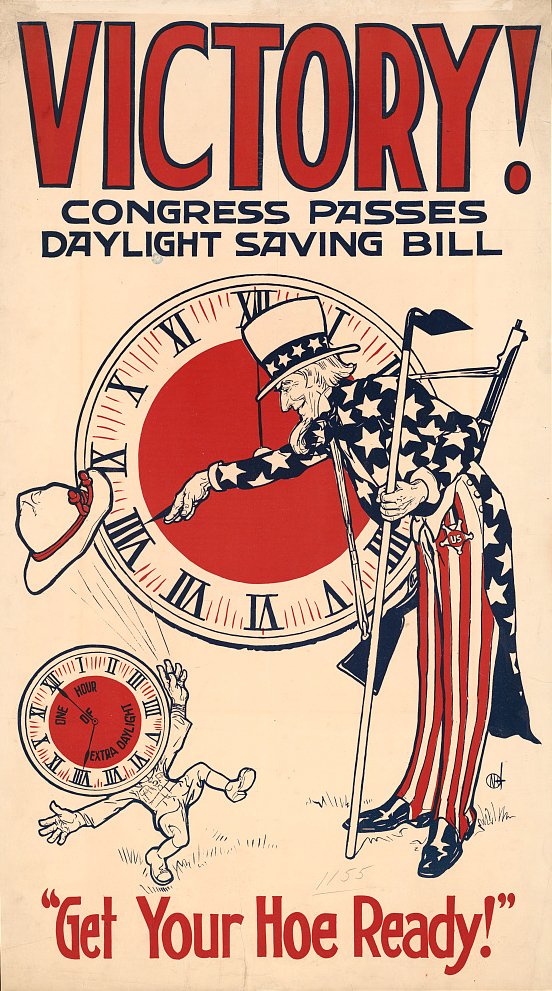 “Victory! Congress passes daylight saving bill.” This poster by the United Cigar Stores Co., which features Uncle Sam turning a clock ahead an hour as a clock-headed figure throws his hat in the air, was produced in 1918 to celebrate the extra hour of sunlight provided by the legislation. (Library of Congress)
1918: Daylight saving time, also known as “fast time” back in the day, had its first run in the United States when President Woodrow Wilson signed it into law to support World War I efforts. All clocks were moved forward an hour on the last Sunday of March and turned back again on the last Sunday in October.
A Tribune editorial described the effort as giving “the nation the gift of a twenty-fifth hour, a new hour insinuated into the clock at the best time of day.”
It didn’t last. The law was repealed by Congress — overriding Wilson’s veto — in August 1919. President Franklin D. Roosevelt launched year-round daylight saving time in the U.S. on Feb. 9, 1942.
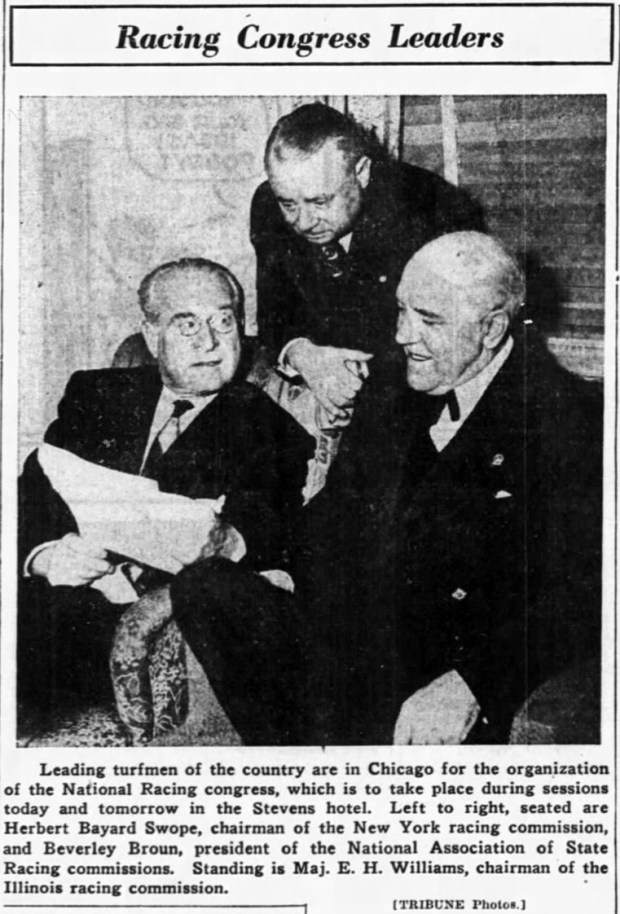 The Thoroughbred Racing Associations of North America was created on March 19, 1942, during a special meeting at the Stevens Hotel in Chicago. (Chicago Tribune)
1942: The first national congress in the history of horse racing convened at the Stevens Hotel (now Hilton Chicago).
The Tribune’s Howard Barry didn’t believe much was accomplished: “The consensus was that the members of the industry could have worked themselves up to an equally patriotic spirit if they had stayed at home without spending large sums of money and devoting a considerable amount of their time to making the journey to Chicago from New York, California, Florida, and other distant points.”
Yet the meeting marked the formation of the Thoroughbred Racing Associations of North America.
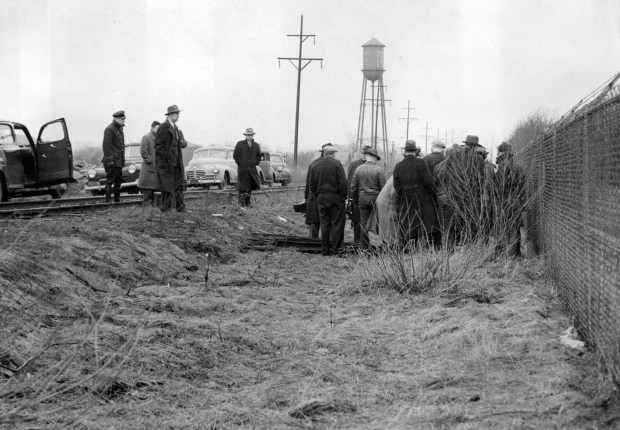 Police gather around Frank Nitti’s body along a railroad embankment in North Riverside on March 19, 1943, after Nitti died by suicide. This photo looks north along the Illinois Central Railroad tracks, south of Cermak Road. (Ray Gora/Chicago Tribune)
1943: The body of Frank “The Enforcer” Nitti — the man who succeeded Al Capone as head of the Chicago criminal empire — was discovered along a railroad embankment in North Riverside.
In tales of the Chicago Outfit, the widowed Annette Nitti mostly stayed in the shadows
Nitti, facing trial and possible imprisonment for his role in a Hollywood movie studio extortion scheme, drank himself into a semi-stupor and fatally shot himself three times as he wandered in the railroad yard only blocks from his Riverside home.
“In pulling the trigger on himself, Nitti, who had become a pariah among the piranhas, became the first major Chicago gangland character to cheat the government out of a trial by sentencing himself to death,” Tribune reporters Ronald Koziol and Edward Baumann wrote in 1987.
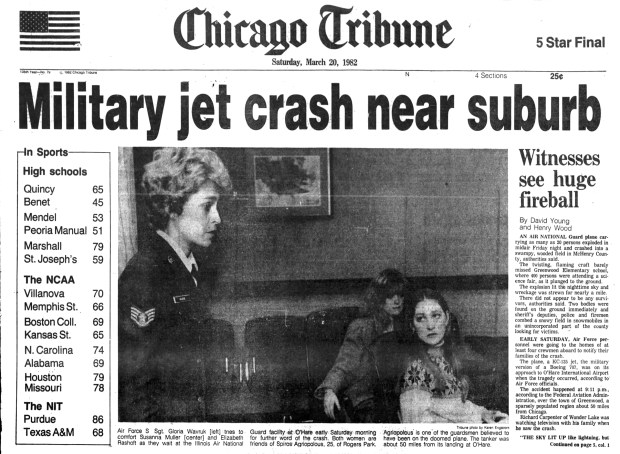 Twenty-seven people aboard a military plane died when it crashed on March 19, 1982, in McHenry County. (Chicago Tribune)
1982: An Illinois Air National Guard KC-135A exploded in midair over Greenwood and crashed into a wooded field in McHenry County. The military plane was on approach to Chicago’s O’Hare International Airport when the incident occurred at 9:11 p.m., according to the Federal Aviation Administration.
The passengers were from the U.S. Air Force Reserve’s 928th Tactical Airlift Group and the aircrew was with the Illinois Air National Guard’s 126th Air Refueling Wing. All 27 of the aircrew and passengers perished.
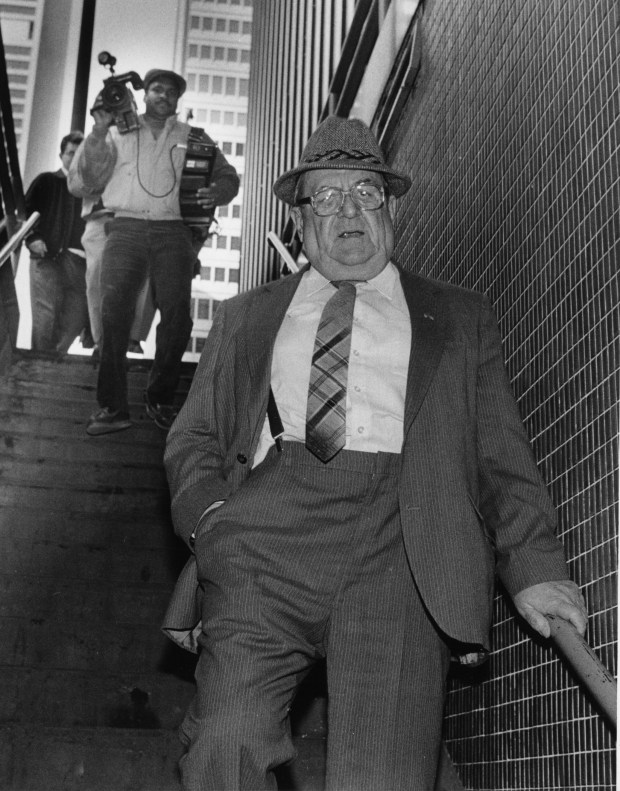 Former Chicago Ald. Chester Kuta enters the subway near the Dirksen Federal Building on March 19, 1987. Kuta pled guilty to charges arising from extortion-related indictments. (Chuck Berman/Chicago Tribune)
1987: Former Ald. Chester Kuta pleaded guilty to participating in a shakedown scheme that allegedly extorted about $60,000 from a businessman who sought to open a flea market in Kuta’s West Side ward. He was sentenced to 60 days’ work release, fined $5,000 and ordered to perform 1,000 house of community service.
The Dishonor Roll: Meet the public officials who helped build Illinois’ culture of corruption
Kuta and businessman Leonard Kraus were allowed to plead guilty to their roles in the alleged scheme as part of an agreement under which they would testify as key witnesses against former state Sen. Edward Nedza, who at the time was still the 31st Ward Democratic committeeman.
The three men were among 11 charged as part of the sweeping Operation Phocus federal investigation into the city’s system for licensing businesses and enforcing city codes.
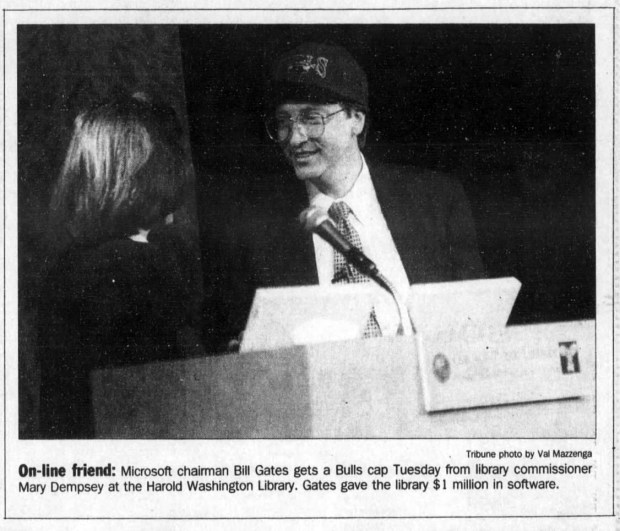 Microsoft CEO Bill Gates donates $1 million in software to the Chicago Public Library on March 19, 1996. (Chicago Tribune)
1996: In an event at the Harold Washington Library Center, Microsoft Corp. Chairman and CEO Bill Gates donated $1 million in computer and educational software to the Chicago Public Library system.
On hand for the event, Mayor Richard M. Daley told the Tribune afterward that he didn’t use computers.
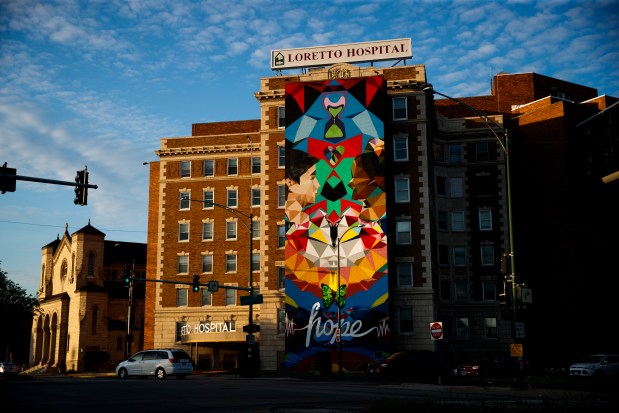 The sun sets over Loretto Hospital on June 2, 2021. (Armando L. Sanchez/Chicago Tribune)
2021: Loretto Hospital CEO George Miller and Chief Operating Officer Anosh Ahmed were reprimanded for their roles in allowing the hospital to improperly distribute coronavirus vaccines at Trump Tower, to Cook County judges and at Miller’s church in south suburban Oak Forest.
The hospital’s board decided to suspend Miller for two weeks without pay, and Ahmed resigned.
Ahmed was charged in July 2024, alleging he embezzled at least $15 million from Loretto. He fled to Dubai before his indictment on massive fraud charges, but was arrested in January in Serbia and is awaiting possible extradition to stand trial in Chicago.
Indicted on fraud charges, ex-Loretto Hospital exec wages bizarre PR campaign from Dubai
Miller was charged in October 2024 in an embezzlement scheme that allegedly bilked millions from the small West Side safety-net hospital, even as the COVID-19 pandemic was raging.
Want more vintage Chicago?
Subscribe to the free Vintage Chicago Tribune newsletter, join our Chicagoland history Facebook group, stay current with Today in Chicago History and follow us on Instagram for more from Chicago’s past.
Have an idea for Vintage Chicago Tribune? Share it with Kori Rumore and Marianne Mather at krumore@chicagotribune.com and mmather@chicagotribune.com