
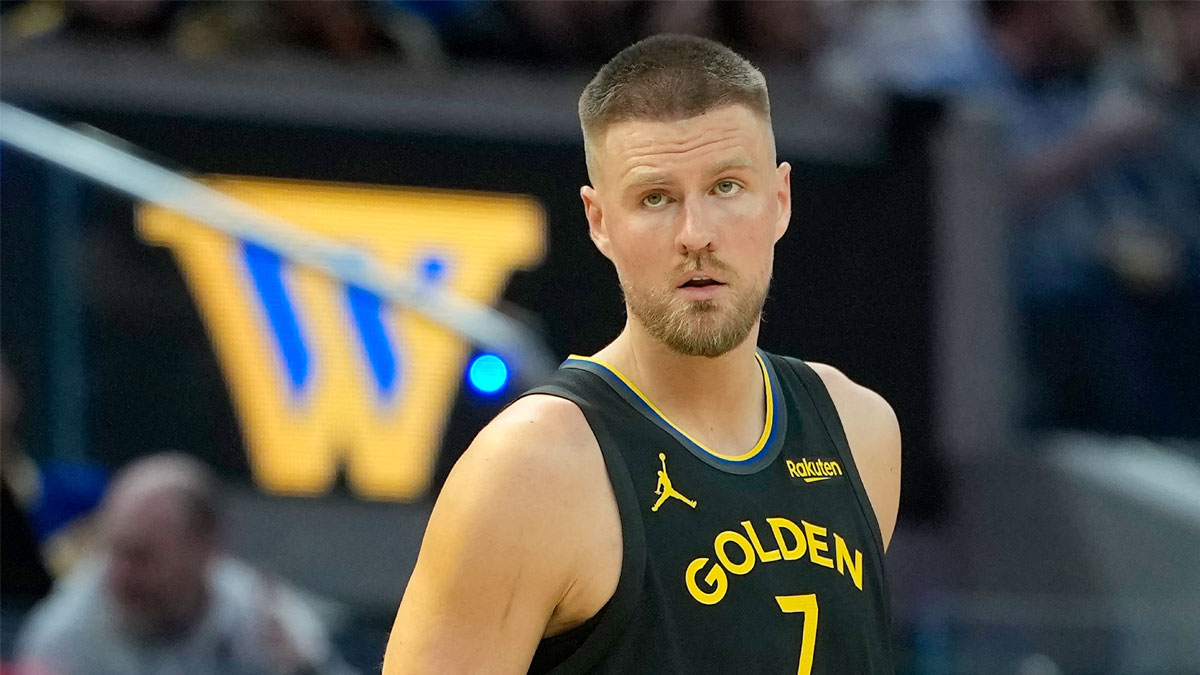
The Kristaps Porzingis Experience during his seven games with the Warriors can be distilled to two acts, one bright as sunlight, the other dark as the team’s last two months.
Act I, The Star, reveals Porzingis as a talented player whose 7-foot-2 height makes him an imposing figure on offense and defense. A player who, on paper, is an All-Star.
Act II, The Tease, reveals Porzingis as a player whose body routinely betrays him. No matter how diligent his preparation and training, or how much ice and medication are applied, an ailment will always be lurking, ready to alter his immediate future – and that of his team.
The Warriors knew this when they acquired Porzingis at the Feb. 5 NBA trade deadline. They knew about his long history of frequent absences, some prolonged, a few shrouded in mystery. He is only 30 years old, but he moves about the court rather stiffly, as if carefully hoping to keep his arms and legs from coming off.
When Golden State made the trade, sending out disgruntled forward Jonathan Kuminga and exuberant guard Buddy Hield, they were hoping to get the KP Experience, Act I. Six weeks later, the franchise realizes embracing Act I means accepting Act II.
That’s how it is with Porzingis now – and how it almost certainly will be next season and beyond, should he re-sign with the Warriors after moving into unrestricted free agency in July.
Porzingis left in the second quarter of Friday’s 115-101 loss to Detroit. He took two hits in a short span of time – a bump from the front and a shove in the back – from Pistons center Paul Reed, who at 6-foot-9 is five inches shorter than KP but has a considerably sturdier physique. Grabbing at his back, Porzingis signaled he needed to be subbed out and walked into the locker room. He did not return.
“I kind of started feeling it from the first quarter,” Porzingis told ESPN’s Anthony Slater in the locker room at Little Caesars Arena. “It started to spasm up a bit. I tried to move and … while I was warm, but at one point I kind of felt a little spasm.”
The Warriors were up 45-44 when Porzingis exited. They were outscored 33-14 over the next 12 minutes spanning the second and third quarters.
So closed the door for an upset against the Pistons, who were without All-Star guard Cade Cunningham.
“We were hanging in there in the first half,” coach Steve Kerr told reporters. “But when (Porzingis) went out, it obviously takes away our space-5 against a great defensive team. It was going to be hard to find openings. And the second half just got away from us.”
Porzingis has been sidelined with back problems four previous times in his nine-year NBA career, the first time in November 2017, his third season, and last time in February 2024. It has caused him to miss as little as one game and as many as five.
Upon heading to the airport for their flight to Atlanta, the Warriors had no idea how long Porzingis would be out of the lineup. Of the 18 games the Warriors have played since acquiring Porzingis, he has appeared in seven.
When Porzingis took the floor in Detroit, he was playing his third consecutive game for the first time since joining the Warriors. This was a benchmark, a sign of progress. Kerr, before the game, even considered the possibility of KP playing both sides of a back-to-back set for the first time against the Hawks.
The Warriors were encouraged because Porzingis’ performances in those seven games have ranged from decent to terrific. Act I KP is a loud difference-maker on both ends.
Act II KP is a cipher. Invisible. Unable to do anything but watch.
Every false step or tumble by Porzingis will engender momentary anxiety among his employers and within the team’s fan base. The NBA has three Big Ifs that exist in this realm of suspense: Anthony Davis, Joel Embiid and Porzingis.
The Warriors hope, for evaluation purposes, to see a few games with Stephen Curry and Porzingis playing together. It hasn’t happened, but Curry could return as soon as next week.
The potential is fantastic if it’s KP, Act I. KP, Act II, would be a flop.
Download and follow the Dubs Talk Podcast