
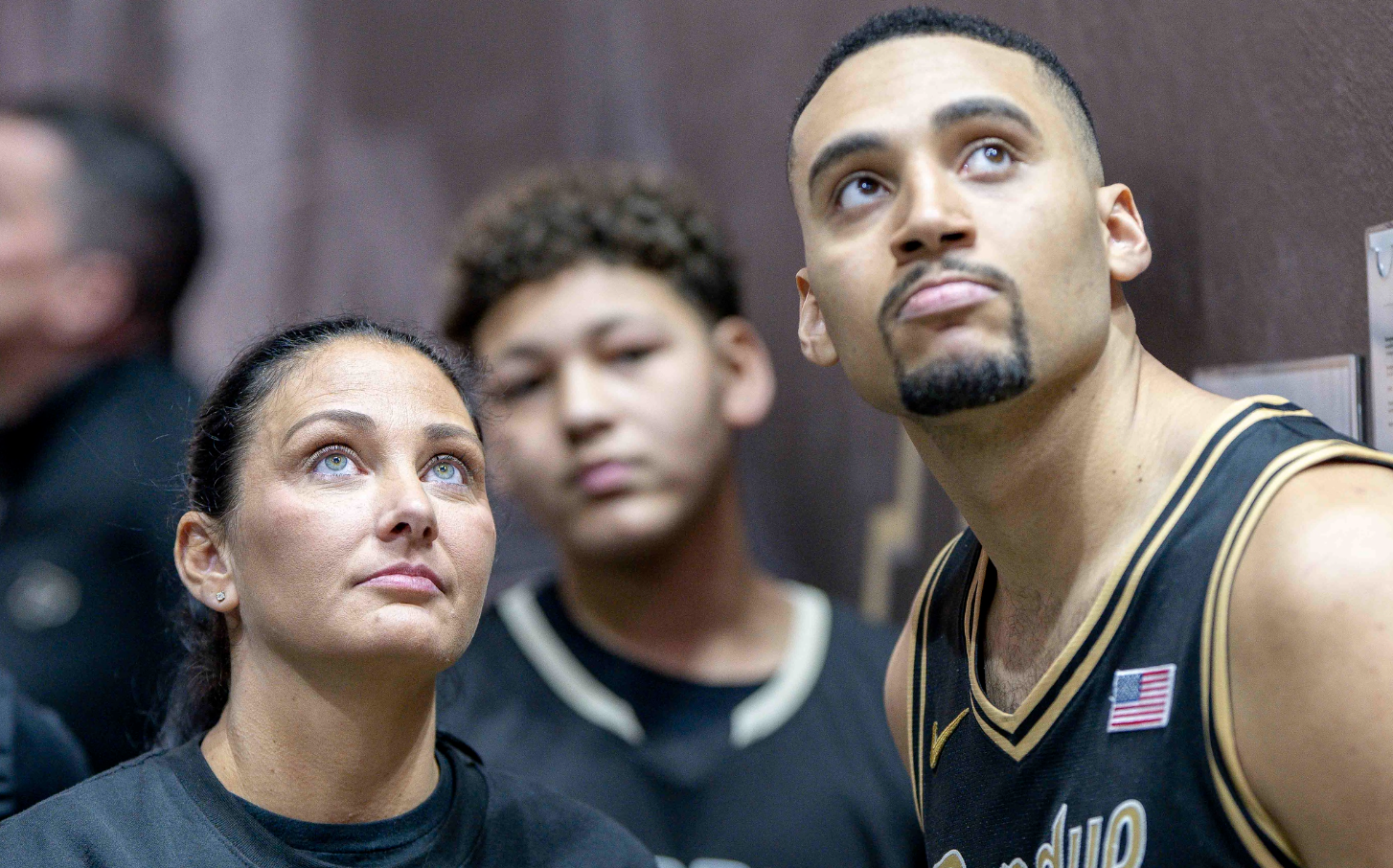
SAN JOSE — That version of Trey Kaufman-Renn you saw at the United Center laying waste to the biggest, baddest frontcourt in college basketball, and that version of Trey Kaufman-Renn you saw earlier in the season dominate at Alabama and Nebraska as a cutthroat rebounder, they’re merely part of the story of Trey Kaufman-Renn, the Purdue senior wrapping up his Boilermaker career in the NCAA Tournament, however it may end.
On the floor, Kaufman-Renn is an extremely physical, more competitive-than-people-know and sometimes overly, and surprisingly, emotional player; off the floor, he steps into a different life, a life of deep thought and introspection, purpose and perpetual learning.
He is the anti-“jock,” a stark contrast from the basketball player who’s spent years crafting his body and mind alike, establishing purpose and seeing it through. That drive is what turned Kaufman-Renn into an All-America-caliber player for the Boilermakers who’s scored just under 1,600 points in basically two seasons as a high-usage offensive contributor, while also emerging as an often dominant rebounder as a senior.
The 23-year-old Boilermaker fifth-year senior is two different people, one of them a devout follower of Aristotle and St. Augustine and the other a disciple of Rodman. They’ve genuinely been two different people working in concert to create one of the best players and most interesting human beings Purdue’s basketball program has ever produced.
“Basketball kind of puts him into a different mindset,” said Kaufman-Renn’s mother, Lara Renn. “He’s told me before, ‘When I’m playing, people don’t like me.’ Because he has to flip a switch — be aggressive, be mean — and that’s not who he is naturally.
“I used to tell him, ‘Superman has to take off the cape.’ You can be Trey off the court, but in the game, you’ve got to be TKR.”
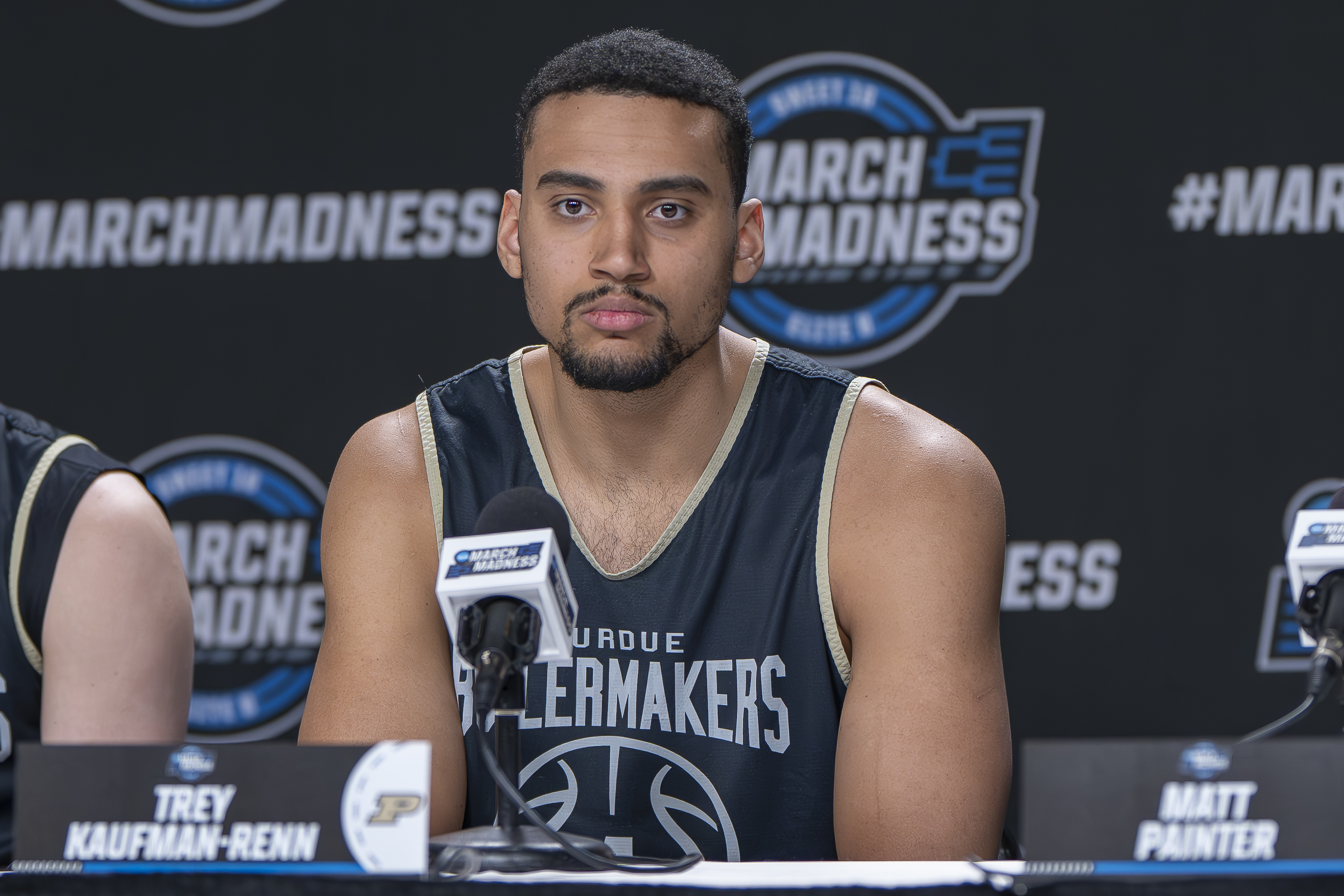 Purdue’s Trey Kaufman-Renn (Chad Krockover)
BEING ‘TREY’
Though he was born into a basketball family — Lara and uncles Matt and Josh Renn all starred at Silver Creek High School — and dedicated considerable time, energy and thought into the sport, Kaufman-Renn has attributed his diversity of interests and natural curiosity to, in part, “boredom,” growing up in the small Southern Indiana town of Sellersburg, close enough to Louisville to be considered a “suburb,” but a very different world from the big city.
There were no video games, still aren’t. He read a lot. He thought a lot. He asked questions and listened.
At school, he wove in and out of all sorts of different social circles.
“He doesn’t really care what people think of him,” Silver Creek coach Brandon Hoffman said. “And that’s rare for high school kids.”
Still doesn’t.
Even now, as an adult and a member of a perpetually online generation, he’s managed to avoid social media entirely, because he’s become deeply interested in the subject of social media’s effects on mental health. (Lara runs his accounts and handles his NIL-related obligations.) He watches cartoons. He’s notorious for not being on his phone.
When he invests in a topic, he digs deep. For a while as a kid, Lara Renn said, it was politics. He’ll talk your ear off about ethics. Sports analytics had a moment.
He once struck up a conversation with the basketball program’s sports information director, Chris Forman, about the moral and ethical ambiguities of Batman being unwilling to kill the Joker, then gave Forman literature covering some of the underlying ethical considerations.
Kaufman-Renn fully supports the comic book superhero’s moral compass.
“What Batman represents is the belief that, no matter what, given enough time, you can change somebody’s heart,” Kaufman-Renn said during an NCAA Tournament open locker room session in St. Louis, surrounded by teammates, coaches and media talking about three-pointers, offensive rebounds and dribble containment. “(Ideas) like that would be why I’m against capital punishment.”
When Kaufman-Renn was first onboarded into Purdue’s philosophy program, he visited with Prof. Jan Cover and the two chatted for hours. They’re more friends than academic associates now, Cover says.
“What stood out was this: Trey was already inclined to think deeply,” Cover said. “That likely comes from his upbringing — being asked questions about right and wrong, the good life, what happens after death. Not everyone is wired to pause and reflect like that. He is.”
Needless to say, these are not mainstream discussions occurring in most college basketball locker rooms.
“He’s as clever as anyone,” Cover said, “but most people, regardless of intelligence, aren’t interested or patient enough to think about things like the distinction between body and soul, free will vs. determinism, the relationship between human beings and God, if there is one, the nature of moral duty and right action. These are questions people don’t typically engage with.”
Kaufman-Renn has been deeply interested in the soul and what proof may be found of its existence.
Pretty heavy stuff.
One of Kaufman-Renn’s early challenges, he’s admitted, was relating to his contemporaries who might not be wired as he is and learning to communicate, while still wearing his uniqueness on his sleeve. The trolley problem ethics exercise, for example, is not typical locker room fodder. There was the time in the training room when Kaufman-Renn and devoutly spiritual teammate Caleb Furst got lost in conversation discussing God, faith and existence at length.
Forever a seeker of knowledge, Kaufman-Renn credits his mother for challenging him.
“Politics, ethics, morality I thought about that stuff a lot as a kid,” Kaufman-Renn said. “For whatever reason, whether it was on the way to an AAU game or coming back, my mom would talk about politics. She’d say things like, ‘I don’t think this is fair,’ or ‘We should do this’ or ‘We shouldn’t do that.’ And the natural question is: Why?
“When you start talking about what people should or shouldn’t do — those normative questions — you immediately want to understand the reasoning behind it. So we got into a lot of discussions like that.”
It was always something.
Assistant coach Brandon Brantley laughs about the time Kaufman-Renn explained the Metaverse to him. He’s also promised to teach Brantley how to play chess, another of his pastimes in addition to being an excellent ping-pong player, by most accounts.
Hoffman remembers his star player’s many thought exercises during practices, workouts, whatever it might have been, topics like handicapping theoretical matchups between male and female athletes.
“I don’t even know if he believed what he was arguing, but he’d argue it to the death,” Hoffman said. “Just random stuff. He’s super competitive too, so that makes him a very good arguer.”
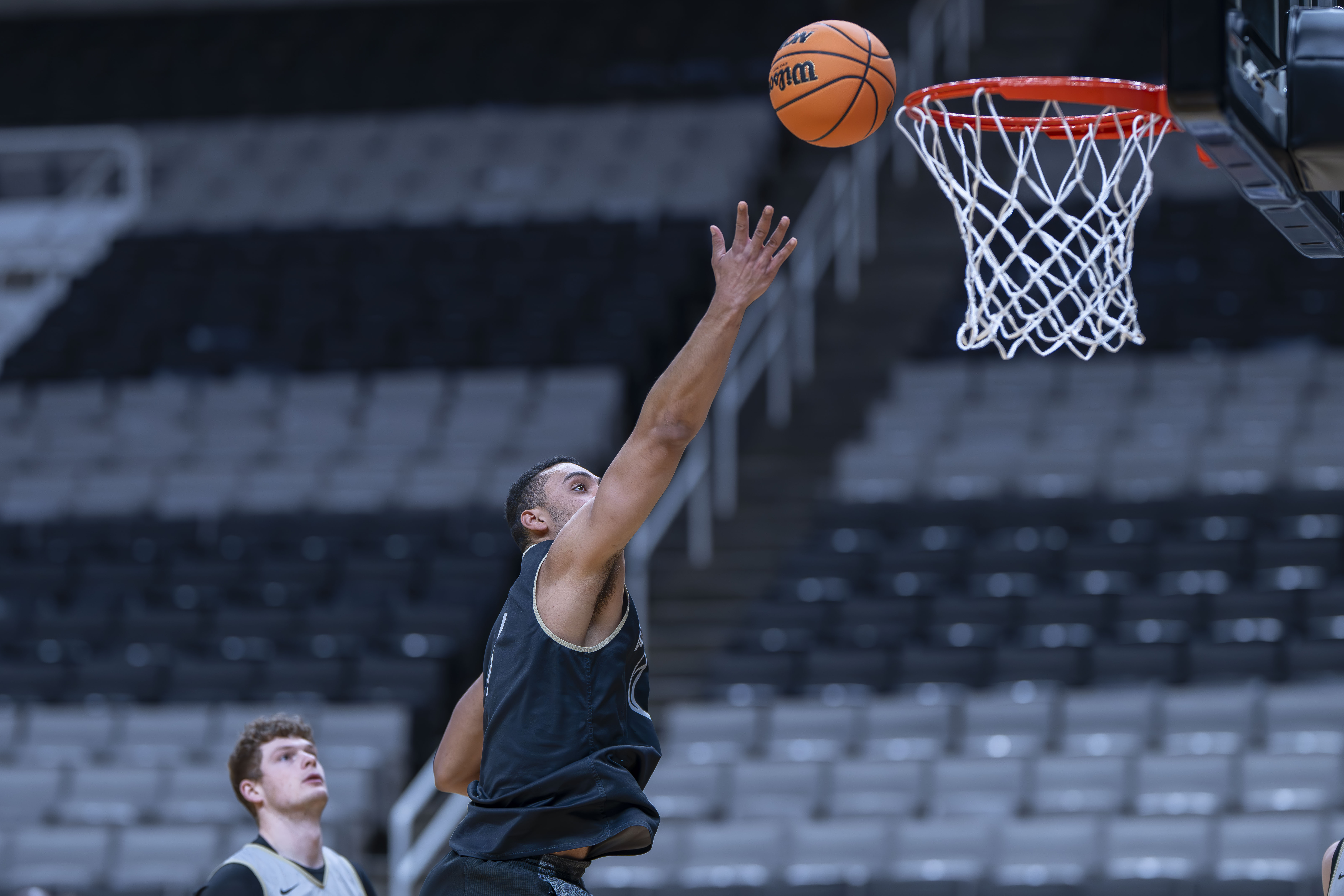 Purdue’s Trey Kaufman-Renn (Chad Krockover)
BEING ‘TKR’
The flip side of Kaufman-Renn’s cerebral, soul-searching personality is the visceral, emotional and hyper-competitive force he’s become over his five years at Purdue.
That player who bullied Michigan’s elite (and gigantic) frontcourt in the Big Ten Tournament championship game and who grabbed 19 rebounds at Nebraska stood in stark contrast to his perceptive and discerning personality off the floor.
A studier of life and death away from the court, Kaufman-Renn’s become a killer on it.
“Oh man,” Brantley says with a little extra animation. “When he smells blood in the water, I like the chances for the Boilers.”
When Purdue beat Michigan, Kaufman-Renn took that game personally and played angry, weaponizing his zen. When Purdue won at Indiana his sophomore year, another game he took personally, Kaufman-Renn walked out of Assembly Hall putting hands on familiar onlookers in raucous celebration.
That sort of edge is the stark counterbalance to Kaufman-Renn’s nature otherwise, to the person who says things like “You can’t plow yesterday’s field” when discussing disappointments.
This season has been different for Kaufman-Renn. He was widely viewed as a preseason All-American, but wound up not even being All-Big Ten, which is probably more a reflection of how many great players there are in an 18-team league and there only being 15 all-conference certificates to hand out. The Boilermakers’ unfulfilling regular season — “yesterday’s field” — didn’t help, either.
He averaged 20 points per game as a junior, but that number dipped a half dozen spots this season as he moved from playing as an undersized center to be an oversized power forward again.
But even as he looked at times like a marginalized asset, substance was revealed by Kaufman-Renn growing into a more complete player, upping his rebounding average by 25 percent or so and turning last season’s negative assist-to-turnover ratio into a sparkling 2-to-1 mark.
Kaufman-Renn’s methodical mind has grown into increased processing speeds in a key decision-making role that requires him to manage double-teams in the post and make snap decisions in pick-and-roll. His 91 assists are second only to all-time NCAA assist king Braden Smith and Kaufman-Renn’s turnover percentage was trimmed from 13.9 percent last season to 12.3 now. Putting that simpler: Kaufman-Renn committed 2.85 turnovers per 40 minutes last season. He’s cut that average to just under 2.0.
He’s fouling less, from 3.8 per 40 last season to 3.2 now, correcting a significant hindrance to his productivity last season. Personnel dynamics around him helped, too.
The rebounding has been critical for Purdue, as Kaufman-Renn promised to up that part of the game this season, then responded with 12 double-digit rebounding games to this point, tripling last season’s total.
“He said he was going to do it,” Coach Matt Painter said, “and he has.”
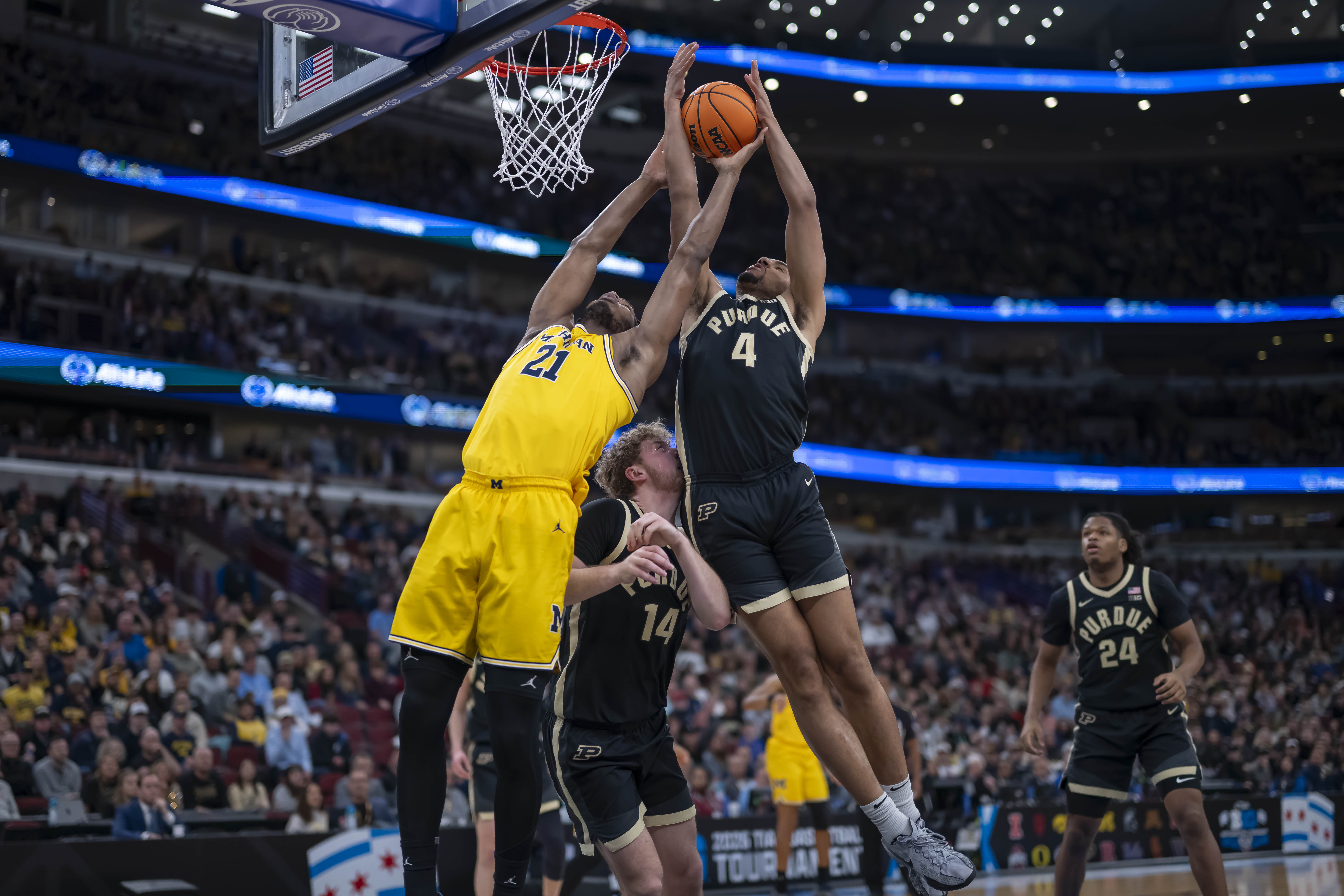 Purdue’s Trey Kaufman-Renn (Chad Krockover)
‘PATIENCE IS THE COMPANION OF WISDOM’
St. Augustine said that. He’s one of Kaufman-Renn’s favorite philosophers, if not the favorite. Again, very few college basketball players can rank their favorite philosophers.
He’s always been development-minded, goal-oriented and driven by the big picture.
A top-50-ranked recruit out of high school who was offered by North Carolina and then-national champ Virginia, among many others, Kaufman-Renn eagerly redshirted. Injury contributed but it was hardly the lone impetus behind him laying out his freshman season. Today, he’s half serious when he says he wishes he could redshirt again mid-career to apply all he’s learned from playing experience.
When player-of-the-year Zach Edey returned to Purdue for his senior season, it meant that Kaufman-Renn’s moment to be a leading man would be put off another year. He didn’t budge. He easily could have transferred. Instead, the deep thinker that he is, he vetted the possibility of Edey using his COVID year and playing, in effect, a second senior season at Purdue. That was never even remotely a possibility, but Kaufman-Renn thinks, therefore he is.
He’s purposeful, intentional and always eager to ask questions. When he was being recruited, he sought out players who’d transferred out of Purdue and other schools to pick their brains. (Matt Haarms spoke highly of Purdue, by the way.)
His senior year at Silver Creek, a reporter covered his senior-night game on a Friday night, then received an unsolicited message the following Sunday afternoon seeking input on how he might best prepare himself to play at Purdue.
“He’s never going to think he’s reached his best version of himself,” Silver Creek coach Brandon Hoffman said. “He’s always looking for ways to get better.”
It’s always been that way.
“He’s always said, ‘If I don’t reach my goals, I want it to be my fault,’” Lara Renn said. “And we’ve had a lot of conversations about how that’s not always how life works. Sometimes good things happen to bad people and bad things happen to good people.
“He used to think, ‘If I work hard, I’ll get what I want.’ But that’s not always guaranteed. What it does do is prepare you for when the opportunity comes. That’s how he looks at it now — be ready. A lot of people get opportunities and don’t capitalize because they weren’t prepared. He always wanted to be ready.”
He waited his turn and was ready, paid off for patience during a unique window in college basketball in which players were paid off for impatience. Now, he reflects.
“What’s the dollar amount on the relationships that I’ve built?” Kaufman-Renn said. “What’s the dollar amount on the values that I’ve learned? For me, it’s an easy thing.”
Speaking of money, when NIL first came about and Purdue’s staff explained to its players how things would work, Kaufman-Renn again slipped into thought. Elliot Bloom, Purdue’s director of operations, remembers him grappling with the thought of what money would mean to him, how it could change him, the entanglements that might come with it and whether he should accept it at all.
Suffice to say, that was not the consensus reaction nationally.
‘QUALITY IS NOT AN ACT; IT IS A HABIT’
Kaufman-Renn is summed up well by this quote widely attributed to Aristotle.
When Purdue was recruiting him, he crushed its well-known personality test, revealing an “elite details guy” with an obsessive work ethic, Profile CEO Chad Brown said. Kaufman-Renn is known as one of Purdue’s most engaged and inquisitive players in film sessions. He’s consumed with scenarios, what-ifs and nuance.
“He’s driven to find answers to things no one else is even thinking about,” said Purdue’s sports performance coach Jason Kabo.
After a summer practice last year, when Purdue was implementing various defensive wrinkles, Kaufman-Renn sat down with assistant coach Paul Lusk to discuss how Nebraska would handle certain things.
That one-handed floater that’s become his signature shot, that’s the product of Kaufman-Renn injuring his left hand in high school, then spending weeks shooting with only his right hand, over and over and over, from a wide variety of distances.
The physical development has been most evident during his career.
His symphonic connection with point guard Braden Smith is the product of a million reps dating back to sophomore year.
And those vicious rebounds he snatches one-handed while using the other arm to clear out adversaries, those are the result of him setting aside Augustine for a bit to watch videos of modern-day philosopher Dennis Rodman.
The time and energy Kaufman-Renn puts into basketball makes his well-balanced being all the more interesting.
But it comes at a cost.
“He struggles sometimes with things he can’t control,” Lara said.
Example: When games get really physical and he may not see eye to eye with the officials, Kaufman-Renn’s inner peace may slip, as happened vs. Memphis in the Bahamas in November. Foul trouble plagued him as a junior, though positional dynamics drove that issue.
But as is true in more ways than one, there are different layers to that competitiveness.
After a frustrating run of games against Michigan and some general disagreements with the Wolverines’ tactics, Kaufman-Renn played in that Big Ten Tournament title game on a warpath. Twenty points later, he had one more Big Ten championship to celebrate.
That game in particular was the ultimate testament to Kaufman-Renn’s years-long development-mindedness and commitment to the weight room.
“He’s awesome,” Kabo said. “He’s usually the guy sitting in my office before lifts, sitting there 20–30 minutes having deep conversations about absolutely nothing.”
Maybe the farm Kaufman-Renn tells people he’ll move to after he’s done playing.
“He’ll tell me I’ll never hear from him again after basketball until the carrier pigeon he has drops a letter on my desk,” Kabo said. “That’s just him.”
‘KNOWING YOURSELF IS THE BEGINNING OF ALL WISDOM’
Another Aristotle-ism applicable to Kaufman-Renn.
It was late in Purdue’s Final Four season, during the Big Ten Tournament that year, actually, weeks before season’s end that Kaufman-Renn’s mind was on his, well, mind. His physical form was taking shape, starting every game for the eventual NCAA runners-up while showing signs along the way of the brilliant future that has since been realized.
But it was then that Kaufman-Renn realized he needed to be stronger mentally, though one might suggest that understanding the need to be stronger mentally might be a prime example of mental strength.
Nevertheless, he began plotting his off-season then and there, reaching out to his trainer, Jordan Delks, to begin crafting an off-season workout plan heavy on mental training in addition to physical. Kaufman-Renn has since co-authored a book with Delks after years earlier hatching the idea for “Camp Better,” which has been held each of the past two years in Sweetser, Ind., at the rural home of Jordan and Courtney (formerly Moses) Delks. Courtney is a former Purdue women’s basketball star. Their training business originates out of a barn situated on an old dairy farm, where Kaufman-Renn has spent many weeks during his college career, living out of Airbnbs in near-by Marion.
It was after the national championship game that Kaufman-Renn met with Jordan Delks to map out his off-season.
“He said, ‘I need an opportunity to really level up my mind, body and spirit,’” Delks remembers.
The workouts took place in relative isolation, a feeling Kaufman-Renn sometimes appreciates.
When Painter stepped out of his team’s hotel on Wednesday in San Jose, he saw Kaufman-Renn outside sitting on a bench by himself, maybe decompressing, but definitely thinking.
 Jordan and Courtney Delks’ Compete Training Academy facility in Sweetser, Ind.
‘LOVE YOUR NEIGHBOR AS YOURSELF’
In accordance with the words of one of his other favorite philosophers, Jesus Christ, Kaufman-Renn seems to live a life free of ego or vanity. To hear those around him tell it, he’s always thought of others, if not put them first.
When former Purdue player and coach Frank Kendrick passed away last year, Kaufman-Renn not only attended his celebration of life in Ross-Ade Stadium’s Pavilion, but stood up and spoke for his former AAU coach.
A man of the people, you might say, though not the particularly overt kind.
“He was No. 1 in his class, basically a valedictorian, all-time leading scorer here, won two state titles,” Hoffman said, “but you walk into the cafeteria and he’s not sitting with the ‘jocks’ or acting like he’s above anyone.
“He’d sit with all kinds of different people. He made time for everyone. Had deep conversations with people you wouldn’t expect.”
In modern recruiting and the digital world Kaufman-Renn has carefully insulated himself from, the commitment announcement is a big deal. It might involve a press conference. In many cases a professionally produced video to publish on social media channels. At the very least, an “edit.”
When Kaufman-Renn committed to Purdue, he told the world about it from a studio at Jeffersonville High School, keeping a promise he’d made to long-time friend and aspiring broadcaster Wyatt Williams, who put Kaufman-Renn on student radio to make his announcement, the official end of a recruitment that Purdue won with a message of substance that stood out against the superficial, rock-star pitches other schools made.
“He’s intelligent — he can see through BS,” Hoffman said. “Purdue was honest with him. They told him what he needed to improve, what they envisioned for him. No empty promises.
“I think he appreciated that more than being told he’d be a superstar somewhere else.”