
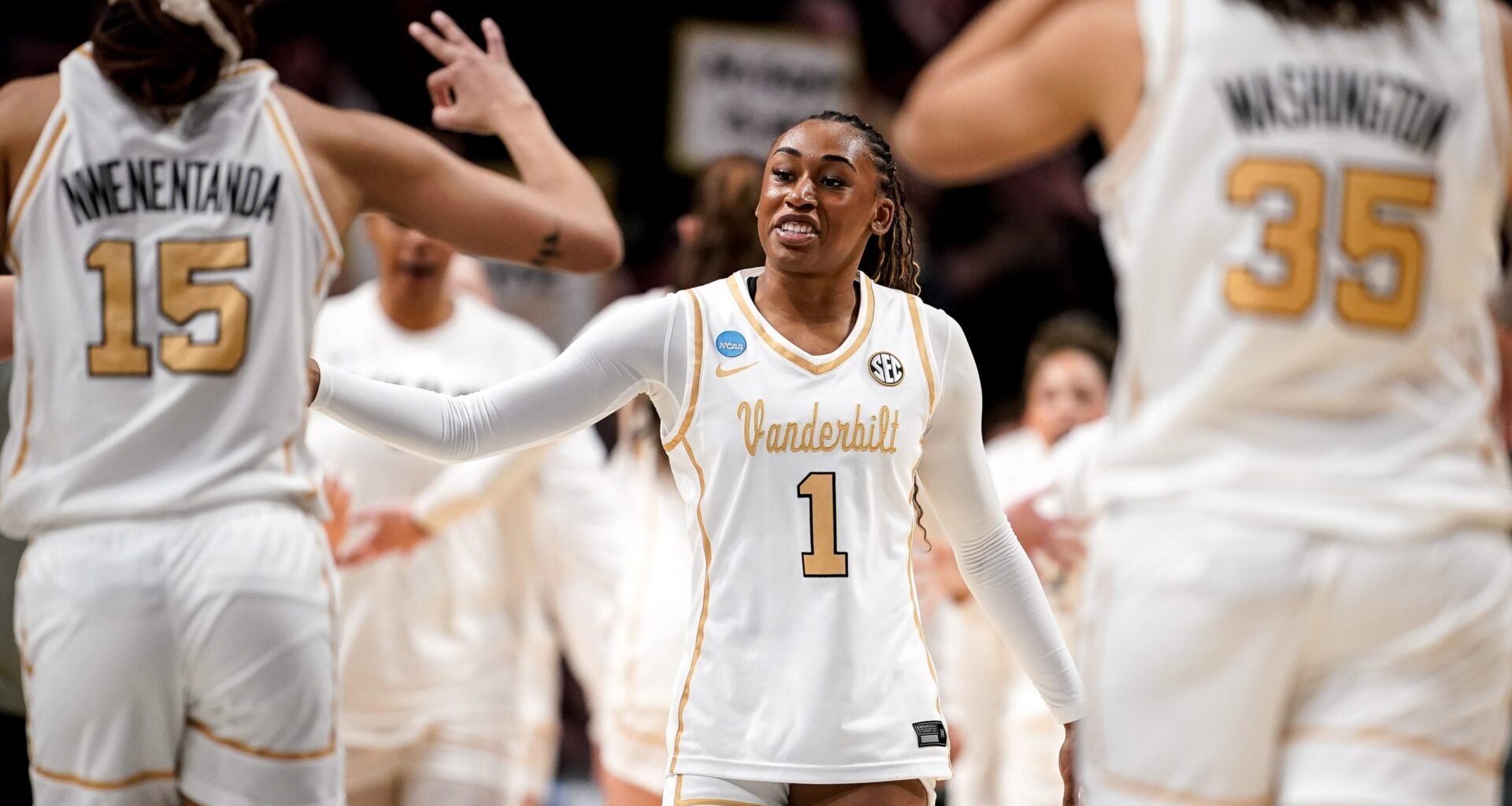
FORT WORTH, Tex. — As teams progressed through practices and press availability at Dickies Arena, it became clear that all eyes would be on the region’s elite guards when they take the court on Friday for the Sweet 16.
And why wouldn’t they be, when you have two of the nation’s top players facing off in the backcourt in Game 1?
Vanderbilt’s Mikayla Blakes is pacing the nation with 27 points per game and 892 total points, which is an NCAA Division I record for a sophomore. During the Commodores’ run to the Sweet 16, she was named SEC Player of the Year and earned a consensus nod as a first-team All-American.
Hannah Hidalgo of Notre Dame ranks third at 25.2 points per game and leads the nation in steals. She won ACC Player and Defensive Player of the Year honors.
And though the athletes definitely wanted to downplay any potential pressure from that matchup, Vanderbilt coach Shea Ralph admitted that she’s looking forward to “witnessing greatness” when her second-seeded Commodores face the No. 6 seed Fighting Irish.
“Hannah is also a great player in her own right,” Ralph said. “What I do know about my player, Mikayla, is I don’t have to worry about her getting outside of herself. I never have, and my guess is I never will. She was built for these moments. She’s prepared and ready, and it really doesn’t matter who we play against.”
Hidalgo, who faced Blakes in high school before suiting up alongside her for Team USA in last year’s FIBA AmeriCup, offered her own analysis of the Vanderbilt guard.
“She can score the ball in so many ways,” Hidalgo said. “Obviously, we all know she’s the No. 1 scorer in the country, but just the way she’s able to put the ball in the hoop, it’s unlike I feel like I’ve ever seen. Like Caitlin [Clark]-type of level.”
Expanding on her impressions of Hidalgo, Ralph cited her USA Basketball experience as a huge factor in the growth of her game. Hidalgo is especially skilled in pressuring the ball, averaging 5.56 steals per game.
Listen now to The IX Sports Podcast and Women’s Sports Daily
We are excited to announce the launch of TWO new podcasts for all the women’s sports fans out there looking for a daily dose of women’s sports news and analysis. Stream on Spotify, Apple Podcasts or anywhere you listen to podcasts, and make sure to subscribe!
“I love the way that they play her on defense,” Ralph said. “It allowed her — I said this yesterday — to be a free safety in a lot of ways. Because of her high IQ and competitiveness, she takes full advantage of that.”
The day’s second game between UConn and North Carolina will keep the focus in the backcourt, where the Huskies set an NCAA single-season record with 854 assists and an average of 23.7 per game. Junior guard KK Arnold ranks second in the nation for assist to turnover ratio and Azzi Fudd is 24th.
Defensively, North Carolina’s senior guard Indya Nivar has helped slow down opponents with a career-high 90 steals, while typically guarding their top guards. But the Tar Heels will have their work cut out for them against the top-seeded and undefeated Huskies who average 89.1 points per game and shoot north of 50% from the field, while holding opponents to 50.3 points on average.
Courtney Banghart calls for more respect for ACC teams
North Carolina and Notre Dame are two of the record-tying five ACC teams preparing to play in the Sweet 16. And though that is the second-most of any conference, all five will take the court as the lower-seeded team, including tournament champion Duke who will face LSU in Sacramento.
“I think the strength of our conference continues to be on display,” Banghart said in an enthusiastic opening statement. “Obviously, we know we have a significant challenge in front of us, and that’s what you live for.”
Banghart’s Tar Heels will face top-seeded defending champion UConn, which is riding a 52-game winning streak. North Carolina is seeded fourth.
“I don’t know, but I think the ACC has been the underdog all along,” Banghart said. “It’s amazing that we get the four seeds and the five seeds all the time when we have more people advancing in the Big Ten, for example, year after year to the Sweet 16.”
“Becoming Caitlin Clark” is out now!
Howard Megdal’s newest book is here! “Becoming Caitlin Clark: The Unknown Origin Story of a Modern Basketball Superstar” captures both the historic nature of Clark’s rise and the critical context over the previous century that helped make it possible, including interviews with Clark, Lisa Bluder (who also wrote the foreword), C. Vivian Stringer, Jan Jensen, Molly Kazmer and many others.
The league sent eight teams to the tournament in 2025, and four advanced. This year, nine went dancing, and five are in the Sweet 16. Four of the five are ranked in the AP Poll.
“Our job in this role, me and the other coaches in our league, just have to continue to win the games in front of us, recruit the best talent, and coach the best that we can with the teams we have,” Banghart said. “I think the postseason, the March success, I think is speaking for itself. We just need to ensure our seeds are correct so we can continue that.”
Shea Ralph reflects on the evolving role of coaches
As one of many former players now coaching, Vanderbilt head coach Shea Ralph has had to define exactly what she wants to offer to the players in her program. When it comes to her Commodores, she’s chosen a blend of educator and mentor, helping them navigate life off the court.
“I take it very seriously the job of leading young women,” Ralph told reporters. “So the world is always going to change. We know that. It’s changed for us. There’s always going to be some new distraction. There’s always going to be something that gets in the way of what you’re supposed to be doing.”
Asked specifically about the role of coaches in this new NIL landscape, she said the core motivations have not changed.
“They’re still kids. They still need direction,” Ralph continued. “They still need to be able to learn how to overcome adversity. They still need leadership. They still need relationships. They are not commodities. They are kids.”
Related