
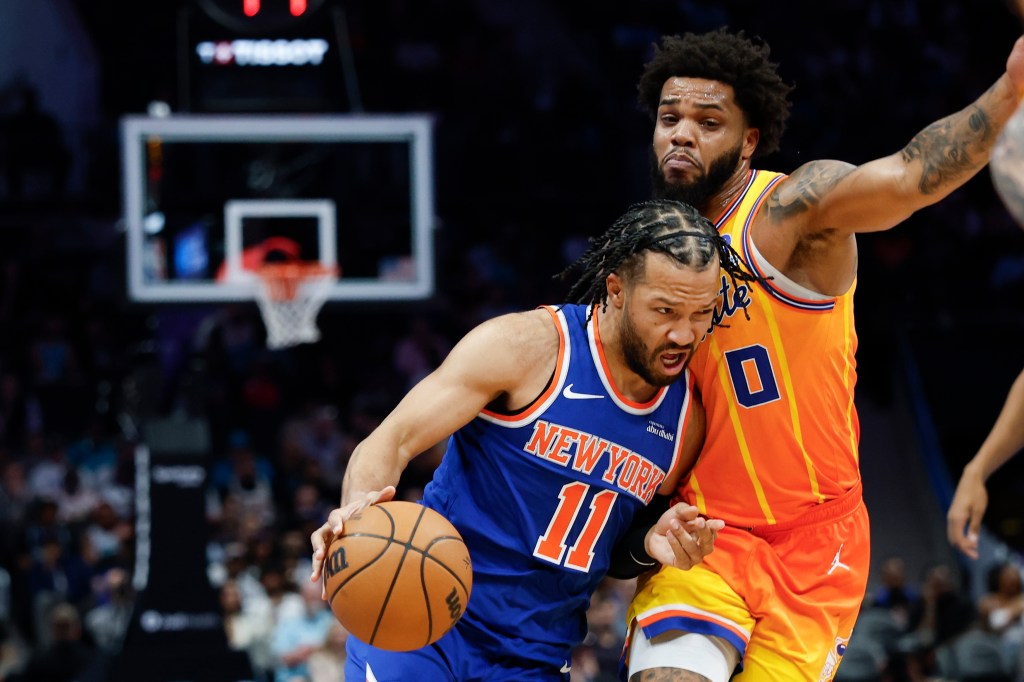
Brandon Miller is the smallest player in the Charlotte Hornets’ starting five. He stands 6-5.
Charlotte’s point guard, LaMelo Ball, is 6-7.
This is the direction of the modern NBA, and the Hornets offered a revealing case study in a 114-103 over the Knicks on Thursday.
Across the Eastern Conference, size has become the baseline, not a team-by-team luxury. Derrick White, a lanky 6-4, is the smallest piece in Boston’s switchable machine with the smaller Payton Pritchard adding pop off the bench. Cade Cunningham, at 6-5, operates as Detroit’s “smallest” player in its healthy starting five. Even the Atlanta Hawks deploy lineups with 6-7 Dyson Daniels functioning as the smallest player on the floor.
Length is no longer positional. It’s foundational.
The Knicks have gone the other way.
They’ve doubled down on small guards in a league that is supersizing at every position. Jalen Brunson, listed at 6-2, plays 35 minutes a night. The remaining minutes at point guard are split between Jose Alvarado (6-foot), Tyler Kolek (6-2), Miles McBride (6-2), or Jordan Clarkson (6-5), who isn’t a traditional floor general.
There are workarounds. Josh Hart (6-5) and Mikal Bridges (6-6) can initiate offense. In Mike Brown’s offense, the roles of players one through four are interchangeable.
But when the Knicks put a true point guard on the floor, they are conceding size — by design.
That tradeoff has always existed. It’s always been exposed.
But more and more teams are now rolling out lineups with no one shorter than 6-6 — groups built to switch everything, smother space, and turn size into pressure at every level of the floor.
The Knicks, by contrast, are asking skill, game plan discipline — and, of course, Brunson’s brilliance — to solve a structural problem.
The results have still been strong.
The Knicks are on pace to surpass Tom Thibodeau’s 51-win mark from last season — already the franchise’s best since Carmelo Anthony’s 54-win campaign in 2013. They’re doing it in Brown’s first year at the helm, following Thibodeau’s dismissal after the franchise’s first Eastern Conference Finals appearance in a quarter century.
But the bar has changed.
As owner James Dolan said in January, this season is about one thing: an NBA Finals appearance. Anything short of that — in an Eastern Conference thinned by injury — risks being viewed as a missed opportunity. Or worse, a reason to re-evaluate.
Because the window won’t look like this forever.
Tyrese Haliburton will return. Jayson Tatum will be fully healthy. Detroit is building confidence as a rising contender. Cleveland, already aggressive, could remain in the mix for another star. Miami is always one move away. The Wizards will spawn with an All-Star duo (Trae Young and Anthony Davis) after years in the lottery.
And now, the Hornets are coming. The path won’t get easier.
This might be the cleanest runway the Knicks will get, which is what makes the inconsistency harder to ignore.
The record says one thing. The eye test says another. And the gap tends to show up against teams built with the very blueprint the Knicks are betting against.
Take Charlotte. The Hornets entered as the East’s ninth seed yet were the most complete team the Knicks had faced in weeks. And the Hornets, if they continue to ride this hot streak, could see the Knicks in a No. 2 vs. No. 7 or No. 3 vs. No. 6 first-round playoff series.
Another test is coming.
The reigning champion Oklahoma City Thunder are up next, with 6-6 Shai Gilgeous-Alexander orchestrating the offense from the point. Even their “smaller” guards — Cason Wallace and Lu Dort — bring physicality and defensive bite.
Teams are taking the new NBA model and running wild with it. Teams except the Knicks, that is, who are betting on the engine responsible for fueling the franchise’s rise from the ashes of perpetual lottery seasons.
Because Brunson is the kind of leader you trust — unquestionably — to carry you as far as he can.
That’s the gamble.
The Knicks have built size everywhere else. They can play double-big with Karl-Anthony Towns and Mitchell Robinson. They can switch with OG Anunoby, Mikal Bridges and Mohamed Diawara. They can toggle lineups and cover ground.
But they are smaller at the point of attack — oftentimes, significantly.
And in a league where size is becoming the entry fee to contention, the Knicks are tasking a smaller guard with delivering the biggest prize.
That’s nothing new. Neither are the way defenses are guarding New York’s All-Star guard and write-in mayoral candidate.
The stakes? That’s a different story. Because in New York it’s Finals appearance or bust. And if they can’t win it in this wide-open of a race, there’s no telling when the next opportunity will come.