
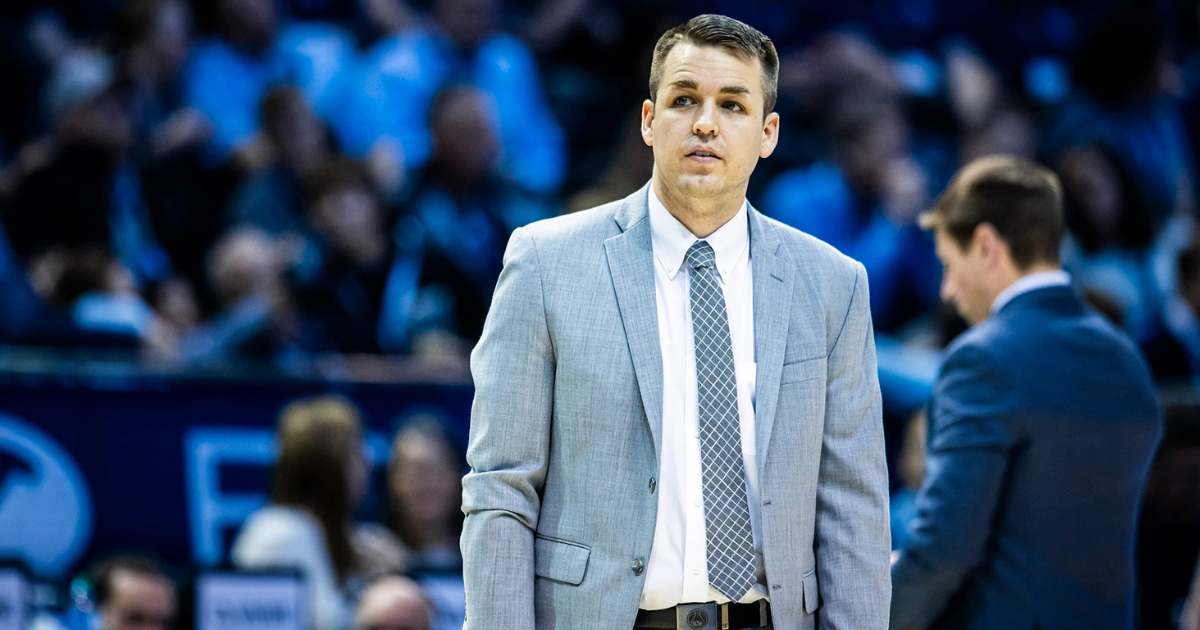
Keegan Brown started a new job last week as the Director of Roster Management at the University of Kentucky. Is that just a fancy title for General Manager? Maybe. Probably. But in this new era of NIL and the transfer portal, schools are molding front office staff in their own vision, rather than copy-and-pasting NBA job descriptions over to the college level.
Whatever you want to call the position, Brown is going to have a huge say in how the 2026-27 Kentucky basketball roster looks. So what is his philosophy? What is his approach to building a collection of players to compete for a national championship? Thankfully, Brown has been very forthcoming with his thoughts on this subject on his X account, and with the help of modern tools, I’ve combed through years of Brown’s posts and aggregated his thoughts on NIL budget management, analytics emphasis, and the types of players he prioritizes to help get an understanding of the type of team Big Blue Nation can expect moving forward.
In short, Brown embodies a data-driven, fit-first, value-oriented philosophy that emphasizes team chemistry over raw talent accumulation. Expect priority to be given to players who mesh with Pope’s system rather than chasing after star power. According to Brown, this strategy minimizes risk, maximizes on-court chemistry, and avoids the pitfalls of mis-evaluated high-cost additions, which are harder to project in college than in the NBA.
Kentucky fans, we are not in the John Calipari era anymore.
NIL Budget Management
Kentucky’s struggles this season were amplified by that daunting $22 million pricetag on the roster. Mark Pope’s squad was seemingly the only team in college basketball whose total payroll became public knowledge, and this nugget of information served as the everlasting gobstopper for not only haters to dunk on Kentucky, but also frustrated Wildcat fans to mock as well.
According to Jack Givens, Kentucky may have fewer funds to work with next year, but that is okay in Keegan Brown’s book. He views the NIL budget through a Moneyball lens rather than the Los Angeles Dodgers style of simply buying all the best players.
Brown sees NIL as a tool, not a strategy. He criticizes the obsession with how big a program’s NIL budget is, and pushes for smarter utilization. In one post, he illustrated this with a pyramid graphic.
Everyone is focused on how big a program’s NIL budget is.
But not enough are asking how it’s being utilized.
A few thoughts on why the best rosters aren’t the most expensive, they’re the most intentional: 👇 pic.twitter.com/2RstRrcbgt
— Keegan Brown (@Keegs32) August 1, 2025
The pyramid features three layers:
Base (foundation): Roster Planning + Identity
Middle: Targeting + Evaluation
Top (smallest): NIL Spending (Cap Strategy)
The message is clear: NIL allocation must sit atop a solid plan for team identity and rigorous player evaluation. Otherwise, it’s wasteful. The best rosters are the most intentional, not the most expensive. He advocates proactive salary cap modeling, scenario planning for NIL splits between high school recruits and transfers, and adjusting based on market factors, such as years with a stronger high school class and a weaker portal supply or vice versa. The ultimate goal is to avoid overpaying for poor fits or mis-projected talent, which reduces wasted dollars and frees resources for high return-on-investment additions.
Sounds easy, right? Don’t overpay for players that don’t fit your system, something that Mark Pope would be the first to admit he was guilty of this season. But who are these players?
Player Characteristics Brown Values Most
According to Brown, fit and situational alignment outweigh pure talent or NIL demands. Some of the most important player attributes include:
System and role cohesion: Players must fit cohesively together and make sense within a system. Complementary skills, chemistry, and scheme fit matter more than star power.
Honest self-awareness: Players should prioritize role, minutes, and development alongside (or instead of) NIL. This leads to better long-term compatibility.
Value and projection: High-floor contributors who raise the team’s ceiling without creating mismatches. He warns against coaches chasing public perception and talent over roster construction and fit, and has been critical of players seeking NIL dollars instead of the overall situation.
Brown prefers a roster built around identity with players who complement each other, rather than an amalgamation of guys with the best YouTube mixtapes. How does he identify these players? Data, analytics, and more analytics.
The nuance being that Roster Construction is at a premium going forward. Just bringing in talent for the sake of talent is a big gamble in this era of CBB. Making sure the players fit cohesively together and make sense within a system is paramount.
This is where GM’s will make… https://t.co/6fEco0XzJQ
— Keegan Brown (@Keegs32) February 20, 2024
How Brown Applies Analytics to His Evaluations
Brown views analytics as the core for filtering, evaluating, and decision-making regarding which players to pursue, especially in the chaotic transfer portal era. He uses data to:
Create custom filters: Brown applies analytics across all available players to flag high-value returns amid portal overload. Only afterward does he layer in film for further context. He admits numbers alone don’t paint the complete picture.
Drive recruiting, portal targeting, and NIL decisions holistically: Brown pounds the mantra of a data-driven approach into the ground, while also zooming out to look at the whole team instead of solely individual players.
Quantify efficiency: Brown uses tools like Synergy for shot quality and shot-making charts, heat maps (offense/defense tendencies), 3-point attack metrics, and Dean Oliver’s Four Factors.
Brown is especially keen on Dean Oliver’s Four Factors. According to Oliver’s book Basketball on Paper (which sounds exactly the type of tome that Mark Pope would view as basketball scripture), these four factors correlate most closely with winning: Effective Field Goal Percentage (40%), Turnover Percentage (25%), Offensive Rebound Percentage (20%), and Free Throw Rate (15%).
Brown describes analytics as the fastest way to raise a team’s ceiling and grab an extra win or two. It uncovers inefficiencies others miss, turning limited resources into competitive advantages.
With the limited resources college staffs have combined with how many players are in the Portal, you have to use analytics to filter through players.
With that said, there are many different filters that can be developed and put in place to customize what players get flagged for…
— Keegan Brown (@Keegs32) April 2, 2024
Translating this Philosophy into Kentucky’s Basketball Roster
The biggest takeaway from Brown’s posts is that he repeatedly stresses that bringing in talent for the sake of talent is a big gamble. He warns strongly against chasing public perception recruitment wins.
It is hard not to read that and not think of Tyran Stokes, the number one recruit in the 2026 class, whom Pope’s staff has long pursued. Depending on what happens at Kansas, he is still considering Kentucky. Stokes would undoubtedly eat up a good chunk of the NIL budget and bring with him a feisty reputation that toes the line of the type of personality certain teams would welcome. Based solely on Brown’s posts on X, Stokes embodies the type of risky player he tends to shy away from. Then again, maybe Stokes’ Four Factor data aligns perfectly with the Pope system. If Kentucky does continue to go hard after Stokes, it won’t be purely for the sake of talent and scoring a big fish recruiting win.
The more likely scenario is for Brown to target the Mason Williams of the world. Kentucky’s only 2026 commitment, Williams is ranked 124th in his class according to Rivals, but he averaged over 15 points in high school while shooting 60 percent from the field, 41 percent from 3, and 89 percent from the free-throw line. These are the type of efficiency numbers that data-driven Directors of Roster Management like Brown drool over. Williams also comes into Kentucky likely understanding his role as a freshman point guard slotted to back up a veteran coming in via the portal.
Just Win, Baby
Overall, not only are we entering a new era of college sports, but we are launching into a monumental shift in Kentucky basketball roster construction. No longer will the ‘Cats rely on star-studded freshmen to out-talent the competition, but instead, look for multi-year veterans who identify with Pope’s system and have been vetted through analytics filters.
Will it work? Time will tell. Both proponents and naysayers have fuel to argue their side of the coin. In 2024, Brown praised Syracuse for embracing this modern roster construction model, yet the Orange had a losing record the next two years. Instead, talent-rich Duke dominated the ACC.
Then again, Brown has been credited for assisting Pope in constructing his first roster at Kentucky and hinted that an analytics approach helped land a “game-changer” in Amari Williams.
At the end of the day, most Kentucky fans don’t care about a staff’s approach to acquire players. They just want to win and have fun doing it. If Brown can help hang banners inside Rupp Arena, students and middle-aged men alike will dress up like computer algorithms and hold up posters of shooting charts, heat maps, and Excel spreadsheets.
The most important statistic of them all is team wins.