
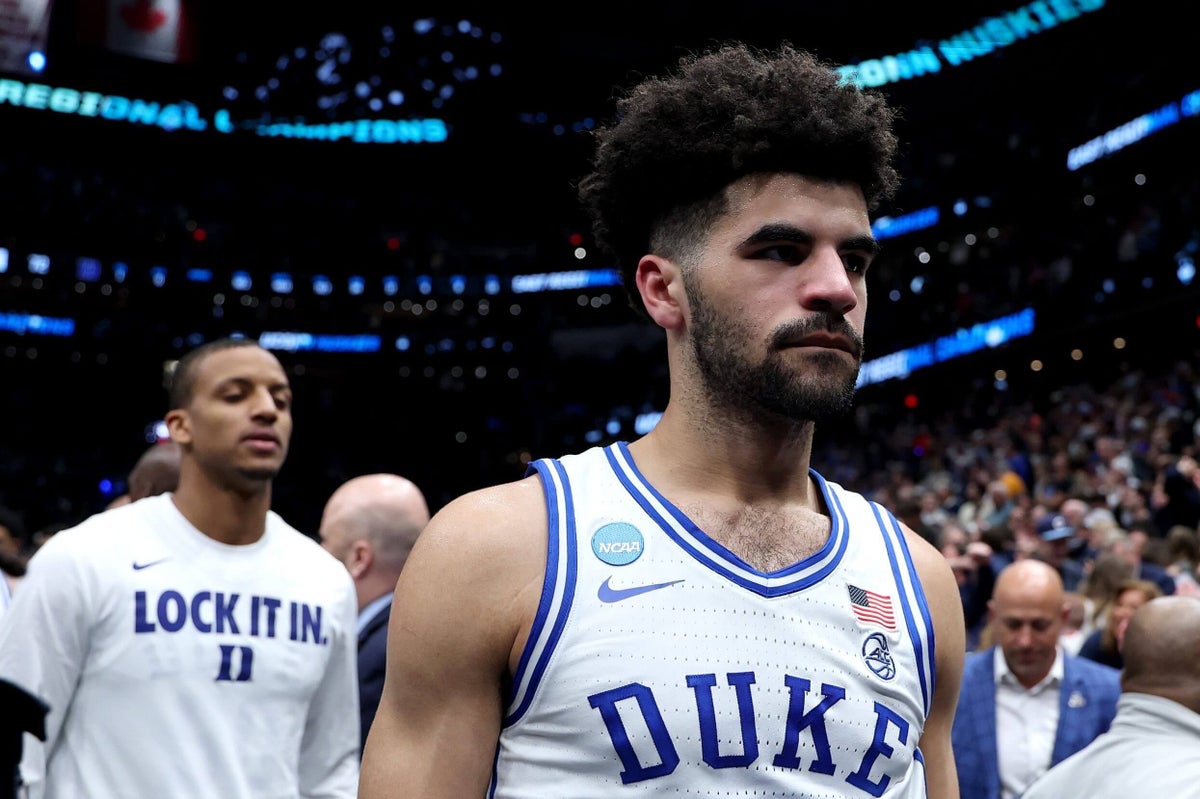
WASHINGTON — For a moment, he almost held it together.
Almost.
But then the bloodshot eyes started to water, again. The deep voice, cracking with every word.
“I ruined our team’s season,” Cayden Boozer finally choked out. “That’s the best I can put it.”
And though Boozer is certainly not solely responsible for Duke’s latest stunning postseason collapse — a 73-72 meltdown to No. 2 UConn in Sunday’s Elite Eight — his turnover with six seconds left will endure forever as one of the all-time bungles in the history of the NCAA Tournament.
As the final, fatal mistake in another epic Blue Devils collapse.
With Duke leading 72-70 with six seconds left, all the 6-foot-4 freshman needed to do was hold the ball and get fouled. Yet, he didn’t. Instead, he elevated and went for the home run pass, a heave over two UConn defenders at midcourt. But UConn guard Silas Demary Jr. tipped it, the Huskies recovered — and then the nightmare hit full-throttle.
Alex Karaban — already a two-time national champion — throwing a pass back to UConn freshman Braylon Mullins.
Mullins, lining up a prayer from the penultimate “S” in the midcourt MARCH MADNESS logo.
A long parabola, time seemingly stopped still — and then the swish of the ball through the net, inaudible as thousands of UConn fans roared to life inside Capital One Arena.
“We just have to secure it, right? We got it,” Duke coach Jon Scheyer said postgame. “They had a foul. I was ready for a timeout. We’ve just got to hold on.”
But Duke couldn’t. And instead, Sunday night became the latest heartbreaking season-ender under Scheyer:
NC State in the Elite Eight in 2024.
Houston, ending Cooper Flagg’s one college season last April in the Final Four.
And now, UConn, after leading by as many as 19.
Three unthinkable, unimaginable collapses, each more excruciating than the last.
“I don’t have the words,” Scheyer said. “I’m incredibly sorry for these guys that they’ve got to go through this. This is on us.”
It’s hard to process it any other way. With the collapse, Duke became the first No. 1 seed in March Madness history to lose after leading by 15-plus at the half; until now, teams were 134-0 in such scenarios. Furthermore, UConn’s comeback is the second largest in Elite Eight history, only a point behind Louisville’s 20-point rally in 2005.
For Scheyer, it’s another unthinkable defeat snatched from victory, and one that will follow him for the remainder of his career.
No matter that Duke won 70 games over the last two seasons, more than any previous two-season stretch in the program’s rich history. No matter that it has had consecutive generational freshman superstars, in Flagg and Cameron Boozer, both of whom deservedly won National Player of the Year. No matter that Duke lost only three games this season — by 5 combined points, somehow — and tied the all-time record for regular-season wins over ranked foes, with 11.
All that matters is what was — and then quickly, stunningly, wasn’t.
It is easy, of course, to start at the end. With Duke’s final possession, one which will be Zapruder-ed for years and years to come:
Why didn’t Scheyer have Isaiah Evans — Duke’s best free-throw shooter this season — back as an inbounds option?
Why didn’t Cayden Boozer just hold the ball?
Why did Scheyer have his team keep passing, rather than attempt game-clinching free throws?
But in reality, the Blue Devils’ crumble began well before that fateful final possession. Remember: The first 15 minutes were practically a parade, the return of “Death Star Duke,” which swept the ACC regular-season and tournament championships while surpassing last season’s all-time squad in the advanced computer metrics. After lingering injuries to Patrick Ngongba and Caleb Foster, it appeared that Scheyer’s team had weathered the storm and was 20 minutes from strutting to Indianapolis with all the momentum in the world.
After taking a 19-point lead about four minutes before halftime, though, the wheels started to wobble. UConn cut it to 15 at the break, and Ngongba’s ill-advised 3 on the team’s final possession was proof that the Huskies’ backbone was still intact.
That became even more palpable after intermission, as the physicality switch flipped on the UConn sideline. Dan Hurley’s team suddenly punched first and second, drawing fouls at a prolific rate and forcing Scheyer to toggle his frontcourt duo of Ngongba and Maliq Brown. In many ways, it was a wise scouting move on Hurley and his staff’s part, using the same strategy that Texas Tech and North Carolina had employed earlier this season to come back from down double digits against Duke. Nobody was more key to those efforts than UConn center Tarris Reed Jr., the eventual Most Outstanding Player of the East Region, who single-handedly carried the Huskies in the first half en route to a team-best 26 points and nine rebounds.
“We came out a little flat and gave them a little bit of life,” said Cameron Boozer, after likely the final game of his storied one-year college season. “When you’re playing a team as good as UConn, that’s all they really need.”
And then came the 3s, UConn’s swing skill this entire season. The Huskies had made at least five of them in every NCAA Tournament game but started 1-for-18 from deep Sunday, struggling to get quality looks over Duke’s length.
Until Demary drained consecutive corner 3s, that is — one from each side of the court — to shrink Duke’s cushion down to a mere 7 points, with just over six minutes to play.
By that point, something was definitely in the air.
But that’s what makes the final result so unbelievable, even in the aftermath: Because Duke still had every opportunity to win — to make its second straight Final Four, the first time the program would’ve done so since Mike Krzyzewski’s heyday in the early 1990s. With 1:20 left, after Solo Ball hit 1 of 2 free throws, the Blue Devils still led by 4, with the ball, with all their goals intact.
It’s at that point, though, that the ultimate meltdown began.
A full-on unraveling.
Cameron Boozer — who finished with 27 points, eight rebounds and four assists, not to mention a gnarly black left eye after taking a forearm to the face — turned it over driving against Reed, one of his four giveaways Sunday. Then he got buried on a screen by Reed, which freed up Karaban for his only 3-point make of the night.
It was Duke 70, UConn 69.
Anyone’s game, up for grabs, for whichever side was going to take it.
Which, temporarily, looked like Duke after Boozer’s spinning layup with 28.9 seconds left that made it a 3-point game. For all the drama, all the mistakes, all the anxiety swirling inside the arena, the Blue Devils were still in position to win.
With 10 seconds left, Boozer fouled Demary, who made one of two shots.
One more inbounds pass — just like against Houston last season — and Duke could all but run out the clock.
Or, do that.
Implode, cementing the sixth-worst blown lead in NCAA Tournament history. (Tied for sixth-worst, technically, with rival UNC, in the first round earlier this month.)
“I wish,” freshman Nik Khamenia said, “we would have done a better job.”
But Duke didn’t. It’s the most painful part of the college basketball postseason: There are no do-overs.
The best team, with the best player, does not always win. A team that led for 19 minutes and 59.6 seconds in the second half does not always win.
A team that had gone 8-2 in two-possession games this season — seemingly overcoming its recent history of collapses — can revert to its worst habits, at the worst possible time, and see its season end in a snap.
In silence, really. In a postgame locker room with pizzas being delivered to one corner and reporters shuffling quietly from locker to locker. In that unimaginable limbo, when reality hasn’t quite sunk in yet.
The last moments before a team realizes it’s all over.
That realization seemed to hit Cayden Boozer 45 minutes after the worst moment of his young career. He clenched his hands on a towel draped across his knees, tapping his feet, before answering the final question that busted open the dam:
How are you feeling right now?
Until then, he’d held it together.
Until then.
“Terrible.”