
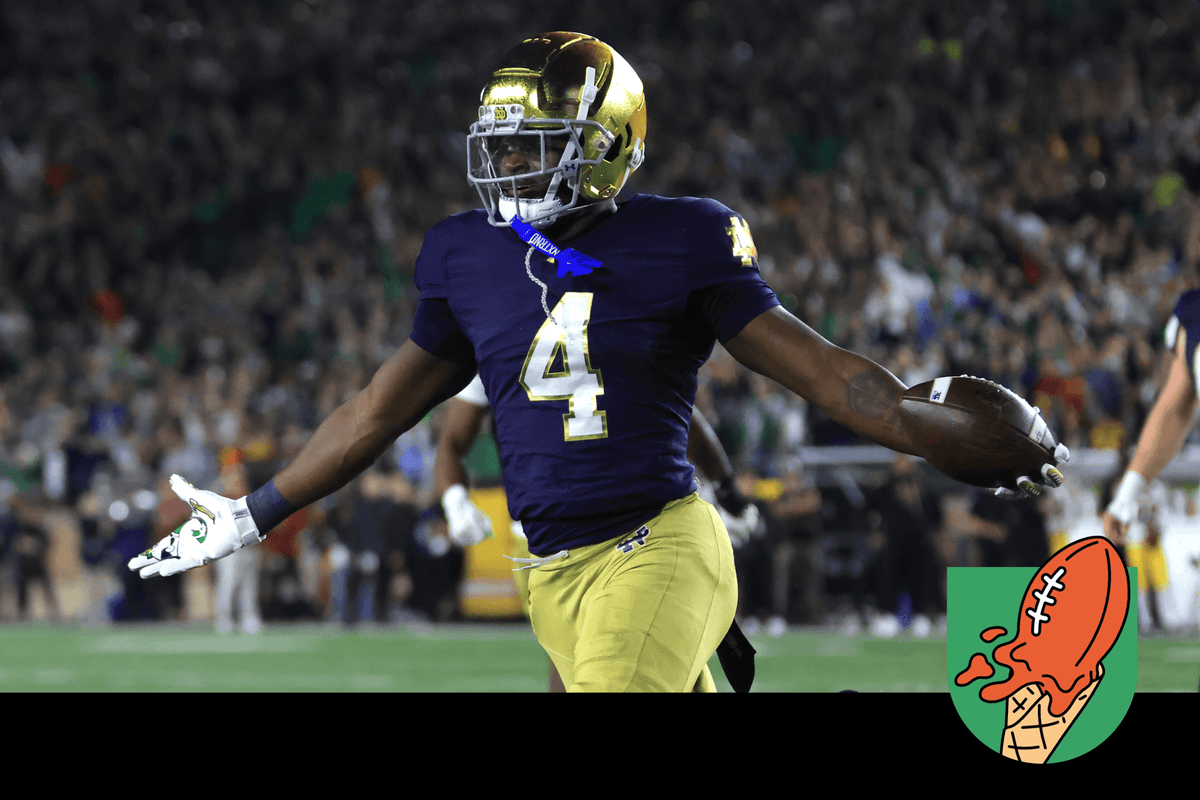
This year, everyone agrees Jeremiyah Love is an excellent running back and one of the top prospects.
In 2025, he averaged 137.6 total yards and scored 21 touchdowns in just 12 games for Notre Dame, finishing third in Heisman voting. He’s Dane Brugler’s No. 3 prospect, and Nick Baumgardner has Love as the best player in this class. Here’s Nick:
💬 “Love has a blend of power, balance and acceleration that is among the best we’ve seen in years. He is a more complete prospect than Ashton Jeanty was in 2025 and is at least as good (if not better) than Bijan Robinson and Jahmyr Gibbs were in 2023.”
Yet no one can agree on where Love should be drafted. Do you draft an elite running back in the top five? Among the first 10? In the first round at all? There are a few considerations.
Inside: Could Jeremiyah Love not be a top-10 pick? Plus: Why we might get replacement officials in 2026 and Dianna also shares what she’s hearing at league meetings.
This article is from The Athletic’s NFL newsletter. Sign up here to receive it directly in your inbox.
Four reasons running backs aren’t drafted early
NFL people rarely agree on much. The draft is no exception. Sure, top quarterbacks almost always go No. 1, and pass rushers often follow. But drafting a running back in the first round? That really depends. Here are four reasons why they’ve fallen out of favor.
1. Draft capital.
Teams don’t use first-round picks on running backs like they used to. In the 1970s, more backs were drafted in the first round than players at any other position. That trend mostly continued until a drop-off in the early ’90s, followed by another sharp decline in 2011. Draft stock has continued going downhill since.
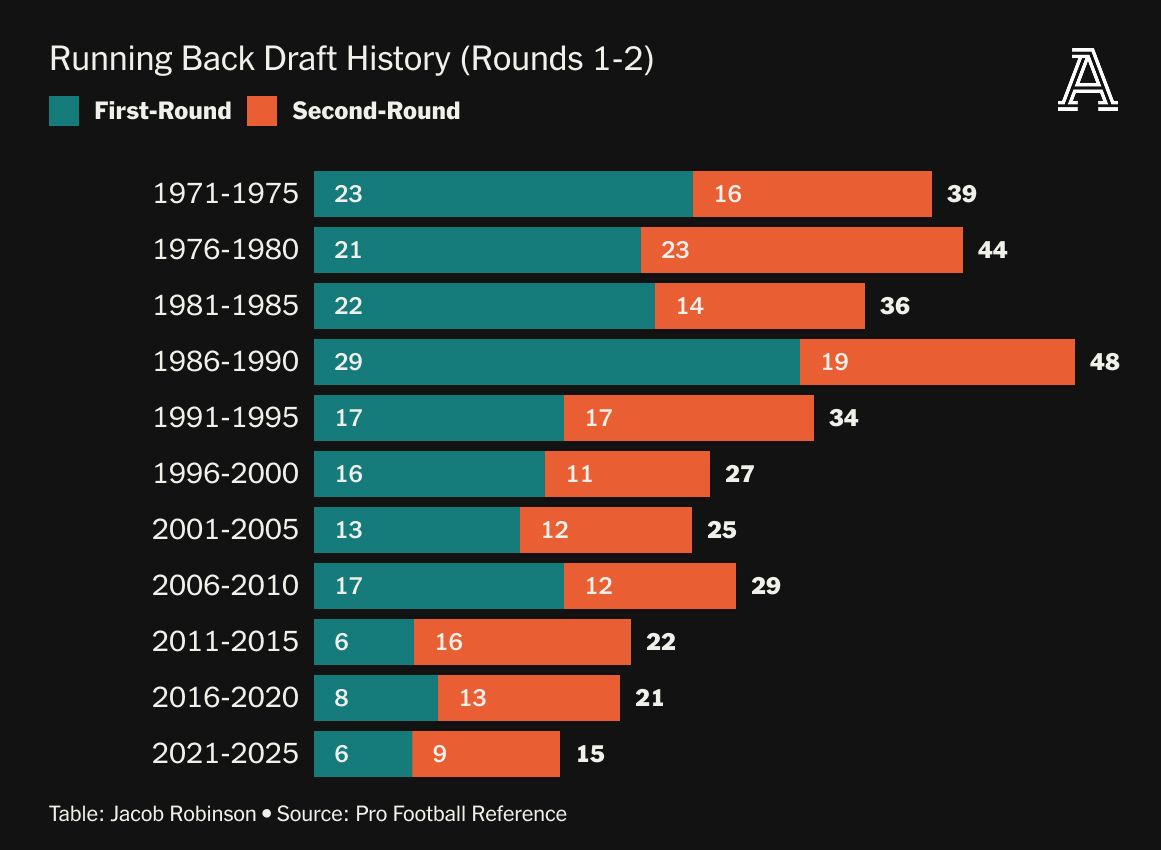
The why behind this trend seems obvious — the modern NFL is a pass-first league — but is more nuanced. My colleague Dan Pompei explained the details here, as did ESPN’s Bill Barnwell here. At a high level, it’s because of evolved rules, schemes and committee approaches, plus poor results from second-contract running backs like Todd Gurley. Which brings me to the next point.
2. Longevity.
In 2011, the rookie wage scale was introduced as part of that year’s collective bargaining agreement between the players’ union and league. It decimated the value of running backs in particular. An example:
Prior to that CBA, the Saints drafted Reggie Bush with the No. 2 pick and signed him to a six-year, $62 million deal. Each team’s salary cap that season was $109 million. A large pizza cost me $10.
Eighteen years of inflation later and the price of pizza has doubled. The NFL salary cap nearly tripled. Yet Ashton Jeanty’s first-round rookie deal pays him 15 percent less than Bush got in 2007. Bush’s average still ranks among the 15 highest-paid running backs ever.
Every position was affected by that rookie discounting, sure. But not equally. Running backs took the biggest hit because their most productive years are their earliest — the point at which the CBA stripped their bargaining power. Other players peak around age 27 or later.
That could arguably make drafting certain running backs more valuable, since you’re likely getting their best years. But free agency further changes the math.
3. Free agency.
Imagine the quarterback equivalent of 2024 free agent Saquon Barkley. Drafted high, showed immense production and had injury concerns. That’d be … a free-agent Joe Burrow?! No team in its right mind would’ve let him hit the open market.
The same is true with other premium positions like pass rusher, receiver, tackle and cornerback, which is why we saw pricey trades (or attempted trades) for Maxx Crosby, Jaylen Waddle and Trent McDuffie. But running backs? Just find somebody in free agency, like Barkley or reigning Super Bowl MVP Kenneth Walker III.
Since you can add top running backs via the open market, their rookie-contract discount is less enticing. It’s more economical to use your draft picks on premium positions instead. This chart compares the average per-year pay for the top 10 veterans at each position to the pay a top-10 2026 draft pick would receive:
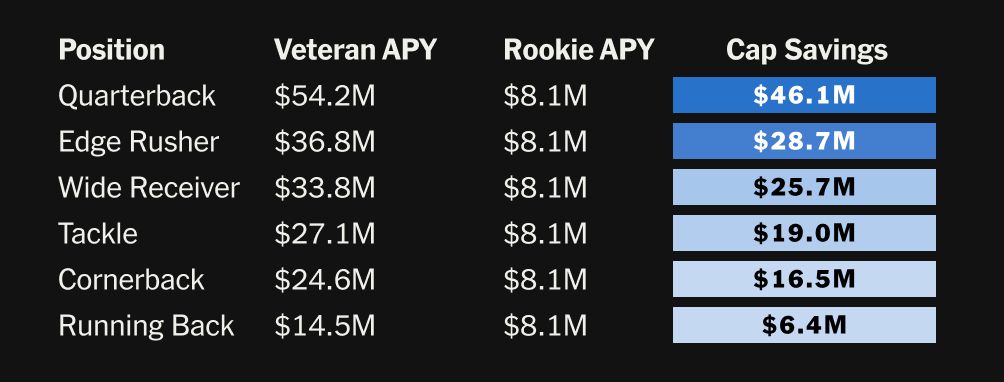
Those savings are significant. A rookie-contract quarterback frees up enough to pay a receiver like Ja’Marr Chase. Having the same at edge rusher could mean affording the league’s best tackle, Trent Williams.
Meanwhile, drafting Love in the top 10 would net you a measly $6.4 million in cap savings over signing one of the best veterans at his position. Only enough to sign a receiver like Tyquan Thornton or Olamide Zaccheaus. Oof.
4. Analytics.
A fourth reason for the sharp decline in RB draft status was the widespread acceptance of football math in the 2010s. Number-crunchers found the effectiveness of rushing offense to be largely scheme-dependent, which made the rushers themselves feel replaceable.
It also became obvious that the teams who were spending premium draft capital on running backs were not improving. Since 2010, nine running backs have been drafted in the top 10. Seven of those nine teams had losing records in the ensuing four years.
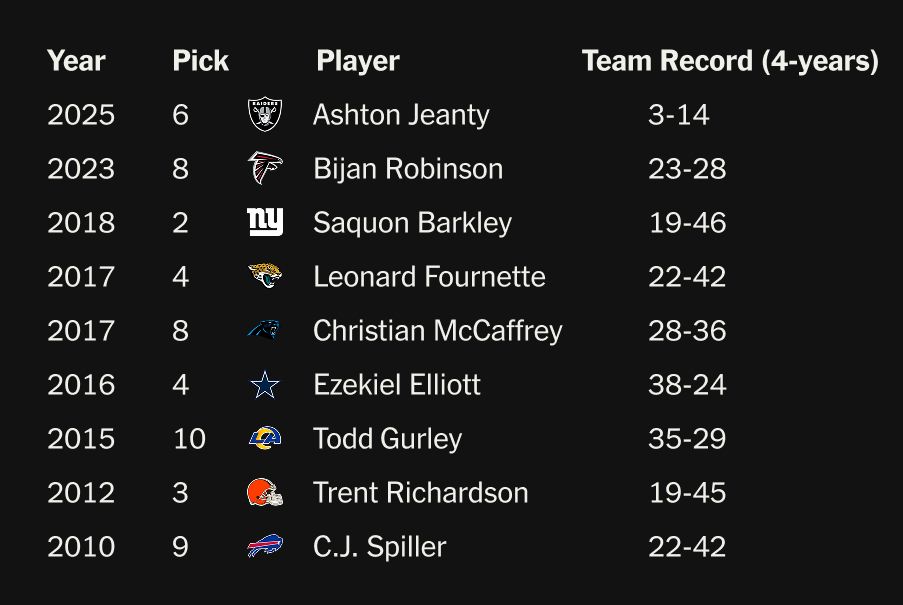
It gets worse. Look at who was still available when these running backs went off the board:
The Panthers took McCaffrey a few spots before the Chiefs drafted Patrick Mahomes.
The Giants drafted Barkley one slot ahead of Sam Darnold and five before Josh Allen.
Eagles defensive standout Jalen Carter went No. 9 in 2023, one pick after the Falcons took Robinson.
Would the 2026 Raiders rather have Jeanty or Jaxson Dart?
Which brings me to the original question — how early should you draft a running back?
Even if Love is as good as advertised, much like Barkley, McCaffrey, Robinson and Gibbs have been, the infrastructure matters. Outside the top 10 seems like a logical move. Our most recent beat reporter mock draft agrees; Love falls to the Ravens at No. 14.
But the Titans, holders of the No. 4 pick, desperately need weapons. It has to be tempting, given this draft lacks star power. Then again, that type of thinking is why bad teams stay bad. What should talent-needy Tennessee do?
As for a bigger question …
Why might we get replacement refs in 2026?
My first-ever job was being a linesman for a men’s under-50 soccer league. I was 12. The head ref failed to show up for my debut, so my career started as a co-head official with the other linesman. “Are you f—ing blind!?” was the first thing one of the men yelled at me. I won’t repeat the others. I was 12.
I know officiating is hard, yet I still yell at NFL officials through my television screen. I might get much worse in 2026, given that stalled negotiations have the league planning to hire replacements.
How did we get here? Officials are represented by the NFL Referees Association, which has a collective bargaining agreement with the league. It expires at the end of May.
And if a deal isn’t reached? Lockout. It happened in 2012, with both sides holding out until the Fail Mary broke the league’s resolve in Week 3:

The labor dispute was solved two days later.
So how does it get resolved this time? It’s simple: We wait for another on-field disaster, unless the big sticking points are resolved earlier. Here’s what’s at issue:
Money. The NFL reportedly offered a 6.45 percent annual increase for officials, who paid an average of $350,000 per season in 2025. The NFLRA wants an annual increase of 10 percent.
Training. The league wants greater accountability for officials and additional offseason training for poor performers. Seems fair.
Assignments. The officials’ union wants the NFL to use a seniority-based system to determine postseason assignments, rather than basing those selections on performance.
Talks have been ongoing since the summer of 2024. Not good. Based on what’s been reported, I have to side with the league on the latter two. We have plenty more details unlocked for you here.
What Dianna’s Hearing: Rams talk trades
Greetings from Arizona, where Rams coach Sean McVay confirmed he engaged in trade talks for receiver Davante Adams. Ultimately, McVay said the team decided against dealing the 33-year-old, and that “We are glad he’s a Ram.”
McVay also said that Los Angeles is looking at veteran options like Jimmy Garoppolo and Kirk Cousins as potential backups to Matthew Stafford. Look for more comments from McVay and his fellow coaches over the next few days from the annual league meeting. Back to you, Jacob.
Extra Points
🏈 Yes, Tom Brady inquired with the NFL about returning to play. “They don’t like that idea very much. We explored a lot of different things.” The minority owner of the Raiders added that he’s happily retired. As if.
👀 Best free-agent fits. Saad Yousuf shares the best landing spots for remaining big names, including ideas like Tyreek Hill returning to Kansas City and Cousins mentoring likely No. 1 pick Fernando Mendoza.
🚨 Falcon in trouble. Atlanta sent its 2026 first-rounder to the Rams in order to draft edge James Pearce Jr. last year. His future is uncertain amid felony charges after an incident involving his ex-girlfriend, WNBA star Rickea Jackson.
▶️ Last week’s most-clicked: Bruce Feldman’s story on the legendary pro day of Randy Moss. “However fast you think he is, he’s faster.”
📫 Enjoyed this read? Sign up here to receive The Athletic’s free NFL newsletter in your inbox.
Also, check out our other newsletters.