
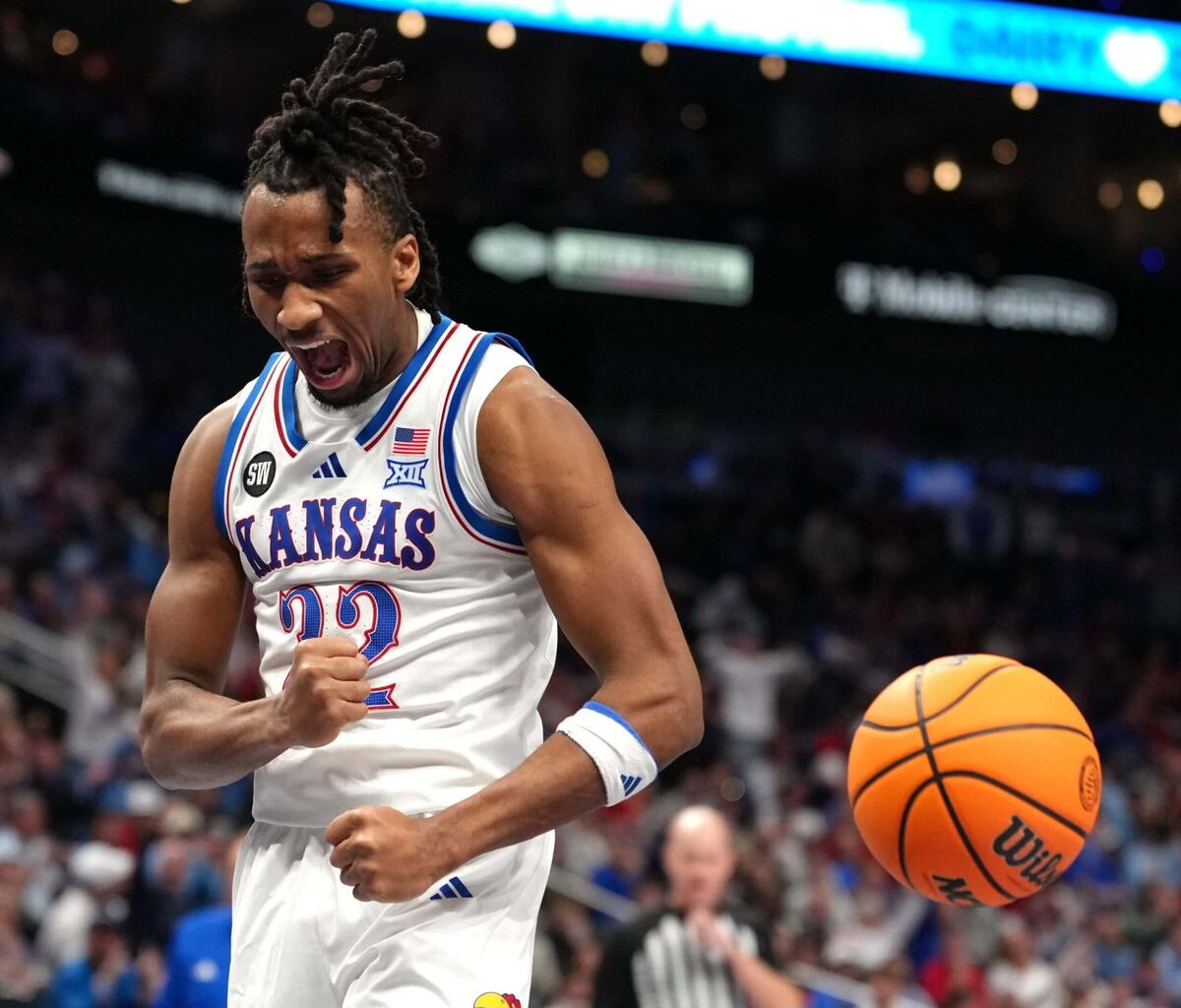
The day that turned the fairytale into a complex drama has been on the mind of Darryn Peterson and those who care about him all season. Bill Self’s annual boot camp is a rite of passage in the Kansas program. No basketballs, just conditioning. Get through that and you’ll be ready for anything.
Peterson survived, but the next week, after a regular, normal practice, he crashed.
Full-body cramps. Forty-five minutes of pain like he’d never experienced before, so bad it sent him to the hospital, where he received two IV bags of fluid and was left wondering what had just happened to him.
“It was a traumatic experience,” Peterson said.
That day has hung over his much-anticipated freshman season since. Eleven games missed. Many others he left early. Yo-yo’ing in and out of the lineup. Every game feeling like Groundhog Day. Peterson would look great for a half, then the second half would start and his legs wouldn’t feel right. Was it happening again? He’d signal to come out of the game.
“As much as I tried to fight it and tell myself I was good, I kind of couldn’t,” Peterson said. “The mind is the joystick, my dad tells me. You can’t beat your mind.”
It wasn’t just the cramps either. He caught a bug in December. Then a sprained ankle in January. Then flu-like symptoms in early February before a much-anticipated game against top-ranked Arizona, his motivation getting called into question because he’d warmed up that night and then disappeared to the locker room.
A narrative took shape for the player who entered the season as the favorite to be the No. 1 pick in June’s NBA Draft. What’s with this guy? Does he really care? Should NBA teams be worried?
“The stops and starts definitely impacted him,” Self told The Athletic. “Conditioning, rhythm, team rhythm, a lot of things. I think it did impact him differently. If you can imagine going into every game believing that this is going to be the game in which your body feels right, and it just didn’t happen.”
Through most of it, Peterson and his family — who had a role in his return from injury, Self said in December — stayed silent. Peterson appeared at several postgame news conferences but his answers were brief. The context to his story was missing. It left everyone to draw their own conclusions. And the pressure seemed to intensify in mid-February once national pundits like ESPN’s Stephen A. Smith started to weigh in.
“I think it’s been a hard year for him, and a lot of it’s been because obviously his body didn’t feel as well. That’s all legitimate,” Self said. “But also the narrative that some people put out, not believing that he was struggling? His body was not cooperating. And I think that was hard on him, even though I don’t know that he would admit to it.”
Self speaks in the past tense, because the last few weeks have (sort of) been normal. Peterson hasn’t asked to come out of a game since a Feb. 18 win at Oklahoma State, when his visible signal to the bench took the scrutiny to a fever pitch and even seemed to leave Self surprised. But the Jayhawks are just 3-4 over that stretch. There have been a few snippets of everything clicking — for Peterson and his teammates — and other moments where the Jayhawks look like they just started playing together.
Peterson has just one season at Kansas to make his mark, which those close to him say is important to him that he does.
But the top of the hourglass is almost empty. The NCAA Tournament begins this week. Kansas starts with 13-seed Cal Baptist on Friday in San Diego, then faces a potential matchup with Rick Pitino and St. John’s to even get out of the first weekend.
Last Friday night, as Kansas struggled to score against Houston, Peterson’s mom stood up behind KU’s bench and pointed at her watch.
“It’s time,” Peterson said.
Self couldn’t contain himself. When Peterson arrived in Lawrence this past summer, he was so good that Self started using hyperbole he usually tries to avoid with freshmen, calling Peterson the most prepared player for college basketball he’d ever coached — a list that includes Joel Embiid, Andrew Wiggins and Deron Williams.
Peterson looked like the type of player capable of delivering Self his third national championship at Kansas. He could at least erase the stench left by last season, when KU lost 13 games and exited in the first round of the NCAA Tournament for the first time since 2006.
At one of his first summer practices, Peterson stole the ball on three straight possessions. On the first one, he got a dunk. On the second, he hit a pull-up 3-pointer. And on the third, he threw a lob to Flory Bidunga.
“He was just totally unfazed by any of it, because it felt normal to him,” said Kansas Evans, a junior team manager at KU. “Like yeah, he really does that. That was just regular for him.”
Self and KU had little reason to be concerned about his physical ability. Peterson had just come off a breakout season at Prolific Prep, one of the top high school basketball programs in the country in Napa, Calif. Prolific Prep coach Ryan Bernardi called his senior season a “year-long honeymoon.”
In head-to-head meetings, Peterson outdueled BYU’s AJ Dybantsa and Duke’s Cameron Boozer, once scoring 61 points on Dybantsa’s Utah Prep. He vaulted above the two players who were once ranked above him and was considered the star of what has proven to be a historically good freshman class. And favorite to go No. 1 in the 2026 draft.
“Darryn was already kind of in a world of his own,” an NBA scout said. “Then the conversation was, AJ’s probably (number) two, or maybe Boozer, but Darryn was in a different field.”
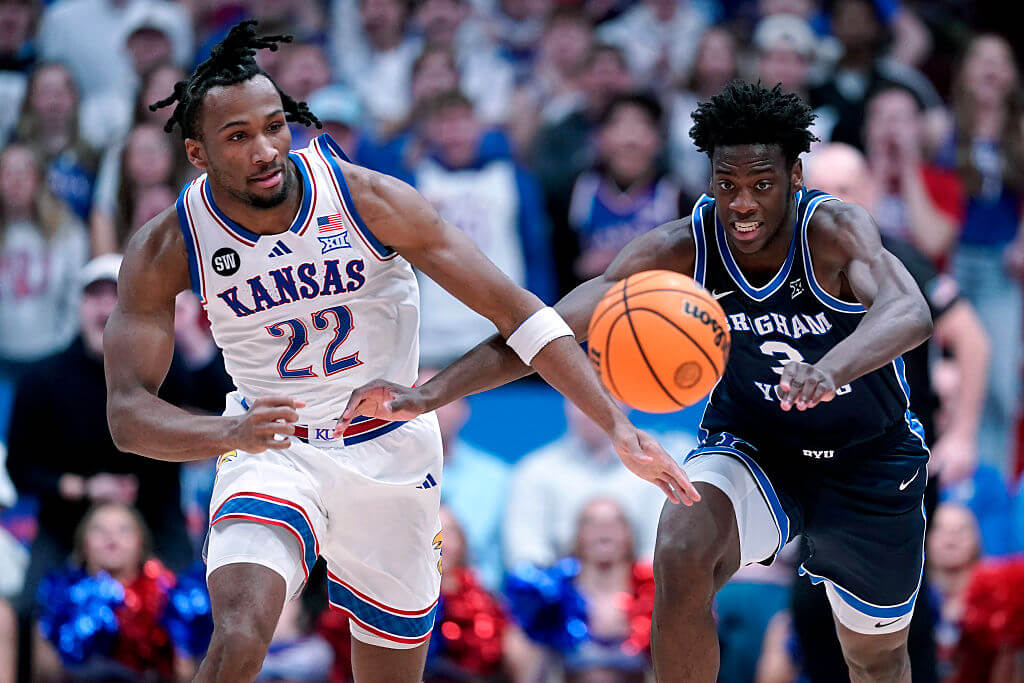
Darryn Peterson moved ahead of AJ Dybantsa in the 2026 class with a strong senior year of high school. (Ed Zurga / Getty Images)
The narrative about his commitment didn’t yet exist. In August 2024, Peterson attended Damian Lillard’s Formula Zero Elite camp in Phoenix, Ariz. Peterson arrived two days early for a workout he was able to organize with Lillard and Lillard’s trainer, Phil Beckner.
After the workout, Beckner drove Peterson and his dad back to their hotel and Peterson asked if they could do it again the next day. Lillard was taking the day off to get ready for the camp, so that wasn’t an option.
“No, no, no,” Peterson said. “I’m not worried about working out with Dame. I need to work out with you again.”
“And I was like, holy cow, number one kid in the country, these guys usually come in with all kinds of arrogance, entitlement,” Beckner said. “So I put him through a workout. Kicked his ass.”
Peterson was so committed that he convinced Beckner to break his “only pros” rule and train him consistently.
Bernardi was asked if Peterson ever cramped up at Prolific. “One time,” he said, in the first game against Dybantsa. “Toe cramp.”
Peterson ate a mustard packet and then checked back in and made two big buckets down the stretch, and it was never an issue again.
There were no issues this summer, either, when Peterson spent several weeks in Phoenix with Beckner, and once again, “I killed him,” Beckner said. “The pace and the purpose of all our workouts were probably higher than any other high school or college kid who has been around our training program in the offseason. Hard, hard, hard, twice a day, and we didn’t have any issues.”
The honeymoon period at Kansas continued all summer, up until the September cramping incident. Since then, nothing has quite been the same.
Details about the aftermath of Peterson’s full-body cramping incident are still scarce; Self declined to talk about it, citing HIPAA. But the lingering effects on Peterson’s mind, the ones he spoke about for the first time last week, were apparent early.
About four minutes into the second half of Kansas’ season opener, it set up a play for Peterson: a flare screen by Bidunga, who caught a ball reversal and turned to hand the ball off to Peterson. But one step off that original screen, Peterson paused, walked gingerly away from the ball and pointed to send it in the other direction. On the other end, Peterson looked at the bench and tapped his chest, asking out of the game. Twenty seconds later, Self called timeout to check Peterson out and he’d never return.
That moment went overlooked, but as the games got bigger later in the year, Peterson checking himself out of games and sitting in crunch time became a national story.
Against BYU on Jan. 31, a huge stage because it was billed as the showdown between Peterson and Dybantsa, Peterson was spectacular in the first half. He showed a little bit of everything, an isolation mid-range jumper against Dybantsa, 3s off a pull-up, spot-up and flying off a screen, and then, his wow moment of the season, a posterizing dunk on the head of two BYU players.
Then, halftime, and … the signal.
Not even three minutes into the second half, Peterson missed a 3, went back to play defense and asked out of the game. The Jayhawks won, and he had 18 points, but the noise started to get louder, from both fans and media alike: Why wasn’t he trying to go back in the game?
Three weeks later, when it happened against Oklahoma State — Peterson making a 3 in front of the KU bench and turning to ask out of the game, easily seen on TV — more pundits weighed in, specifically, Smith and Kendrick Perkins on “First Take.”
“(His) agenda is not playing college basketball,” Perkins said at the time.
Self even seemed surprised by what happened against Oklahoma State. For the first time, he appeared a bit exasperated after the win.
“I thought we were past it, but obviously we’re not,” Self said. “It’s certainly a concern.”
Self has also been quick to defend his player. When Peterson missed an early February game against Arizona because of illness, Self pushed back, starting to provide some context — including that Peterson had only practiced one day in the nine days leading up to the BYU game because of his ankle.
“The thing about it is, when you’re honest, people don’t believe you,” he said in February. “And when you don’t comment on it, people create their own narratives. And you know what? I do the same thing about things I don’t know about. ‘Well, it must be this.’ ‘It has to be that, if they’re not going to talk about it.’”
Beckner, Peterson’s trainer, visits him twice a month, and they also study film on video calls the night before every game. In recent weeks, Peterson has met while hooked up to an IV to get extra fluids in hopes it will keep the cramps away.
That version of Peterson lines up with the one those around KU’s program talk about.
“He’s very selfless. He’s about the people around him,” Evans said. “The conversation rarely steers towards himself or what’s next for him. It’s more focused on today. What are we doing today? What does practice look like for us today? How are the managers today? He never steers the conversation towards himself or what his focus is next.”
Peterson has pushed back on anyone who suggests he’s just looking ahead to the NBA or only cares about where he’ll be drafted: “I’m big about being where my feet are.”
Because Peterson is stoic on the floor and on the bench, especially in the games when he’s checked himself out and not returned, that has led some to question if he really cares.
But Peterson shows his commitment through his work, Self said. “The number of treatment hours and all the extras that he’s put in to put himself in a position to feel better, it’s been exceptional,” he said. “It’s as good as we’ve ever had here. He wants it bad.”
KU assistant coach Jacque Vaughn said he’s suggested to Peterson that he dial it back some throughout the year to conserve his body.
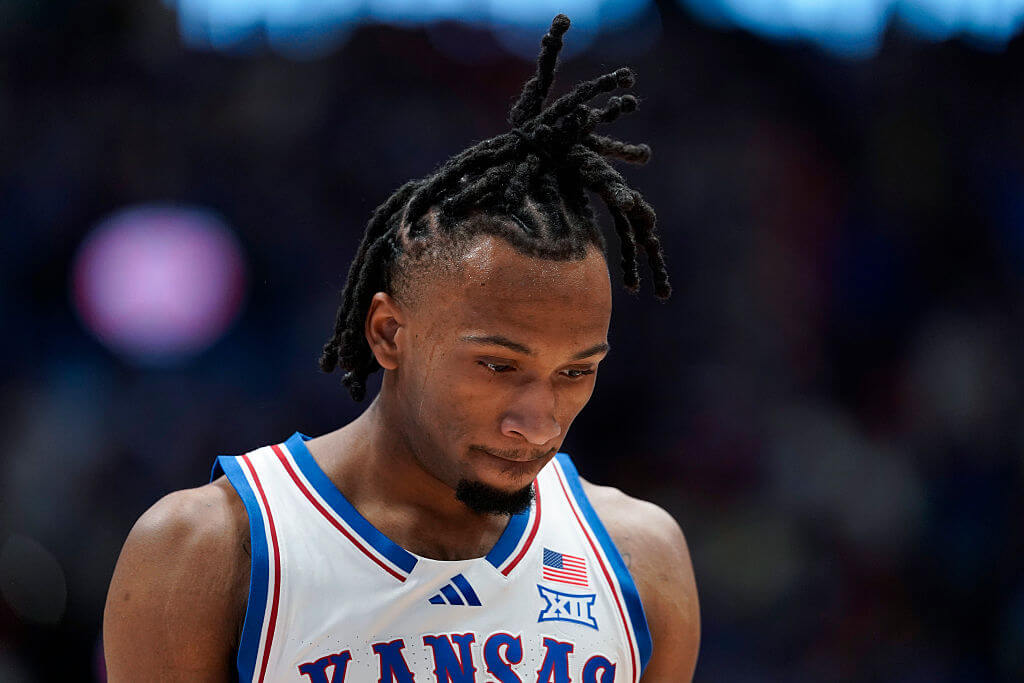
Darryn Peterson has finally gotten a steady run of healthy games, but Kansas enters the NCAA Tournament just 3-4 in its last seven. (Ed Zurga / Getty Images)
Evans said Peterson has the most professional routine of anyone who has ever entered the program. “We’ve had a lot of guys in my three years that have worked really hard,” Evans said. “But I don’t know if anybody’s had quite the routine he has or been quite as consistent with the same little details on a daily basis as I’ve seen with him.”
Part of that routine: Taking the managers out to eat after every time they rebound for him. Hour-long ping-pong sessions with the managers after practice also happen with regularity.
“He knows who’s there for him and who he can trust,” Evans, the student manager, said. “And he is comfortable opening up around those people. He’s not too big-time. He knows that he’s good and he knows he has expectations, but he doesn’t let that interfere with his ability to just be kind to others.”
Peterson’s personality hasn’t really been on display because he’s rarely gone in front of the cameras this year, but the narrative is slowly changing, helped by the fuller version he shared in an interview with The Athletic last week in KU’s locker room.
Mostly, though, it’s on the floor where Peterson can really change the narrative.
NBA scouts trust their eyes, and they say there’s a difference between Peterson’s high school days and now. At Prolific Prep, Peterson got to the free-throw line more often than he has this season, got to the rim more often, and was much more efficient once he got there. When Peterson got around a defender last year, he was creating separation.
Now that defender is often staying on his hip.
It’s almost like Peterson hasn’t fully been able to step on the gas.
“He wanted to be out there so bad, he tried to pace himself,” redshirt sophomore Jamari McDowell said. “I told him, don’t do that. Everybody had told him, don’t pace yourself. You’re just going to hurt yourself. His health is getting better for sure. He’s obviously looking better.”
In flashes, Peterson has. He had arguably his most impressive outing yet against Kansas State in the regular season finale, scoring 27 points on an efficient 10-of-15 shooting. Peterson wasn’t as efficient shooting the ball in the opening round of the Big 12 tournament (5-of-17), but it was a throwback to high school in his ability to get to the line, making 13-of-16 free throws. Then came the Houston game, where all of the Jayhawks looked broken, including Peterson (14 points on 3-of-11 shooting).
“I’m still getting in shape,” Peterson said. “I haven’t played as many minutes, so you probably tell that by the shots that I’m missing. A lot of easy shots that I usually make, I miss now. I’ve missed a lot of games, so people have a lot more games than me, so I’m still adjusting.”
FT Rate% of FGA at rimRim FG%
2024-25 (at Prolific)
46.9
31.9
69.7
2025-26 (at KU)
37.9
20.2
59.4
(Table source: Synergy)
Beckner shares an old lesson from former basketball coach Kevin Eastman, who used to say it takes two minutes to teach something, two days to feel comfortable with it, two weeks to really use it.
“These last couple weeks, which is crazy at the end of the year, has been the most consistent his body has been,” Beckner said. “Think about that, like all year and it’s at the freaking end. So he’s finally getting to his spots. He’s finally really attacking and his ball just isn’t going in.”
That’s been a cruel reality of Peterson being able to finally finish games. Over the last seven, he’s shooting just 27.3 percent from 3.
Peterson’s NBA stock has taken a hit, more because of how he’s playing now than the fact that he sat out games.
“Everything that’s going on with Darryn not playing well and not shooting it well during this time, it is definitely leaning people into AJ at one is a real conversation,” the scout said. “AJ, what he’s been doing at his size, is different. But all this stuff that now is being made public that we knew, a lot of people in the media had said he doesn’t love the game, he’s not competitive and that other bulls—, we knew was all crap. But who goes No. 1 is a conversation now.”
That conversation could still change, the scout said, if Peterson and the Jayhawks could go on a run in the tournament.
Recent results do not inspire much hope. Over the last seven games, Kansas rates as the 62nd-best team in college basketball with the 139th-best offense, according to Bart Torvik. The Jayhawks thrive when they’re able to get stops and play in transition, but the offense often seems stuck in the mud once they’re forced to play in the half-court.
Still, there’s hope that the Peterson from last summer will finally show.
A year ago at this time, Peterson led Prolific Prep further than the school had ever been in the national tournament. And in the quarterfinals, he was having an unusually bad shooting game, missing his first six 3-pointers. With 13.8 seconds left, Prolific had the ball down 2. Peterson received a pass in the back court, took four dribbles and pulled up from 3 about eight feet behind the 3-point line, his feet on the mid-court logo. He nailed it.
“He had an extra edge to him in the biggest moments,” Bernardi said.
Has enough time passed for Peterson’s legs to feel right? For his rhythm to arrive? For his teammates to look comfortable next to their star? For that edge to return?
It must, because the race against time is nearing the finish line.
“I’ll take my chances,” Self said, “with him being 100 percent.”