
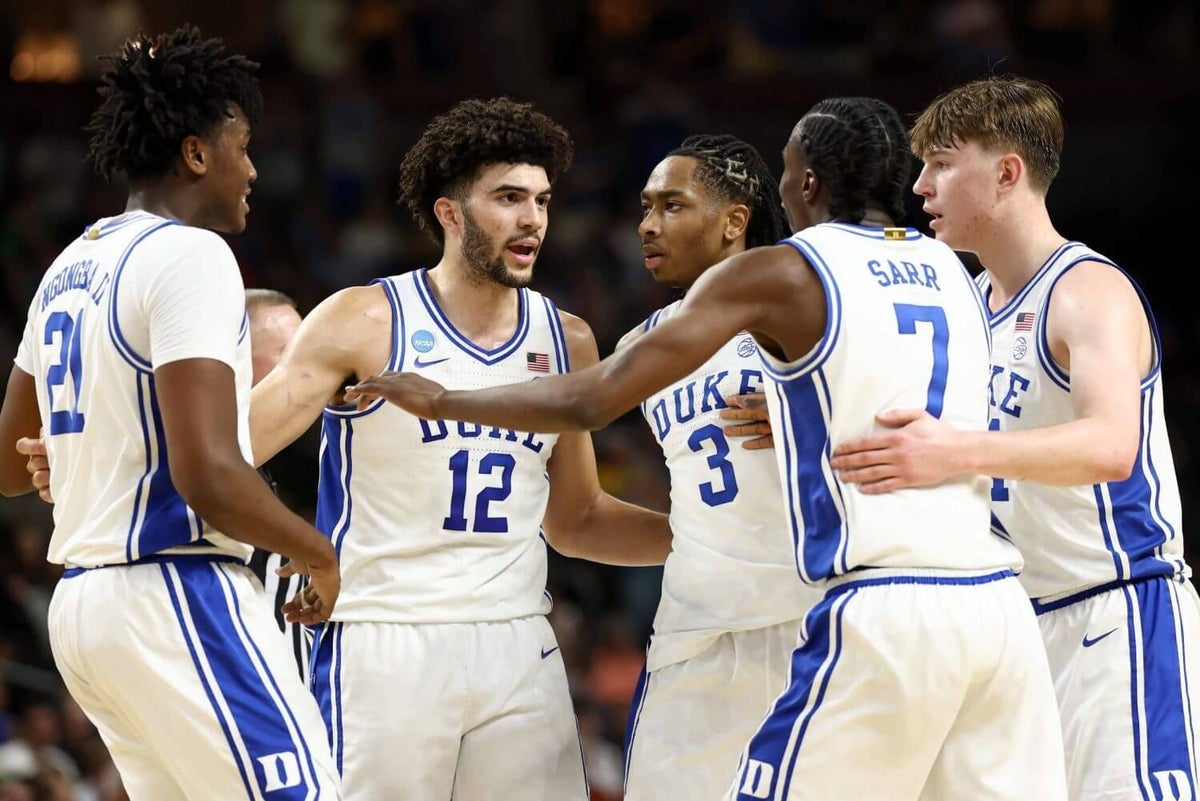
Bomani Jones loves to hate Duke. Absolutely loves it.
As an Atlanta native who earned a master’s degree from North Carolina and hosted a radio show in Durham, hating Duke is one of Jones’ favorite passions. In 2022 he dedicated 15 minutes of his HBO show to a history lesson poking fun at Mike Krzyzewski’s legacy ahead of the coach’s retirement. He followed Krzyzewski’s last home game, a loss to UNC, via live stats on his phone because service was bad on a train.
“I could not believe how excited I was to watch Duke lose in stats, in text form,” he said.
Every March, he drives the bus again. But when Jones began his YouTube show Monday, March 16, on the eve of the NCAA Tournament, his Duke hate call-out had become more of a plea. It was more important than ever to jump on the anti-Duke bandwagon, he said, because not enough people are on it anymore.
For 40 years, Duke has been college basketball’s most polarizing team. The aura of Cameron Indoor Stadium. The floor-slapping. The banners. Coach K. The global fan base inflated by people who didn’t attend the small private school. Christian Laettner’s stomp on the chest of Kentucky’s Aminu Timberlake in 1992. Grayson Allen’s history of tripping incidents. The idea, despite all that, that Duke did things the right way. It’s always been a lot.
As the Blue Devils make another NCAA Tournament run with some of the best players in the country, it’s time to have a conversation similar to the one we’ve begun to have about Notre Dame football.
Has Duke basketball become less hateable? Perhaps, maybe, even likable?
The generational hatred for Laettner was the subject of an ESPN 30 for 30 documentary. Radio personality Peter Rosenberg made raps about why Duke sucks 18 years ago. It’s been more than 35 years since ESPN analyst Jay Bilas played at Duke, but opposing fans still rag on him for it. But now? SB Nation writer James Dator, who comes from a UNC family, wrote a column last year titled, “Duke is actually likable this year, and it feels so wrong,” chronicling his appreciation for the play of Wooden Award winner Cooper Flagg, who was selected by the Dallas Mavericks with the No. 1 pick in the 2025 NBA Draft.
“It’s not as hostile anymore,” Chris Carrawell, a former Duke All-American and current Blue Devils assistant coach, said last week. “We used to go into some environments, man, where they’re going after you. … Sometimes they stepped over the line. Habitual line crossers. But now it’s not the same.”
So what’s changed? There are a few theories.
One is that Duke hasn’t won as big. The program last won the national title in 2015 and has made only three Final Fours since 2011. One of those was last year, and when the Blue Devils squandered a late lead against Houston, the joy in Duke’s loss was widespread like the old days, complete with memes from the third season of HBO’s “The White Lotus” that the school condemned in a statement. But there haven’t been as many high-profile March moments like there were from 1986 to 2010, when Duke reached 11 Final Fours and won four national titles. To fully appreciate a Duke loss, it must involve a fall from a perch.
A younger generation hasn’t grown up with Duke dominance to tire of. And in an expanded media environment, fans can watch any game at any time, instead of limited national games filled by Duke.
“I grew up a Dodger fan, and I didn’t like the Yankees because every time you turned the TV on, they were always on,” said Bilas, who also worked as an assistant coach under Krzyzewski. “But Duke is one of the highest-rated teams on air.”
Nielsen last week claimed Duke was the most “popular” men’s college basketball team, based on TV and social media data. It’s unclear how or whether negative social media engagement was included, but the point stands.
Another factor is the most familiar target for that ire: Coach K doesn’t roam the sideline anymore. Jones admits he hasn’t been quite as invested since Krzyzewski left. Current coach Jon Scheyer doesn’t speak out as much. The former Duke national championship-winning player is still new to this role and hasn’t built up much cache with general fans.
“They don’t have the old thing to kick around anymore,” Bilas said.
Krzyzewski worked to make the Duke program cool across class and race in a different way in the late 2000s. He started to emphasize that Duke played a fun, less structured style of offense. After plenty of conversations with NBA teams, he became the head coach of USA Basketball.
“It helped him to be associated with Kobe Bryant and LeBron James rather than Christian Laettner and Bobby Hurley,” Jones said. “I used to always hear, ‘I’ll root for Iraq before I root for Duke,’ in Chapel Hill. Krzyzewski was testing that when he coached the Olympic team.”
The type of player that came to Duke started to change. In the 2010s, Krzyzewski adapted to the times and began to recruit one-and-done NBA prospects such as Kyrie Irving, Jayson Tatum, Zion Williamson, Paolo Banchero and Flagg. The hatred of players for being Dukies became fleeting.
“They’re in and out, then you get another top guy,” Carrawell said. “Grayson Allen, he was the last four-year villain, where you got the growth. You get to watch him and hate him; you learned to hate him. He was probably the last one.”
In the past, the public only saw Duke players on the court, in that jersey. Those players now have developed huge fan bases outside of their time with Duke basketball, and sometimes even before it. Williamson was a social media star in high school thanks to his viral dunks. Jared McCain’s TikTok dances drew millions of views from people who may not have even watched him play basketball.
“Cooper Flagg, Kon Knueppel and Jared McCain (among others) seem like genuinely nice guys who don’t aim to be the villain,” Dator said in a text message.
The frequency with which Duke basketball is viewed through the lens of race has changed over time, too. Even as Black players such as Grant Hill, Chris Duhon or Carrawell starred for the Blue Devils, it was White players such as Laettner, Hurley, Steve Wojciechowski and JJ Redick who were labeled as faces of the program, good or bad.
So when the best player in college basketball last year was a White guy at Duke, the fact that he wasn’t really a villain was a sign of the times.
“How we talk about race in basketball is just not the same,” Jones said. “Cooper Flagg and Kon Knueppel, two White dudes that went to Duke, are Nos. 1 and 2 in NBA Rookie of the Year and nobody’s done a thinkpiece. That wouldn’t have been the case five years ago, let alone 10 or 20.”
Many of the old reasons to hate Duke aren’t as prevalent anymore, from the titles to the coach to the players fans grew to despise. Maybe that’s permanent. Or maybe it’s temporary.
If the No. 1 overall seed Blue Devils win the national championship this year, the sentiment could return. Maybe Scheyer develops into a character; he made rare off-court headlines in February when he claimed that Duke staffers were punched and injured when North Carolina fans stormed the court after a win.
“That’s a very Krzyzewski move right there,” Jones said, adding that he did agree with Scheyer’s concern about court storm safety. “He’s got time to move into that space as he gets more comfortable.”
Another question: Does college basketball even need Duke to be a villain anymore?
Villains always make for a great story, but sports no longer relies on familiar narratives as the sole strategy for driving interest. When Jones asks people to get back on the Duke-hating bandwagon, it’s part history lesson, part nostalgia.
But more than anything else, he says, hating Duke is about having fun.
“It’s having these characters and where these games are something that you feel, not just something that you bet on,” Jones said. “Not just something that becomes a test of your ability to prognosticate what’s going to happen in a basketball game.
“No, man, this stuff is supposed to be about feeling. That’s where it is at its best. I think there are a lot of us who forgot how much fun it was to hate Duke. It’s a great time. It’s OK to go ahead and bring it back. Give them credit when they win, or don’t give them credit when they win. I don’t care. But it’s more fun that way. We have gotten so quantitatively invested in a number of ways when it comes to sport that we ignore that, no, the fun of this is just to be somewhat irrational.”
— The Athletic’s Brendan Marks contributed reporting.