
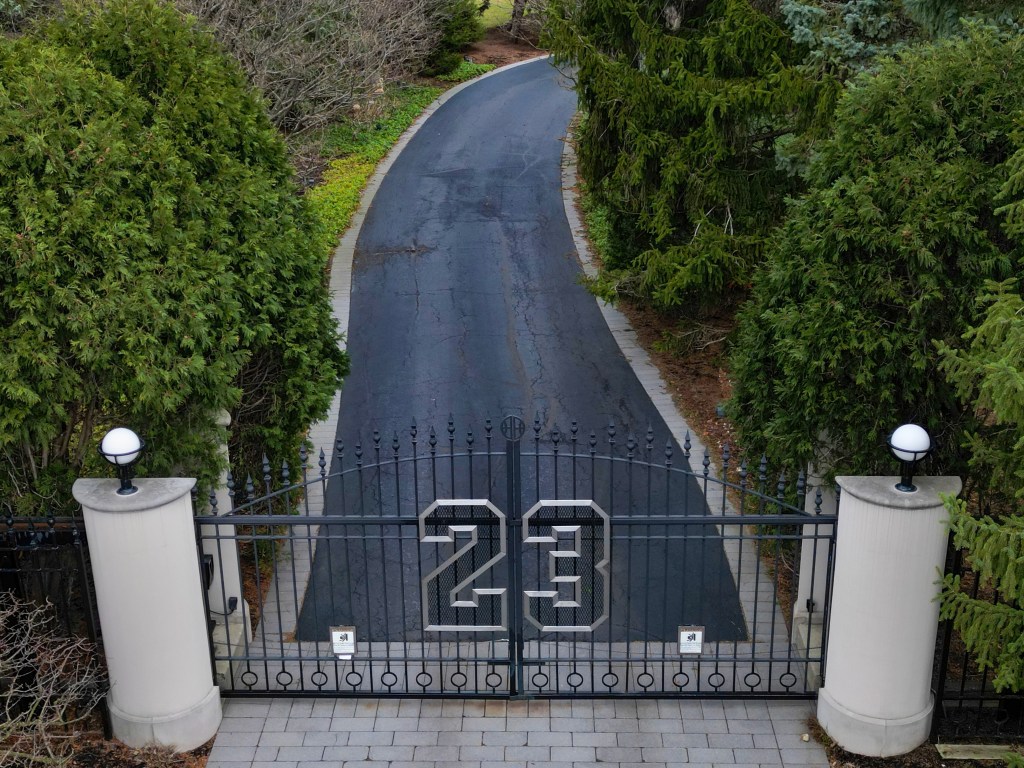
During his legendary NBA career, Michael Jordan was renowned not only for his athleticism and skill but also for his indomitable will to win.
There are no such accolades awarded in the annals of NIMBYism, but if there were, few would compete with Chicago’s North Shore suburbs. The neighbors of the Highland Park mansion once owned by MJ now have flexed their muscle not once but twice at proposals to repurpose the gaudy property for something other than a one-family occupier living therein.
The latest chapter saw the Highland Park City Council on Monday unanimously reject owner John Cooper’s audacious proposal to remake the property into a museum. Cooper went a long way to assuage neighbors’ concerns, going so far as to guarantee personally to buy their homes if offers for their properties fell short of appraised values. That’s quite the offer.
Still, no dice. Bottom line was that the people who live there enjoy the peace and quiet of residing on a cul-de-sac in an exclusive area. You know who else once greatly appreciated the area’s same qualities? One Michael Jeffrey Jordan.
At the time he and then-wife Juanita and their family lived in the 37,700-square-foot mansion, he was among the most famous people in the world. His Bulls weren’t just a national phenomenon, they were fully global. To this day, when traveling abroad, say you’re from Chicago and you’re likely to hear a reference to MJ. Think of how wild that is; his days with the Bulls ended three decades ago.
Jordan put the place on the market in 2012, after he “won” the property in his 2006 divorce from Juanita. She must have known something. The mansion became something of a national punch line as it sat on the market for more than ten years.
Perhaps folks shouldn’t have been surprised that ordinary rich people who couldn’t defy gravity might not be that keen on a mansion with its own full-sized basketball court, a swimming pool in the shape of a basketball hoop and the signature “23” on the front gate. The putting green, on the other hand? Now, we’re talking!
Still, it wasn’t until Cooper stepped up in 2024 and paid $9.5 million, well below Jordan’s $14.9 million asking price (which itself was down from the initial ask of $29 million), that MJ finally could be free of paying Illinois-style property taxes. Cooper’s first idea was to make the property into an experiential, luxury timeshare appealing to those enamored with the Jordan aura.
The neighbors most definitely weren’t down with that. Understandably.
Cooper’s efforts last year to put the property on Airbnb didn’t pan out, either.
This latest plan, the museum, was a better idea. But there was one important problem. Cooper didn’t have MJ’s blessing to use his name as part of this museum experience, which thus would be an exploration of “greatness.” In the generic sense, apparently.
A museum dedicated to the idea of greatness on the former property of a GOAT who shall go unnamed? We can see it now. Before entering, visitors would have to sign agreements not to utter the name of “you know who.”
Nice try. But a crazy idea.
At the City Council hearing, Councilman Jon Center asked Cooper if he would consider opening such a museum elsewhere in Highland Park. “If it loses the unique location, I might as well put it in downtown Chicago,” Cooper responded, according to Tribune reporting.
Exactly!
Come to think of it, that’s a great idea. A well-done Michael Jordan museum in Chicago, the city he remains most associated with despite having not lived here in ages, would be a blockbuster. Someone should get on the horn stat with the great one and find out what it would take to make that a reality.
An authorized reality.
As for MJ’s old mansion in leafy Highland Park?
It’s starting to look like someone is going to have to, well, live in it.
Submit a letter, of no more than 400 words, to the editor here or email letters@chicagotribune.com.