
The snubs get another shot, foregrounded by the lights of Las Vegas and the allure of NIL prize money. The College Basketball Crown returns for a second go-around, casting itself as a sleeper alternative to the Final Four or a flashy counter to the NIT.
All five power conferences are represented in this year’s seven-game tourney. Here’s a guide to the upcoming action. Schedules, stakes and stars are outlined below.
How to watch the 2026 College Basketball Crown
Venues: MGM Grand Garden Arena, T-Mobile Arena — Las Vegas
Dates: April 1-5
Watching in person? Get tickets on StubHub.
GameTime (ET)TVStream
Oklahoma vs. Colorado,
Quarterfinals
Wed., 8 p.m.
FS1
Baylor vs. Minnesota,
Quarterfinals
Wed., 10:30 p.m.
FS1
Stanford vs. West Virginia,
Quarterfinals
Thu., 8 p.m.
FS1
Rutgers vs. Creighton,
Quarterfinals
Thu., 10:30 p.m.
FS1
Semifinal 1
Sat., 1:30 p.m.
Fox
Semifinal 2
Sat., 4 p.m.
Fox
Championship game
Sun., 5:30 p.m.
Fox
Fox is free over the air. Both Fox and FS1 are also available with a Fox One subscription.
A brief overview of the College Basketball Crown
The College Basketball Crown uses a single-elimination format along the neutral-site Vegas Strip. It’s produced by Fox Sports and Anschutz Entertainment Group.
This second edition has slimmed down to eight teams from the original 16. After Selection Sunday set the NCAA Tournament field, the Crown gave automatic bids to top available teams by NET Rating in the Big East, Big Ten and Big 12. At-large bids then made the rounds. Seton Hall, Indiana and Cincinnati were among the programs that declined postseason invites.
Last year’s inaugural tournament ended with Nebraska topping UCF. Both of those teams buoyed themselves this season — the Cornhuskers notched a program-record 28 wins and finally advanced in March Madness, while UCF won 21 games and danced as a 10th seed.
A total of $500,000 is on the line as NIL funding. The Crown’s victor takes a $300K package, the runner-up gets $100K and the other two semifinalists settle for $50K.
What to know about this year’s teams
Teams listed alphabetically. All efficiency stats via KenPom.
Baylor
Baylor is 16-16 under Scott Drew, who coached the Bears to their 2021 national championship. The current group is 25th in offensive rating and 13th in offensive rebound percentage, but it’s 0-9 against ranked opponents and struggles on defense.
Redshirt sophomore Cameron Carr is the team’s top scorer at 19.2 points per game. Another guard, Isaac Williams IV, recently signed a two-year extension to stay in Waco.
Colorado
CU comes in at 17-15, a marked improvement from 14-21 last year. The Buffaloes were two points short of Texas Tech in January, back when the Red Raiders still had All-American JT Toppin on the floor. Colorado went to overtime against BYU in February; the defense held fellow All-American AJ Dybantsa to 6-of-20 shooting and seven turnovers.
Efficient Buffs junior Barrington Hargress just announced that he’ll return for his senior season. But breakout freshman Isaiah Johnson plans to hit the transfer portal.
Creighton
The Bluejays were a single-digit seed in each of the previous five NCAA Tournaments. They have been disappointing this season, but their defense is disciplined with the nation’s fourth-best free-throw rate. Longtime head coach Greg McDermott is retiring after Creighton’s run in the Crown.
Minnesota
This season, Minnesota touts impressive wins versus Iowa, Michigan State and UCLA. Leading scorer Cade Tyson averages nearly 20 points per game on 50/42.2 percent shooting splits. The Golden Gophers move the ball, entering at No. 1 in assists to made field goals.
Oklahoma
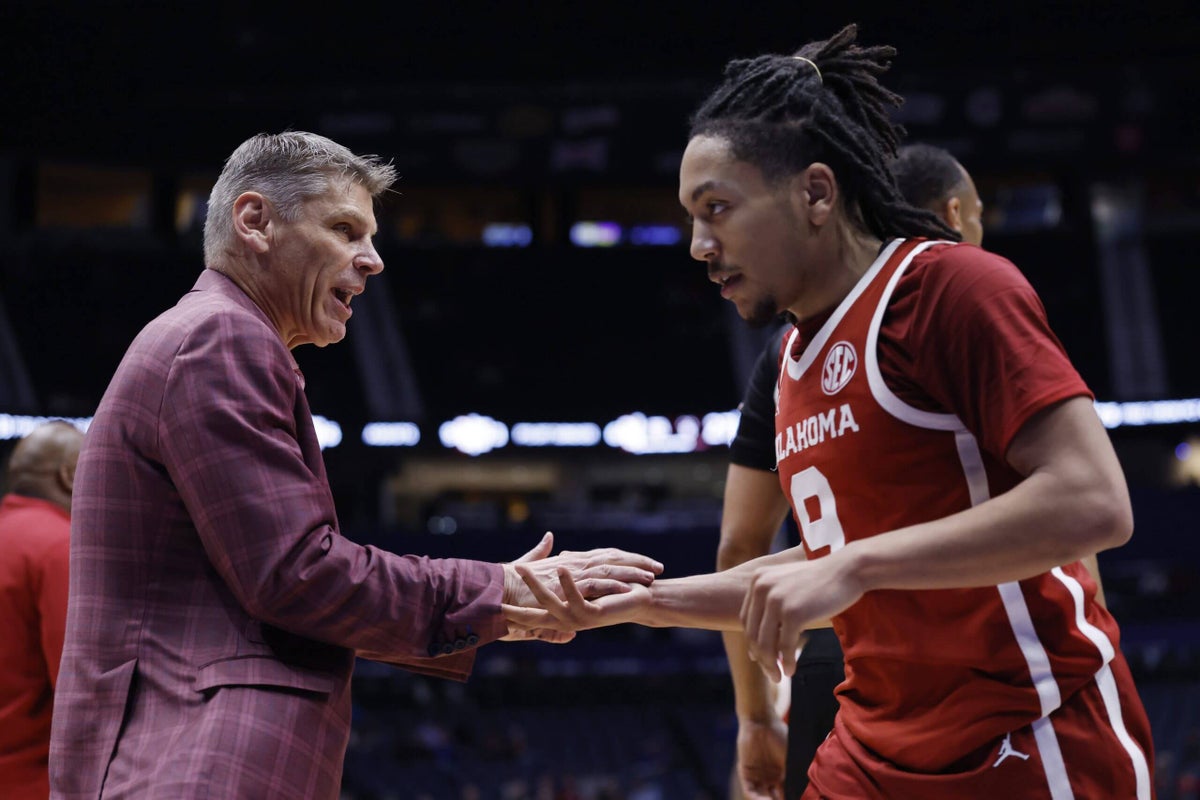
The Sooners bring one of the better scoring punches in Division I, coming in at 16th in offensive rating. The rotation is dominated by upperclassmen. Senior Nijel Pack leads the team at 16.5 points per game, making an SEC-high 45.2 percent from behind the arc.
Porter Moser needs a win here. After transforming Loyola, the coach now has just one NCAA Tournament appearance across five Sooner seasons.
Rutgers
Rutgers took a step backward without Dylan Harper and Ace Bailey, two top-five picks in last spring’s NBA Draft. The Scarlet Knights hope to use the postseason as a platform for freshmen Lino Mark and Harun Zrno.
Stanford
The Cardinal are one of the tourney’s best entrants at 20-12, and they get swipes, sitting at No. 7 in steal rate. Freshman star Ebuka Okorie just led the ACC with 22.8 points per game this season. Okorie’s excellence evokes future NBA projections and, most recently, “Iris” by the Goo Goo Dolls.
Believe it or not, the one-time March fixture Stanford has just one NCAA Tournament berth since 2009.
West Virginia
WVU has yet to go dancing in its post-Bob Huggins era. It was still a strong first effort for head coach Ross Hodge, who guided West Virginia to an 18-14 record. The hard-nosed Mountaineers beat Kansas in January and BYU the following month. Their offense underwhelms, but the defense ranks 17th in efficiency and 11th in opponent 2-point percentage.
The schedule and TV listings
All times ET.
Quarterfinals (FS1)
This round will take place at the MGM Grand Garden Arena, with Tim Brando (play-by-play), Jim Jackson (analysis) and Allison Williams (sideline) on the call for FS1.
Wednesday, April 1
Game 1: Oklahoma vs. Colorado, 8 p.m.
Game 2: Baylor vs. Minnesota, 10:30 p.m.
Thursday, April 2
Game 3: Stanford vs. West Virginia, 8 p.m.
Game 4: Rutgers vs. Creighton, 10:30 p.m.
Semifinals (Fox)
The action moves to T-Mobile Arena. The Fox broadcast team will include Jackson again, with Gus Johnson on play-by-play and Kristina Pink on the sideline.
Saturday, April 4
Game 5: Game 1 winner vs. Game 2 winner, 1:30 p.m.
Game 6: Game 3 winner vs. Game 4 winner, 4 p.m.
Championship game (Fox)
The finals will be back at the T-Mobile Arena. Johnson, Jackson and Pink all return for the Fox telecast.
Sunday, April 5
Game 7: Game 5 winner vs. Game 6 winner, 5:30 p.m.
Ticketing and streaming links in this article are provided by partners of The Athletic. Restrictions may apply. The Athletic maintains full editorial independence. Partners have no control over or input into the reporting or editing process, and do not review stories before publication.