
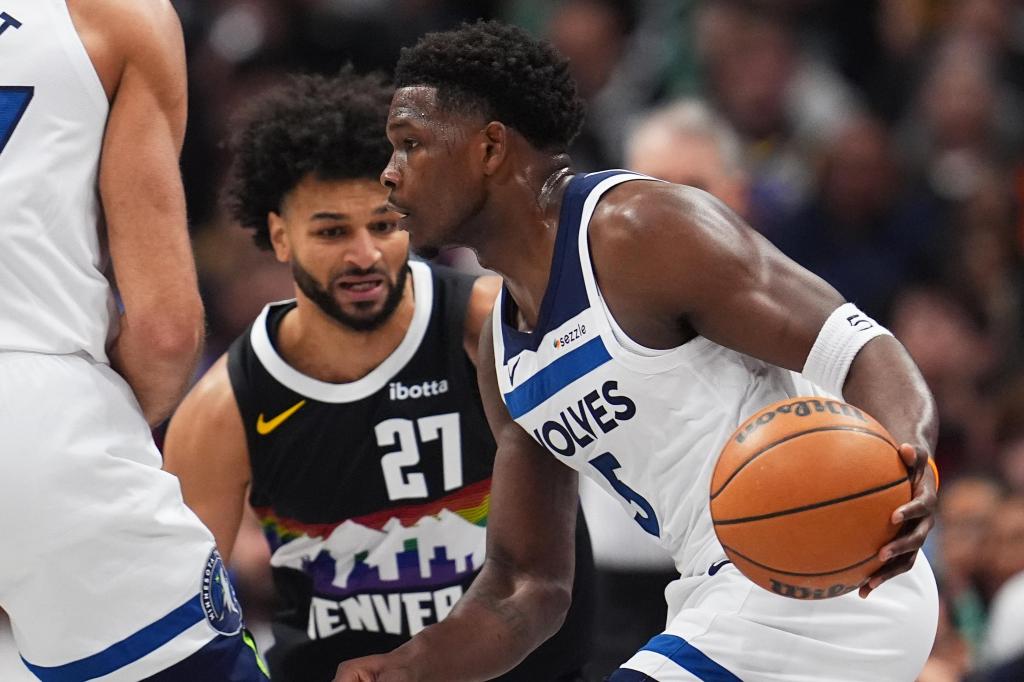
Minnesota’s magic number to secure a top six seed in the Western Conference playoffs and, thus, dodge the play-in tournament is down to just three with a week and a half to play following Phoenix’s loss to Orlando on Tuesday.
The Timberwolves will reach the playoffs for the fifth consecutive season. Now it’s all about positioning. Seeds No. 3-6 are technically all still in play for Minnesota, though the Los Angeles Lakers would have to collapse at this point for the Wolves to nab the third seed.
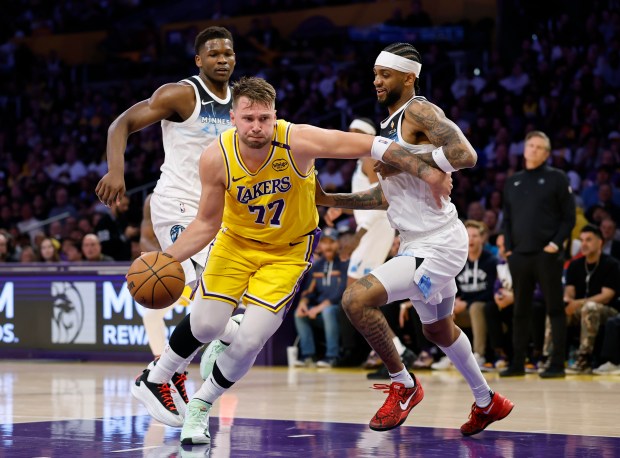 Luka Doncic #77 of the Los Angeles Lakers drives to the basket past Nickeil Alexander-Walker #9 and Anthony Edwards #5 of the Minnesota Timberwolves during a 111-102 Lakers win at Crypto.com Arena on Feb. 27, 2025 in Los Angeles, California. (Photo by Harry How/Getty Images) NOTE TO USER: User expressly acknowledges and agrees that, by downloading and or using this photograph, User is consenting to the terms and conditions of the Getty Images License Agreement. (Photo by Harry How/Getty Images)
So Minnesota will, in all likelihood, be No. 4, No. 5 or No. 6 when the playoffs open in two and a half weeks. But perhaps more important than the seed is the opponent. The Timberwolves’ list of potential first-round opponents is effectively down to three possibilities: Denver, Houston or the Lakers.
Which is preferred? Let’s dive into the options, starting with the best possible outcome for the Wolves.
Rockets
Statistically, much lines up between Minnesota and Houston, which have split a pair of regular season matchups — neither of which included Anthony Edwards. The stats say they’re two solid offensive teams that lean on defense, and that’s probably the best version of each club.
The Rockets have Keivn Durant, a scary proposition for any opposing defense, though Minnesota limited his impact in a playoff series against Phoenix just two seasons ago.
With Durant and Alperen Sengun serving as the team’s top offensive weapons, Houston doesn’t have anyone capable of breaking down a defense off the bounce. The Rockets’ offense tends to devolve into isolation for large chunks of the game, particularly in clutch time.
That plays directly into the hands of Minnesota, whose strength is its ability to guard in isolation situations.
The Rockets haven’t been whole all season, playing without starting guard Fred VanVleet all season and without center Steven Adams since mid-January.
Houston consistently plays with physicality and wouldn’t be an easy opponent for any team, but the Rockets’ roster in its current form lacks anything scary for which to gameplan.
The Wolves would have a clear talent edge here.
Lakers
Minnesota’s five-game ousting of the Lakers in last year’s first round likely remains fresh in the minds of all. But this looks like a better version of Los Angeles in terms of construction and form.
In the playoffs last spring, the Lakers were still just two months removed from the major shakeup of acquiring Luka Doncic from Dallas in a league-altering transaction.
Doncic has since settled in nicely alongside Austin Reaves as the team’s top creators, with LeBron James thriving in a complementary role.
DeAndre Ayton certainly has warts, but he still has given the Lakers necessary size along with Jaxson Hayes at the center spot. Luke Kennard has improved the team’s offensive spacing, and Marcus Smart has added toughness and perimeter defense.
But the biggest difference is Doncic. He came into this season with a leaner build and simply looks like a healthier version of himself. In March, the Slovenian superstar averaged 37.5 points, eight rebounds, 7.4 assists and 2.3 steals while leading the Lakers to a 14-2 mark.
With all that being said, Minnesota could still win the series via the same size, speed and strength advantages that proved so pivotal in last year’s matchup. But Doncic is capable of picking the Wolves’ defense apart, as demonstrated in a pair of Lakers blowout wins in Los Angeles this season.
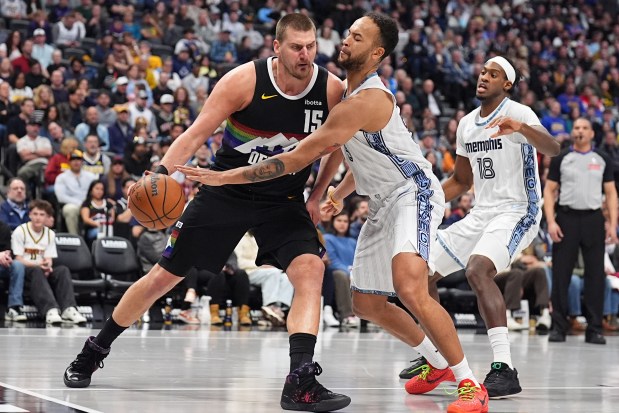 Denver Nuggets center Nikola Jokić, left, drives to the rim as Memphis Grizzlies forward Kyle Anderson defends in the second half of an NBA basketball game Wednesday, Feb. 11, 2026, in Denver. (AP Photo/David Zalubowski)
Nuggets
It’s tough to trust the Nuggets as true threats to win the West this season, even with an ever-dominant Nikola Jokic. Because Denver has struggled with health issues all season, and the team’s lynchpin, Aaron Gordon, doesn’t seem like a good bet to physically withstand two months of high-intensity playoff action.
But whoever faces Denver in Round 1 is likely getting the Nuggets’ best punch, a blow that delivers about as much force as anything the league’s elite can produce.
Defensively, Minnesota has never produced any real answers for Jokic — who has? But Denver at full strength has the depth to keep pace with Minnesota over the course of a series, which wasn’t the case even two seasons ago when the Wolves outlasted the Nuggets in a classic, seven-game square-off.
Even if Jaden McDaniels can slow Jamal Murray on the ball, the Nuggets — who shot 40.4% from 3-point range in March — have more offensive options to capitalize offensively off Jokic’s gravity than ever before.
A series with the Nuggets would require four or five games of excellence from Julius Randle in order for Minnesota to produce enough offense to pick at the lesser of Denver’s two ends of the floor and squeak out a series victory.
Given the up-and-down nature of Randle’s play over the last four-plus months, that could be asking a lot.