
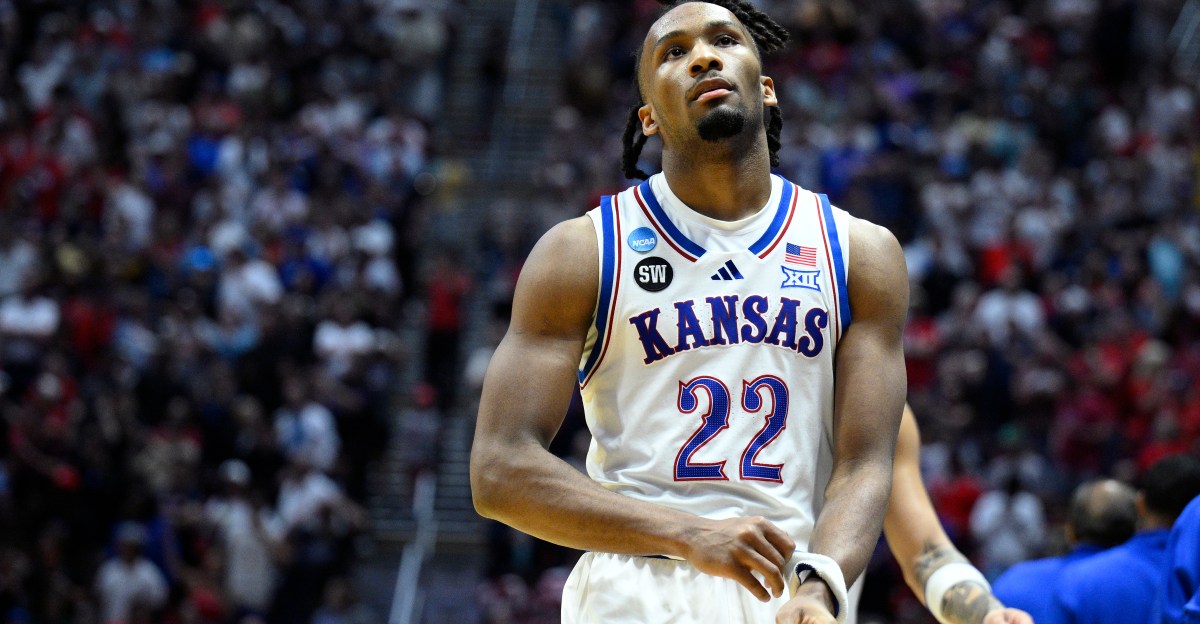
Look, as far as couch-bound talent evaluators go, I haven’t been the most pro-Peterson scout during his freshman season at Kansas. The off-court issues left many — including myself — questioning his motives, drive to compete, and overall health as he withdrew from games on his own accord and constantly battled nagging injuries from the start of the season until the doorstep of the postseason.
I get it. Peterson hasn’t drawn the most attractive mental map of superlatives among his 2026 classmates. But his draft stock is plummeting, and I truly don’t understand why.
Kevin O’Connor of Yahoo Sports recently scribbled out a mock draft that slots Peterson (who currently shares the number-one spot on the SLC Dunk Big Board with BYU’s AJ Dybantsa) all the way down to fifth off the board, a far cry from his position at or near the top for the first two-thirds of the college basketball season. This is not a rare opinion, either, as the rumor boulder is collecting more and more intel that NBA executives see Darius Acuff as the obvious first guard at the podium, shaking Adam Silver’s name on draft night.
Here’s my stance: if the Utah Jazz somehow draft Peterson fifth overall just one year after snagging Ace Bailey from the same position, you may hear an angelic symphony ring out on the block adjacent to John Stockton Drive.
Assuming Utah doesn’t lose its pick by divine intervention or via karmic justice for their “unethical” tanking ways, the options for players 1-4 are incredibly enticing. It’s no secret that AJ Dybantsa is likely at the top of the Jazz draft board, nor would Utah scout Carlos Boozer complain if the front office were to select the Duke standout who bears a striking resemblance to the former Jazzman. Even Caleb Wilson, a defensive monster and athletic freak from UNC, could be an exceptional addition to a Jazz team looking to strengthen the back lines of its pre-instated George, Markkanen, Jackson core.
But if you want the perfect player to round out the Utah Jazz starting five, you won’t find a better shooting guard than Darryn Peterson in the class of 2026.
His offensive game is more polished than the floor of a grand ballroom, which is appropriate considering the way he dances with the ball in his hands. With a jumpshot that’s as close to one fluid motion as you’ll ever find, Peterson’s feather touch finds its target with alarming consistency, as he connected on over 38% of his three-point attempts as a freshman. With a yoyo dribble and flashes of gaudy athletic explosion, Peterson maintains his head and patiently picks his spots before making his move. He struggles as a passer, however, as his assist numbers won’t even make you look up from your morning oatmeal. Not an unwilling distributor or a selfish player by any means, Peterson just doesn’t playmake for others nearly as well as he does for himself. For Will Hardy’s pass-heavy offense, the Jazz wouldn’t struggle to playmake through the air if they added Peterson by any means. He’d just likely be on the receiving end of most offensive sets, teaming up with assist magnets Keyonte George and Isaiah Collier.
On defense, he is cling wrap. He sticks to you and frustrates your plans frequently, whether he’s stealing arrant passes (1.6 per game at KU), playing on-ball stopper, or off-ball disruptor. Peterson’s blend of length and strength made him an excellent defender in D-1 and should translate comfortably to the NBA. I salivate at the potential of a Peterson-Bailey backcourt, stifling the guards of the league around the perimeter with JJJ and Kessler awaiting any fool who dares breach the three-point line and attack the paint.
But Peterson isn’t falling down draft boards without reason.
He dealt with lingering cramping and various injury issues throughout his run with Kansas. He appeared in just 20 of the Jayhawks’ 31 regular-season outings, and had a tendency to, well, take himself out of games, and refused to elaborate as to why. Whether a self-preservation move for the NBA, minutes restrictions for injury management, or the feeling that he had made his mark on the game and had no desire to keep playing in a game that was essentially a foregone conclusion, these instances drew obvious criticism.
His competitive drive was called into question. His desire to play was unclear. And with an apparent lack of burst and difference in play style from high school (settling on a jump shot-heavy diet in college and being an enemy to rims everywhere in high school), could his injury issues be keeping Peterson from playing at 100%?
Look, the good surrounding Peterson is so, so good, and the bad has nothing to do with his ability to play the game of basketball. But the bad is baffling. It’s unsettling. It’s off-putting. In that light, it’s unsurprising that many NBA executives seem hesitant to submit their bid for Peterson when guards like Acuff — though defensively challenged — are more of a known commodity.
But let this be my final warning to eventual owners of the top four picks of the 2026 NBA Draft: if you let Peterson slip to the Jazz, you’ll be kicking yourself over it forever.
Calvin Barrett is a writer, editor, and prolific Mario Kart racer located in Tokyo, Japan. He has covered the NBA and College Sports since 2024.