
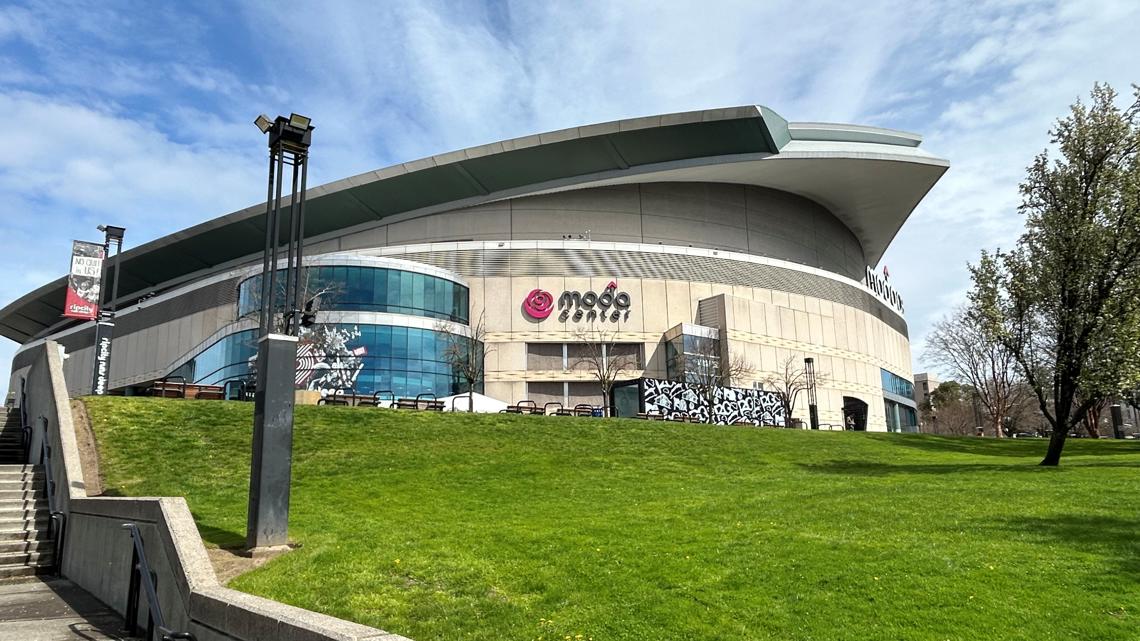
They love the team, but they don’t love the idea of only using public funds to pay for Moda Center upgrades with little financial return on that investment.
PORTLAND, Ore. — Passionate Portland Trail Blazers fans are pushing city leaders to negotiate a better deal for taxpayers before committing hundreds of millions of public dollars to renovate the Moda Center — saying the current plan amounts to a gift to the team’s new wealthy owners with little financial return for the community.
The City of Portland and Multnomah County are expected to vote later this year on their share of funding for the proposed arena overhaul.
The Oregon Legislature has already committed up to $365 million in state bonds to the project, contingent on the city and county reaching funding deals.
As it currently stands, the planned renovation would be funded entirely with public money with minimal financial return on investment for taxpayers — a structure the fans said is without precedent among recent NBA arena deals.
“So far, the public gets none of the money and has to put up all the money,” said Edan Krolewicz, a Blazers superfan with a background in finance and computer science. “I think it’s as bad as it could possibly be right now.”
Devoted fans, deep concerns
Krolewicz and fellow Blazers die-hard Jonathan Pulvers are hardly critics of the franchise.
There are basketball hoops all around Pulvers’ home in Southeast Portland, where his 6-year-old son Eli has developed what his father calls an ‘all-consuming obsession’ with the sport. There’s no question where Eli got it from.
“I have been a borderline pathological Blazers fan since I was five years old,” Pulvers said.
Krolewicz, who is moving his family back to Portland this summer, watches every game from New York — even when that means staying up past 1 a.m. on the East Coast.
Neither of the superfans, part of a larger grassroots group of taxpayer-minded citizens, are getting paid for their advocacy.
Krolewicz created an entire website to detail his position — ripcitynotripoff.com — after spending months analyzing the finances of the proposed deal and comparing it to other NBA arena agreements around the country.
“I think we all love the Blazers, but in something like this, we have to understand that we’re on opposite sides of the table, right?” Krolewicz said. “We need to make sure that people understand what’s going on and [city leaders] are educated enough to make decisions out of a place of understanding and not a place of fear … to get the best deal on behalf of the public.”
Pulvers, an independent consultant who’s no stranger to civic causes, said his enthusiasm for the team can’t override his concerns about how the proposed renovation is being structured.
“There’s rock-solid economic findings that subsidies for sports teams and for stadiums do not provide a net benefit to communities,” Pulvers said. “I think it’s worth taking the time to do this right, and that shouldn’t take forever.”
Blazers management have argued that a renovation would make the 31-year-old Moda Center a “world-class sports and entertainment destination,” allowing Portland to compete for national and international events while boosting the Oregon and local economies.
In a document sent to Portland and Oregon political leaders, the Blazers said public funding is necessary because “the assumption that the incoming ownership group can finance an additional $600 million for Moda Center — which is now a publicly-owned community asset — is not possible. We should be matching the confidence that the incoming Blazers ownership group has in Portland and Oregon.”
The return on investment
As part of its pitch to lawmakers and political leaders, the Blazers and Rip City Management included their own breakdown of recent NBA arena deals.
The Blazers noted percentages of public vs. private contribution for arena projects in places like Salt Lake City (100% public), Oklahoma City (95% public) and San Antonio (63% public).
Krolewicz looked further, noting details like how Salt Lake City’s deal included a $4 billion private investment in the surrounding area and ticket fees to recoup some public money, and how Oklahoma City included a steep $1 billion relocation penalty, revenue sharing and rent at $58,000 per game.
He also included details on arena projects that Rip City Management omitted, including arenas in Cleveland, Detroit, Sacramento and Milwaukee that were mostly funded by private contributions — not the taxpayers.
Krolewicz outlines six specific demands he believes city negotiators should make before city council approves any funding commitment.
Significant private investment from the new ownership group as part of a renovation and maintenance packageA share of the naming rights revenue for the city-owned Moda CenterPILOT payments (payments in lieu of property taxes) — the arena is exempt from property tax, but PILOT payments are commonly used elsewhere to help make up this loss in revenueRent payments or revenue sharing, often used to generate millions of dollars each year for the general funds of comparable citiesStronger relocation penalties — the San Antonio and Milwaukee deals include 30-year non-relocation agreements as part of public fundingA longer lease term — the state’s bill includes a 20-year minimum lease, which Krolewicz noted would be the shortest of any deal he reviewed as part of his dataset
“It’s pretty simple,” Krolewicz said. “Do we want to spend a billion dollars on an arena where we get none of the money back? Or do we want to spend that money on other things that Oregon needs, like better transit … parks issues. We need to fix our education system.”
Public records obtained by KGW show that city officials coordinated closely with Trail Blazers representatives and their consultants in advancing the case for public funding during the legislative session. Pulvers said that dynamic concerns him deeply.
“Basically the state and the city have been — negotiating is a strong word — they’ve been partnering, or maybe colluding, with the Blazers to do the Blazers’ bidding,” Pulvers said. “We need somebody out there to look out for the public.”
The City of Portland said the mayor’s office and executive leadership are leading negotiations with the Blazers ownership, but the city declined KGW’s request to interview a negotiator.
The city has an active contract with Stafford Sports, a sports consulting firm, which was previously used to help secure a bridge lease extension of the Moda Center until 2030.
It is not clear what role, if any, Stafford consultants are playing in the active negotiation of a Moda Center lease extension or renovation funding proposal.
Dan Barrett, a consultant who negotiated on behalf of the public and taxpayers in arena deal negotiations in Sacramento, Milwaukee and Raleigh, is now negotiating on behalf of the Trail Blazers and consulting firm CAA Icon, according to public records.
Barrett effectively changed sides from negotiating against new Blazers owner Tom Dundon in the negotiations over the Lenovo Center in Raleigh — home to Dundon’s Carolina Hurricanes — to now negotiating for Dundon and the Blazers’ new ownership group.
The relocation threat — is it a ‘bluff’?
Throughout the lobbying and legislative process, the Trail Blazers and the team’s representatives raised the prospect of relocation, arguing that public investment was “necessary” to keep the team in Portland.
State lawmakers alluded to that threat in explaining their votes to approve state bonding for the project.
“We’ve got a very good shot to keep the Trail Blazers here,” said senate president Rob Wagner.
Pulvers dismisses that framing entirely.
“It is a bluff. They don’t have anywhere to go,” he said.
In March, the NBA announced it is looking to add expansion teams in Seattle and Las Vegas — the two markets most frequently cited as potential relocation destinations and threats to the Blazers.
NBA Commissioner Adam Silver reaffirmed his desire for the Blazers to stay in Portland, and any relocation would need the approval of the NBA Board of Governors.
Pulvers argues that recent developments, combined with the financial math of relocation, makes the risk of the Blazers’ new ownership group packing up the team and moving elsewhere miniscule.
“The numbers do not pencil out for them to leave,” he said. “This is a convenient negotiating position for them to take because it scares office holders who should be more scared of giving away money and having to face voters for that.”
Krolewicz estimates it would take $1.8 billion to $6.3 billion to relocate the Blazers, calculating fees and other impacts.
Compared to a proposal of a few hundred million dollars of private investment in a Moda Center revamp, that makes it much cheaper for the ‘Rip City Rising’ ownership group to stay in Portland, he argues.
City council’s role
With the state’s commitment in place, attention now turns to Portland City Council, which is expected to vote on the city’s funding contribution and a long-term lease agreement later this year.
Pulvers said that vote represents the last meaningful opportunity to negotiate real protections and financial returns for the public.
There is no date currently set for a city vote or public discussion on the Moda Center’s future.
Multnomah County is also set to vote on its portion of renovations, with a reported contribution of up to $88 million, later this spring.
Krolewicz said more than 1,100 Oregonians have contacted elected officials through a form on his site.
For Pulvers, the push is also personal — a lesson for his son that you can love the Blazers while still demanding a fair deal for your community.
“I don’t think those things are in tension at all,” Pulvers said.