
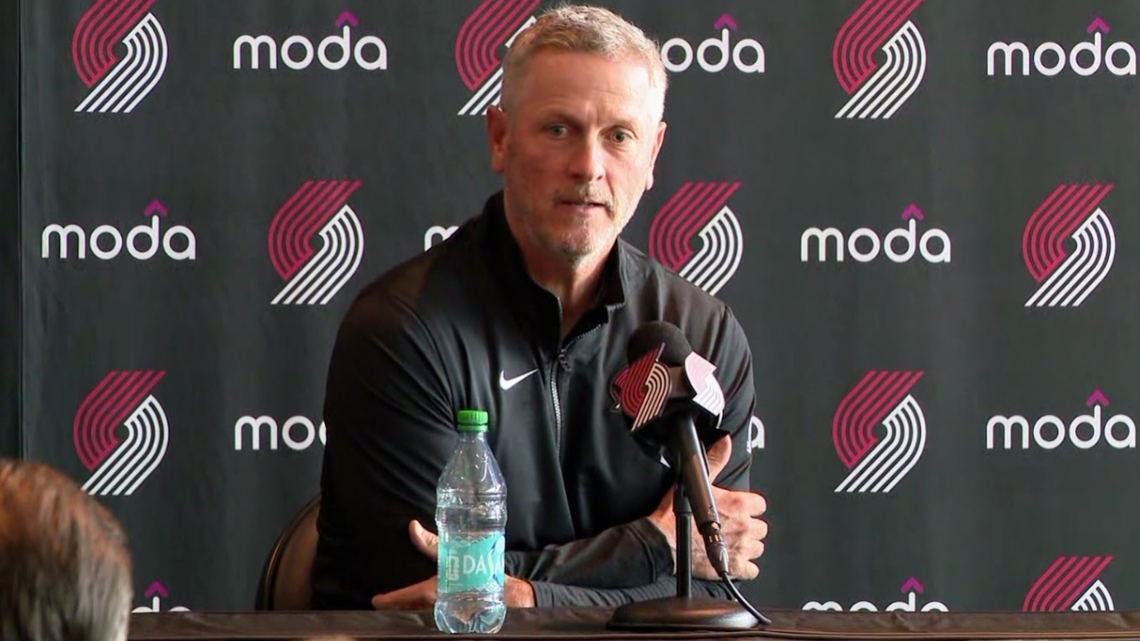
New Portland Trail Blazers owner Tom Dundon outlined his vision for the team Thursday, and addressed potential changes and negotiations on the arena funding deal.
PORTLAND, Ore. — Portland Trail Blazers new owner Tom Dundon spoke to the media Thursday afternoon, outlining his vision for the franchise and addressing potential changes and negotiations around the arena funding deal.
Two co-owners from the new ownership group, Rip City Rising, also spoke. Portland-based Sheel Tyle, co-CEO of Collective Global, and Andrew Cherng, whose family owns Panda Express, discussed what drew them to invest in the team.
General manager Joe Cronin and team president Dewayne Hankins also answered a few questions about their impressions of the new ownership group.
Here is a lightly edited transcript of the full press conference:
Lamar Hurd, Blazers TV analyst: Hello, everybody. I have not seen this room this full in my 10 years here, but that’s what happens when we have a big day to celebrate, and that’s what we’re doing today. Thank you all for being here. My name is Lamar Hurd, TV analyst for the Blazers, and it’s my honor to welcome and introduce a group of people to you that you will come to know and love. We are thrilled to introduce our Rip City Rising ownership group, led by Tom Dundon.
Tom will serve as governor, and he is joined by Andrew Cherng and Sheel Tyle, who will serve as alternate governors. Also joining us today is our president of business operations, Dewayne Hankins, and our general manager, Joe Cronin. I’m going to hand it off to Tom, Andrew and Sheel for brief remarks, and after that we’ll open it up for a Q&A. With that, let’s get the party started. Tom?
Tom Dundon, Blazers owner: Thanks, bud. Thanks, everybody, for coming. I think the main message for us right now is the franchise hasn’t had as much success in the past few years as it did historically, and I think our expectation is that’s starting to change and will continue to change. The focus the last few years has been around development, which is now around winning.
We’ve tried to get this message through the last couple of days that that was fun and probably necessary, but it’s more fun to win and it’s more fun to do the things that lead to success. Hopefully, we’ll start creating more habits that those processes lead to the kind of winning that I expect and I think everybody expects.
I want to thank the family that sold us this team. They did a really nice job, and it gets uncomfortable sometimes talking about what we want to do next, so I really appreciate everything the Allen family did. They’ve built such a legacy. This building is pretty neat. When you walk around it, it needs some work, but it’s still something we can be proud of and improve upon. That’s how I feel about everything they’ve done.
They’ve created this legacy that, with a little love and care, maybe we can keep making better and better. We spent some time with Joe and Dewayne and the people that work for the Trail Blazers, and we’re very fortunate. It’s a really good group of people. They care.
There’s nothing I don’t think we can accomplish if we just start focusing on a little bit of improvement every day, and I feel like all the pieces are here. There’s not something I’m worried about. The only thing I’m concerned about is the speed, pace and intensity at which we’re about to get going might be a little different, and we’ve got to get people there quickly.
I didn’t grow up intending to be in this position, so I want everybody to understand how lucky I am. It’s a responsibility to make sure fans and the community are proud of what we do. Part of that is winning, but it’s also how you treat your fans, how long it takes to get in the building, what the food tastes like. All these things are important, and I probably think about them more than most. We won’t stop thinking about it ever. We will continue to try to make the experience here great while we’re expecting to win, and hopefully you’ll see that over time.
The last thing is I couldn’t have done this without a couple of my partners who are here, and I’m really thankful to them. I think as a group we should be pretty powerful.
This is one of my partners, Andrew, so I want him to say hello.
Andrew Cherng: Hello, everybody. Thanks for coming. I’m excited. As a new owner, we’re 1-0, so let’s keep it that way. Thank you for coming.
Dundon: And our local partner, who I think you’ll see the most of, Sheel.
Sheel Tyle, Blazers co-owner: Thanks, Tom. I want to start with a few thank-yous. I see some franchise legends here, so thank you. Thank you to everybody who came. I know you took time out of your busy schedules. A special thank you to my wife, Sajal, who is the reason we are in Oregon. She’s the star of the family, so I hope you get to spend some time with her.
I want to say two things today. The first is about the power of sport. Folks often ask, why did you do this? One of the most special things about sport in this country, in this state, in this city, is the power to bring people together. It doesn’t matter where you come from, how you pray or who you love, etc. All that matters on game day, in our case, is the Portland Trail Blazers. That is something we feel passionately about in this ownership group, and it’s something we think we need right now in this country and in this world.
The second thing I want to talk about is Portland. Portland is my home. Our daughter, Sia, who will be here today — she’s taking her second nap right now, so we’ll see if she makes it — was born at OHSU not too far away. This place has the best food in the country and is an incredible place to live.
We called our ownership group Rip City Rising for a very specific reason. We could have called it other things. We could have called it Rip City Stabilizing or Rip City Reminiscing. We called it Rip City Rising, and that was a unanimous decision, because we believe Portland was a world-class city, can again be a world-class city, and potentially ascend beyond that.
We think the Blazers can and should play a small role in that, and we’re really excited to do that with your help.
The last thing I’ll say is, as somebody who lives in Portland, I’ve gotten to know these guys and some of our amazing other partners over the last year. This is a group that you will be proud of. Tom came from nothing and risked it all to achieve what he has achieved. Andrew — to do what he did, when he did it, Andrew and Peggy — is nothing short of extraordinary.
This is an incredible group of people that will fight every day to have your back. With that, thank you.
Hurd: Thank you all for that. We’re going to open it up now for Q&A. We have mics we’re passing around. If you want to ask a question, just raise your hand. Our first question will go to Bill Oram right there.
Bill Oram, The Oregonian: Hey, guys, congratulations. Tom, you’ve talked about the amount of work that needs to happen and has already started happening. How is this organization going to be different a year from today than it is right now?
Dundon: Good question. Like I said, I think all the pieces are here. I think the pace at which we want to move and the expectations are going to be different. We’ve started that.
There are no real secrets. Everybody talks about commitment, passion, structure, expectations and standards. It’s just how committed you are to that every day and getting everybody to do it. I don’t know if you’ll notice, but I hope you do.
Jason Quick, The Athletic: Tom, Jason Quick with The Athletic. I’ve got two questions. First, do you care about being liked?
Dundon: On the list of things I care about, it’s lower. But I don’t think anybody who says they don’t care what people think is telling the truth.
I think I care more about my character than my reputation. I know what I do every day, and I want to win and achieve things without hurting anybody. There’s nothing about me that doesn’t want to do the right thing. I do it every day.
But if we have to trade a player, we’re going to trade the player. If we need to make a decision that’s best for the Portland Trail Blazers, I’m going to make those decisions. That doesn’t mean I’m going to love doing it.
Everybody I know who has that responsibility struggles with hard decisions, and I do, too. I don’t like it, but I’ll do it because it’s best for the organization.
Quick: My second question is, after the Clippers game, there was a video the team put out where Joe Cronin gave you the game ball and you made a few comments. I couldn’t really tell, but I think you might have been emotional. Were you, and if so, why?
Dundon: Haha, caught that. Yes, I was. I’m so lucky to get to do this. I want our players to do things that are not easy. It’s difficult to play all these games. They make a lot of money, and that’s irrelevant. What’s relevant is how hard their job is — the travel, the commitment.
Sometimes we take for granted that you’re in the NBA, you’re playing pro sports, and you’re so lucky — and they are. But I really appreciate when you see that kind of effort. That’s all I want. If we lose and it looks like that, then I’ll be happy. We’ll try to get better players, but if they do that, I appreciate it.
That’s why I felt that way. We came in that day thinking I wasn’t going to meet with the team. I do it once to say hello and set the standard. It was probably coincidence, but when it looks like that, that’s what makes me emotional.
My whole thing is, OK, we did it. What’s next? We can do better again.
Reporter: Hey, Andrew, Joe Freeman with The Oregonian. Can you tell us how you became involved in this, how you got connected with Tom, and why you decided to get involved in sports ownership?
Cherng: I’m a fan. Actually, I was not thinking of it this way because I don’t live here. As a Chinese (man), I love the fact we have a prospect in Hansen Yang. So it got me thinking. And Tom is a winner. And he’s done a wonderful job with his previous team. So we have a winning combination here. The NBA is a popular sport in China. There’s a lot more influence we can make. I’m excited.
Freeman: Did he reach out to you, or how did you guys connect?
Cherng: We connected by one of my team members.
Sean Highkin, Rose Garden Report: Tom, you’ve owned a hockey team for about eight years and have probably been studying the NBA for about a year, however long it’s been since you decided you were going to buy the team. What are some things that have worked in the NHL that you think will translate to the NBA, and what are some things you think you’ll have to adapt or adjust in how you run the team and operations?
Dundon: I’ve been warned a lot that the players are harder to get through to. They make more money; they have a bigger impact on the game. There are fewer players, you can give the ball to the good ones a lot, and making sure they’re all of the same character and effort can be harder in the NBA, I’m told. So far, I haven’t seen it.
I’ve been very happy with the culture of the organization. I assume you all know this who are fans. The players here work hard, they care. There’s no drama.
It’s really special relative to what my expectations were, because I didn’t know other than what I was told. You hear rumors and try not to listen, but they can impact you. I don’t think it’s that much different than a company, than a basketball team than a hockey team.
You set expectations, you work hard, you want people with character who care. I don’t think there’s going to be any difference between here and there and anything else I do in life.
Anne Peterson, The Associated Press: Hi, Anne Peterson from The Associated Press. Tom, how would you describe your management style, and are you going to be a hands-on owner? Will you be involved in the day-to-day or delegate?
Dundon: I don’t think it’s that cut and dry. You can be involved and delegate. You can be hands-on and also trust people.
I don’t trust anyone to make decisions without information. Joe (Cronin) and I have talked a lot about this, and he already does it. There are coaches, scouts, analytics — a lot of people involved in running these businesses and making decisions.
I don’t expect to be the decision-maker because the process creates obvious answers, but I’ll push really hard to go through a process that doesn’t leave anyone out and doesn’t miss any variables.
Mike Richman, Locked On Blazers: Tom, how do you view the Blazers’ coaching situation with Chauncey Billups nominally employed and Tiago Splitter entering a decision point coming up here?
Dundon: I don’t know anything about the first situation. I wasn’t here, and they don’t really talk to us about it. It’s none of my business.
I think Tiago’s done a really good job, and the team has this opportunity. We’ll get more information every day, but so far he’s done a great job. I’m curious to see how this goes from here because my expectation is I want to win.
Danny Marang, 105.1 The Fan: Tom, you’ve talked about where the team is and where you want it to be. How do you get there? Is there a desire to make a big splash like we’ve seen from other (new) owners, and what’s your timeline?
Dundon: It’s really difficult to have an actual plan in these situations. Our plan is to work hard and make good decisions.
Joe had a deal at the trade deadline that I was aware of that would have been what you described as a big splash. If that opportunity exists, I’m probably more aggressive than most.
If it doesn’t exist, you have to find pieces to continue to get better and decide if you can get good enough to win a championship or if you have to take a step back. Joe and I have talked about this a lot. There’s no one way this is going to go for sure.
If we get a star, we have a chance to win. If we can’t find a star, we add pieces and hope things develop. If that doesn’t work, we try again with a new plan. There are equal chances for all those things to happen.
Eve Peyser, Portland Business Journal: I know your real estate firm invested in a multi-million dollar redevelopment effort around the Lenovo Center in Raleigh. Do you have similar plans to invest in redeveloping the area around the Moda Center?
Dundon: I haven’t spent any time on it yet, so I’d love to answer if I knew, but I don’t know yet. Those things are interesting to study and look at. It’s something I enjoy figuring out. If there are things to do, I’ll listen and take a look.
Nick Krupke, KPTV: Why Portland? Why now?
Dundon: They called me and said there was an NBA team in Portland for sale. Luckily, I found a bunch of guys to help me do it, and that’s how it happened. I wasn’t out looking.
Tyrese Smith, KOIN: Joe, we haven’t heard from you in a while. When Tom and the ownership group were named, what were your initial thoughts, and how do you feel about your future as general manager?
Joe Cronin, general manager: Initially, when I first learned about it almost a year ago, it was mixed emotions because I respect Jody Allen and Bert Kolde so much, knowing they were leaving the organization was a loss.
Then you quickly turn to what’s next — what this organization is going to be now. As I’ve gotten to know Tom and his partners, I’ve been incredibly encouraged. The skill set, expertise, drive, passion and will to win — for me, it’s perfect.
This organization is in an incredible spot to have all these super capable people to help drive this train. I couldn’t be more optimistic.
Quick: Tom, I filed my taxes the other day, and it seems like a lot of money is going out to taxes. It seems like an elephant in the room is who’s going to pay for the arena upgrades. So far, it doesn’t look like you have much skin in the game. It’s all public funding. Is it your position that you won’t pay rent on this or there will be no relocation penalties? Can you answer to the public you’ll have some skin in the game?
Dundon: No one’s ever told me I didn’t have skin in the game before. We don’t know each other very well.
We’re going to negotiate and do a market deal. The people who represent the city and the county and your tax dollars should do a deal that’s great for them, I hope, and I’m going to try to do the same for the Trail Blazers.
I think we have a good framework and we’re moving forward, but there’s a lot of work to figure out the form and structure of that. We’ll get a market deal and be fully committed to it.
KGW INVESTIGATES: Blazers fans push for a better Moda Center deal, calling plan a ‘rip off’ for taxpayers
Oram: This is Bill Oram with The Oregonian again. Tom, you mentioned renovations on Moda Center should start this summer. Dewayne, we’ve talked about a three-summer timeline before the Women’s Final Four (in 2030). How do you envision getting those renovations started, there’s a lease that needs to be sorted. Do you anticipate a lease agreement happening quickly and what is the current view of the timeline of those renovations?
Dundon: It’s unclear what the timeline is because of everything you just mentioned. There’s some work to do. We’ve been here for two or three days now.
I desperately want to get started as soon as possible because when you walk around, you see what things could be. But how we accomplish getting started now, we haven’t sorted it out yet.
Dewayne Hankins, team president: I’d add the same. We have to go through a full planning process. We’ve done some of that work already, but having Tom and his team here with their expertise and knowledge helps. We may get some things done this summer, with the big plan still being on that timeline to be ready for the Final Four.
Guillermo Mota, KATU: Guillermo Mota with KATU. Portland Trail Blazers have worried about the team possibly leaving. What is your commitment to Portland, and Sheel, your perspective as a local?
Dundon: When I bought the hockey team, everyone assumed I would move it to Houston because I’m from Texas. I never spent any time on that, and I haven’t spent any time on that here.
All I’ve focused on is the renovation and the lease. You’re welcome to write what you want because if we get attention for the Portland Trail Blazers, I appreciate it. But at this time all I’m focused on is how we get a lease done and how we get the building renovated.
Tyle: I’ll just add that Tom would not have asked me to join this group had that been on the table. We’re optimistic people. We met with the mayor today, and the state has done great work on this also. We’re full speed ahead.
Hurd: All right, winding down, just a few more questions.
Joey Vaca, KOIN: Tom, you are just stepping into this, but on the subject of arena renovations, a lot of the conversation was happening before you got here. How closely were you following developments with the state legislature and conversations with the city and county before it was official?
Dundon: All that stuff, I don’t really enjoy. Dwayne and his team have done a really good job. I just want to know what they want to do so we can get started. They kept me updated, but honestly, I don’t even really understand all the nuances of city, county, and state. It’s pretty complicated. I just want to know when it’s time to go, and if I can help, I’ll help. I wasn’t the owner before, so it wasn’t appropriate for me to do much on the subject. Now, it’s starting to get more appropriate.
Orlando Sanchez, KGW: How often do you see yourself being in Portland, especially early on, and being at games?
Dundon: I don’t love going to games because I get nervous. And I don’t want you all taking pictures of my face out there if something bad happens. I don’t go to many games, but I like working on the fan experience, the building, the roster — all the stuff you can do whether you’re here or not.
In the beginning, I’ll probably be here more because there’s so much to learn. Over time, probably less, and I’ll come for the big games. Especially if we’re winning more, it’s more fun to come. The more we win, the more likely I am to be here, because the winning part is the part I’m here for.
Richman: Tom, maybe Dwayne as well, just a point of clarification on the renovation: you’ve floated a $600 million number. If negotiations come up short of that, is there a way to move forward if you don’t hit $600 million with renovation work?
Dundon: Like $599 (million)?
Richman: I guess that’s what I’m asking.
Dundon: I have no idea. There’s so much nuance that goes into that question in terms of timing and terms. I haven’t been part of many negotiations where someone sets a number down and there are no other variables. I would expect in this situation there are more variables than just one specific number.
Hurd: Well, thank you, gentlemen. I had an opportunity yesterday in a partnership group to meet these gentlemen and talk to Sheel and Tom, and they are very consistent in their messaging and excited about the Blazers. I know you all are too. The Blazers have a game to win in a few hours. Hopefully, everybody will be present for that, or a fan in some way, whether here or afar, and we can watch our Blazers continue to have a good close to the season. Thank you all for joining us today. Again, welcome to Rip City, and we look forward to the future. Thank you.