
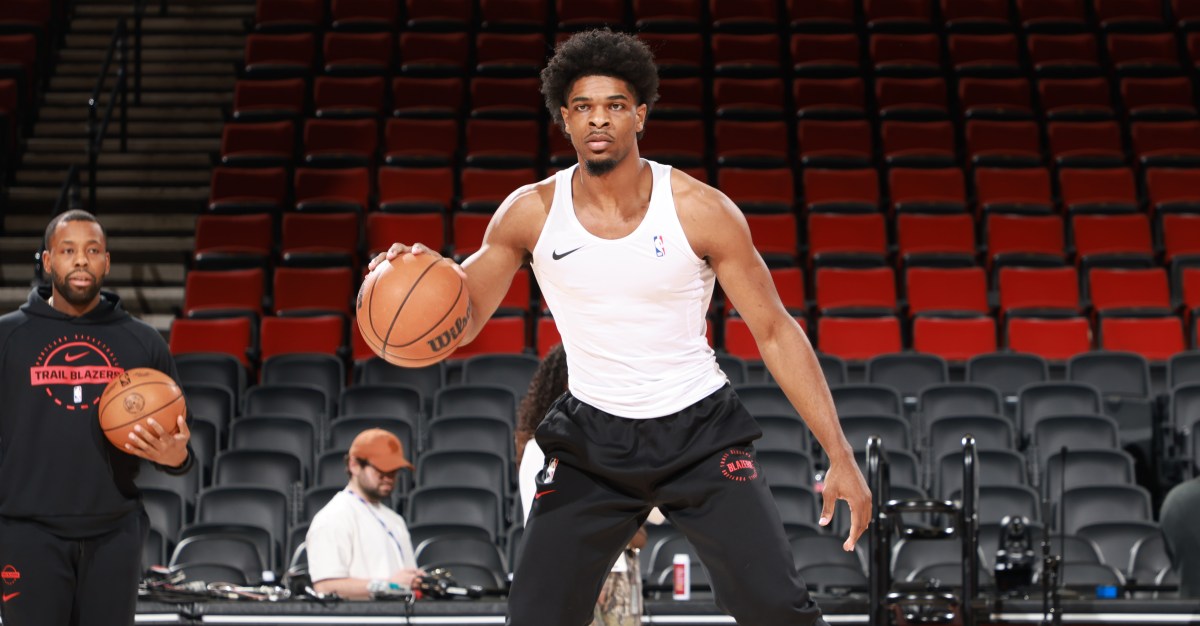
The Portland Trail Blazers currently hold a 40-38 record, good for 8th place in the race for the Western Conference playoffs bracket. That’s great for Portland, exactly what they were aiming for this season. Compared to the entire NBA pantheon, though, this is a modest achievement at best.
That gap between local agenda and global standard has plagued the Blazers for years, maybe decades. It’s rearing its head again even as they fight nobly for a Play-In spot. The issue is typified by this question from the Blazer’s Edge Mailbag.
You’ve mentioned admiring the Utah Jazz and New Orleans Pelicans recently and even suggested the Jazz might leapfrog us next year. I’m trying to shift my expectations for the team away from being the young and promising hopefuls towards actual winning. I’m not sure I’ve made it all the way, so my question is whether you still consider us a promising team? Are other teams taking over that role and if so are we winning enough to make up for it?
The Blazers DEFINITELY have half of the “young and promising” equation down. They’re young still.
Jrue Holiday is 35 years old, the clear grandpa on the team. Jerami Grant is unc at 32. The next major players are Matisse Thybulle at 29 and Robert Williams III at 28. Both have years left in their prime.
It’s worth noting that none of those players would be identified as core members of the roster. All four are important veterans; the Blazers wouldn’t be the same without them. But nobody over 28 is guaranteed to start on this team, let alone star.
Every other player at the heart of the rotation—Deni Avdija, Toumani Camara, Shaedon Sharpe, Donovan Clingan, Scoot Henderson, even Vit Krejci and Yang Hansen—is 25 years of age or younger. Camara will turn 26 in half a sneeze, but Sharpe, Henderson, Clingan, and Hansen are far younger, ranging from 20-22 years of age.
If they want to, the Blazers have a lot of years ahead of them with this basic roster. They’re as young as anybody.
Whether they’re still promising leaves room for debate.
Avdija is beginning to round into peak form. He still has areas of his game to shore up, outside shooting and turnovers among them. But Deni projects to stay at or near an All-Star level as long as he gets the reps.
Sharpe has made strides defensively but he’s still a scorer primarily. How much ceiling does he have over his current 21.4 PPG average? I don’t think anyone would be surprised to see him score 23, but 25 or 27 might be a reach. At 22 years of age, he is one of the prime targets to point at for growth potential. I don’t know how much practical room remains, though. The avenues are too few.
Camara will become as deadly of a weapon as anybody in the league if he can get his three-point percentage to 39% or above. His defense is incomparable. The only thing he lacks is the superlative floor-stretching capacity of the best 3-and-D wings. We’ve all seen what happens when he’s hot from distance. Portland’s offense opens up almost instantly. Providing that night in, night out will be the test for Toumani.
Donovan Clingan has made huge strides in his second season. If he makes even half that leap forward in his third, he’ll become an awesome advantage for the Blazers most nights. It’s likely he’ll provide a boost over the next five years beyond what we’ve yet seen. Three-point shooting and mobility are areas to work on, the keys to keeping him on the floor against varied matchups.
That said, everything we’ve talked about so far amounts to incremental improvement. We’re adding percentage points to what’s already there. Venturing outside that, we quickly hit a barrier. Clingan is never going to be a laterally mobile defender from sideline to sideline. Camara will never be a wizard on offense with the ball in his hands. Even if all these improvements happen together, none of them add truly new facets to the mix.
For those, we have to turn to the less-proven youngsters: Henderson and Hansen.
The point guard shows flashes of dominance but hasn’t put it together for more than a few weeks at a time. Even those stretches are rare and seldom unbroken. Henderson is still at the stage where we have to slice sections of his statistics to show what he might be instead of wrapping the aggregate in a nice bow to show what he is.
Hansen is a complete unknown, with various tools but zero history of putting any of them to use effectively at an NBA level.
If you want to gauge how promising the Blazers are, you’d hang about 35% on the Avdija-Sharpe-Clingan-Camara quartet. Collectively they can raise the floor of this team with their improvements. If you want to raise the ceiling, though, you have to turn to Henderson and Hansen for that other 65%. That’s a lot to assign to those two players.
One alternative would be to pull in Sidy Cissoko, Caleb Love, Kris Murray, and other young roster members below the Henderson-Hansen fame line. While I like those players for various reasons, I don’t see anything at this point that would make me think they’re the best future hopes for the franchise.
The other alternative would be to forecast future drafts and/or trades bringing in new talent to the fold. That’s probably the route the Blazers will have to take. Then we’re talking about whether a speculative, future team is promising, though, not whether the one in front of our eyes is.
Summing up, I’d say that the Blazers can still rely on being young as a natural seedbed for possible improvement. Measuring just by age, they have some claim to upward potential, more than most teams. If you look at the actual talent on board, though, other teams might have more promise. If they hit, their ceiling is higher than Portland’s even if the Blazers do get closer to maxing out their potential as the years roll by.
Thanks for the question! You can always send yours to blazersub@gmail.com and we’ll try to answer as many as possible!