
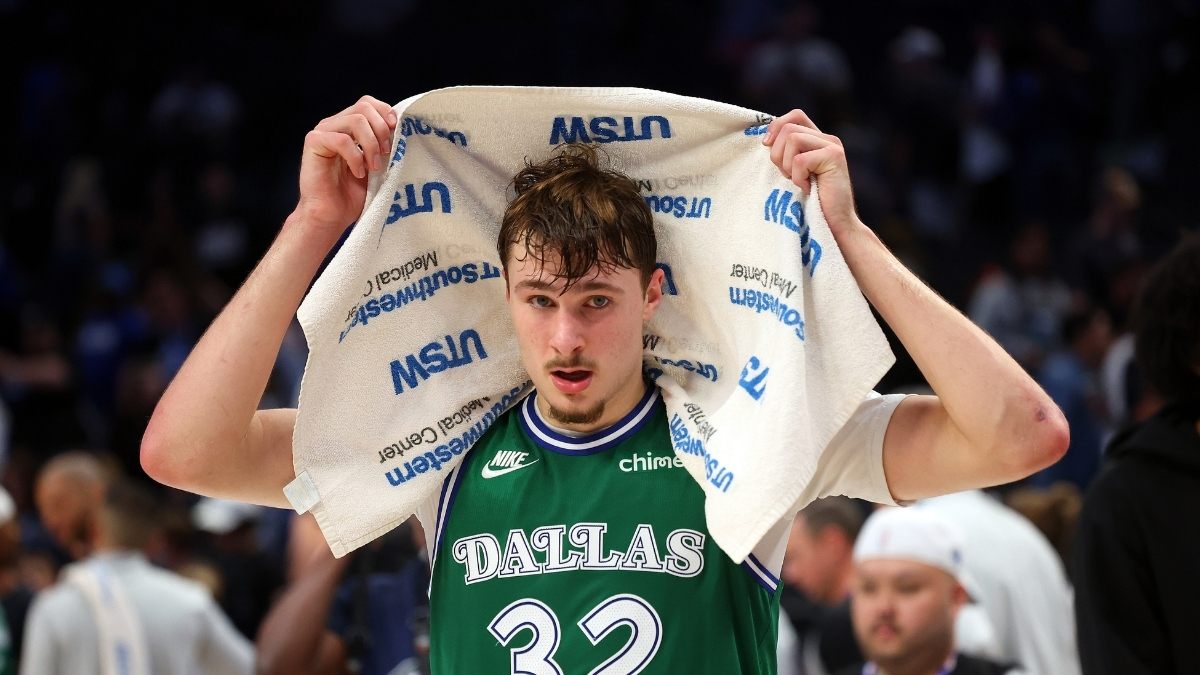
DHJ Quick Take: Cooper Flagg’s Shooting Display
The Breakout: Cooper Flagg’s 51-point performance against Orlando was a tactical pivot, not just a scoring outburst. By hitting a career-high six threes, Flagg dismantled the “pack the paint” blueprint defenses have used against him all season.
The Tech: Only 10% of Flagg’s attempts this season have come off the catch. Thursday showed a shift toward aggression, with Flagg hunting pull-up threes to punish defenders who sagged to protect the rim.
The Vet Influence: The arrival of Khris Middleton has accelerated Flagg’s perimeter patience. The two have focused on “spot identification,” allowing Flagg to spend less energy “banging” inside and more time attacking mismatches.
The Quote: Mark Cuban told Dallas Hoops Journal that if Flagg keeps improving from deep, he will be “unstoppable,” while Jason Kidd noted the shot’s importance in reducing the physical “wear and tear” on the rookie’s body.
The Outlook: With five games left, Flagg’s 29.3% season average from deep is secondary to the confidence shown in the 4th quarter. The NBA’s defensive blueprint for Flagg just became significantly more complicated.
DALLAS — Defenses have had a plan for Cooper Flagg all season when they face the Dallas Mavericks. Put the best defender on him, load up against the drive, and make him beat you from the perimeter.
On Thursday night at American Airlines Center, the strategy fell apart.
Flagg pulled up from the top of the key again and again against the Orlando Magic, firing nine three-point attempts — nearly double his previous single-game high — and making six. He finished with 51 points. More than the number, though, it was the manner that mattered. Every time Orlando dared him to shoot, he shot. When a defender sagged to protect the rim, Flagg stopped, rose, and fired. The game plan that had been containing him all season became the thing that undid them.
What Thursday revealed is not just that Flagg can make threes. It is what happens to the rest of his game when defenses have to respect that he will.
The Defensive Math
Flagg has operated this season as one of the most physically dominant drivers in the rookie class, with 51.6% of his attempts coming within 10 feet of the basket at a 58.9% clip. He is averaging 20.8 points, 6.6 rebounds, and 4.5 assists across 65 games while commanding the opposing team’s best defender virtually every night he has taken the floor.
But defenses have had a margin. When a team can pack the paint without consequence — without worrying that Flagg will pull up or step back and punish them from 25 feet — the calculus tips in their favor. Klay Thompson, who has spent over a decade on the other side of that calculus as one of the most feared shooters in NBA history, understands precisely what changes when that margin disappears.
“Just his ability to get there and rise up,” Thompson told Dallas Hoops Journal when asked what already separates Flagg as a scorer. “At 6’9″, with that play style, that’s going to be a staple of his game for the rest of his career.”
That ability is already there. It exists against defenses that are still comfortable loading up because they have not yet been forced to honor his range. The moment they do, the lanes Flagg already navigates so well open further. The pull-up he already gets to at 30.4% becomes available at higher quality looks. The catch-and-shoot opportunities he has been passing up — only 10% of his attempts this season have come off the catch — become decisions he no longer has to second-guess.
Mark Cuban, who watched Thursday’s performance from afar, went straight to that point when he shared his reaction with Dallas Hoops Journal. The importance of perimeter shooting is well established throughout the organization with significant excitement for his long-term potential.
“Insane. So much fun to watch,” Cuban told Dallas Hoops Journal. “If Coop keeps improving from three so teams have to play up on him, he will be unstoppable.”
Where the Work Has Been Happening
The shot Flagg used most Thursday — the pull-up three — is one he has been developing with deliberate intention since Khris Middleton arrived via trade at the deadline. The two share the pregame floor most nights, and the philosophy Middleton has built his career on — patience, reading the defender, knowing when to go and when to hold — has seeped into Flagg’s approach from the perimeter in ways that showed up against Orlando.
Jason Kidd traced the specific instruction as far back as mid-March, when Dallas Hoops Journal asked him about Flagg’s developmental priorities with roughly 15 games left.
“Take the three when it presents itself, when you’re open,” Kidd told Dallas Hoops Journal before a March 15 game in Cleveland. “He’s comfortable shooting it off the dribble, but we want him to get a little better with catch-and-shoot threes — less energy spent, less banging. Health is the biggest thing. He plays hard, attacks, and gets hit a lot.”
The health angle is not incidental. Flagg was assessed a flagrant foul by Desmond Bane in the second quarter Thursday — one collision among the dozens he absorbs every game by driving into the teeth of defenses. A reliable three-point shot is not just an offensive upgrade. It is a way to hurt teams without paying the same physical toll possession after possession.
“He didn’t hesitate. He was super aggressive,” Kidd told Dallas Hoops Journal of Flagg’s shooting Thursday. “He loves to drive, we all know that, but this is the next step. The attempts matter — you’re going to make some and miss some. It also helps take some wear and tear off his body so he’s not getting hit as much inside.”
Middleton connected the same idea directly to what a consistent three-point threat would unlock.
“Once he starts letting it fly and knocking those shots down, it’s going to open up so much more for him,” Middleton told Dallas Hoops Journal. “Defenses know once he gets to the paint, he’s a handful to deal with. So once he gets a consistent three-ball like he’s working on, it’s going to make him even better.”
Brandon Williams, who has been in Flagg’s ear about shooting all season, credited Middleton specifically for the progress in spot identification.
“Just finding his spots on the floor — where he likes the ball,” Williams told Dallas Hoops Journal. “He’s picking his spots, knowing when to shoot, where to get it, and he’s being more demanding. And Khris Middleton has done a great job trying to coach him, showing him how to get to those spots. Having a vet like that is huge.”
The Support Around Cooper Flagg
The data is specific about where the reluctance has lived. Only 10% of Flagg’s attempts this season have come off the catch — a remarkably low figure for a player whose size and positioning put him in catch-and-shoot situations regularly. His pull-up three at 1.9 attempts per game is already his primary long-range option, narrowly ahead of catch-and-shoot at 1.5. Both convert at similar rates, 30.4% and 28.3% respectively. While efficiency could be better, the priority right now is to get up more attempts.
Williams has been direct about it.
“Me and P.J. were telling him to shoot the ball,” Williams said. “He turns down a lot of them, but shooting the three is only going to open his game a lot more.”
The reluctance traces back to who Flagg is as a player. He defers. He finds the open man. He would rather make the right play than the highlight play, even when those two things are the same.
“He’s a humble guy,” Williams said. “He wants everybody to get touches. But when you’ve got it rolling and you’re 6’10” and basically unguardable, you need to shoot the ball. We can’t stress it enough to him.”
What Thursday Proved
Against Orlando, Flagg stopped deferring. He fired from the top of the key in the fourth quarter of a game that had already been decided, not because the outcome was in doubt but because the shot was there and he took it. Thompson noticed.
“I was proud of him, because people say that’s the part of his game that needs to improve,” Thompson said. “But at this time of year, even when you’re eliminated from postseason contention, you’ve still got work to do. He let it go and didn’t care about the numbers.”
Jamahl Mosley, who has now coached against Flagg twice and coached him during USA Basketball camp, saw the same thing from the opposing bench.
“He was coming off injury the last time we played him, so it wasn’t as explosive early on,” Mosley said. “Now you see more explosion — popping up for jump shots, the three, coming down in transition aggressively. That’s a lot for a young player, and he’s doing a heck of a job.”
Bane, who spent the night guarding Flagg and was hit with a flagrant foul in the second quarter, spoke to Dallas Hoops Journal at Friday’s shootaround.
“I think he’s got a great motor — great motor, great feel for the game,” Bane told Dallas Hoops Journal. “The sky’s the limit for a kid like that.”
Flagg, for his part, pointed to exactly the shot that has been the subject of every conversation around him this season.
“Tonight, I felt really confident off the dribble — pulling up and attacking mismatches,” Flagg told Dallas Hoops Journal. “That’s definitely been an area of growth for me this year, just trusting my pull-up and my off-the-dribble game.”
What Comes Next
Flagg said the offseason will be dedicated to it.
“A hundred percent,” he said when asked whether shooting will be a priority. “It’s the most powerful weapon — being able to knock down shots. I’ve been in the gym all year trying to stay consistent, and I’ll keep working, keep my head down.”
Five games are left in a season that has asked more of Flagg than any rookie should reasonably be expected to give. The 29.3% three-point average will not move much from here. But Thursday was not about the season average. It was about what the shot looks like when Flagg decides to use it — and what every team in the NBA will have to account for the moment he decides to use it consistently.
The defensive blueprint has been the same all season. Load up against the drive. Make him shoot. Dare him to beat you from three.
He is starting to answer that dare.