
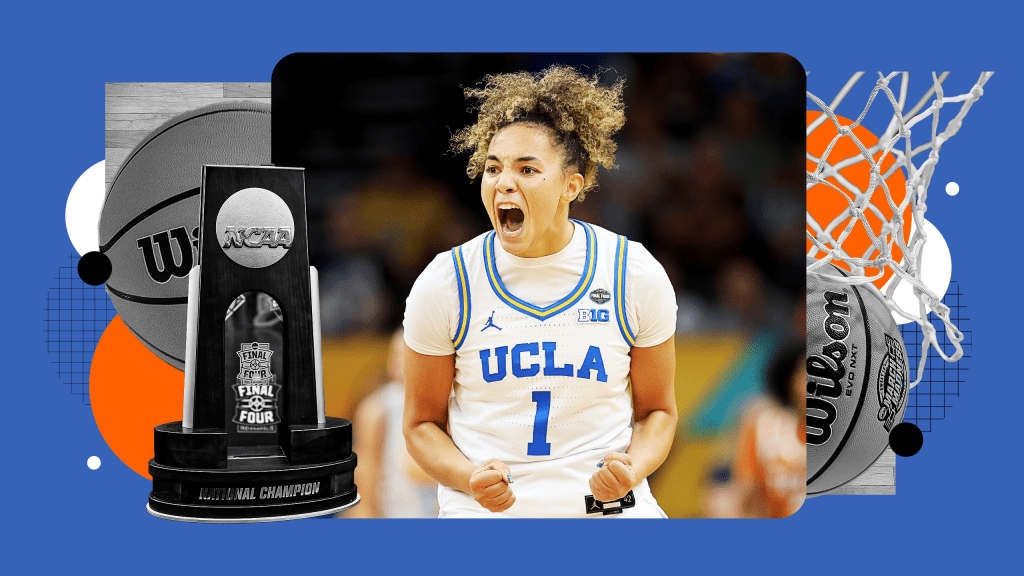
Last season, in the run-up to his 12th national title, UConn coach Geno Auriemma warned that parity was disappearing from women’s college basketball. Twelve months later, a first-time winner lifted the NCAA tournament trophy.
UCLA beat South Carolina 79-51 on Sunday afternoon in Phoenix, cracking a level dominated in recent years by just a handful of schools and coaches. The Bruins’ win was the culmination of a decade-long build by UCLA and head coach Cori Close who have capitalized on this new era of chaos in college sports to create a potential new women’s basketball power.
For one, the players. UCLA leaned heavily on a series of transfers—four of the team’s six highest scorers started their careers elsewhere—including 6’7″ star Lauren Betts, who had a 14 points and 11 rebounds in the title game. Close said earlier in the week that she would probably add another five transfers to the team next year.
UCLA also rode the latest wave of conference realignment, leaving the collapsing Pac-12 for the financial comfort of the Big Ten. The school reported $19.9 million in media rights revenue in its final year in the Pac-12, while Big Ten teams each received about $60 million in similar distributions last season. This is the Big Ten’s first women’s basketball title since 1999.
“Now being in the Big Ten, I think resource-wise, exposure-wise, commitment-wise, I think they’re leading the way nationally,” Close told reporters before the Final Four. “There is not another conference I would rather be a part of from a women’s basketball perspective. So I just am humbly thankful.”
That Big Ten money has helped UCLA start to balance what had been one of the largest athletics deficits in the country. Bruins sports have operated at a consistent loss for most of the last decade, a deficit that hit $219.5 million last year, according to the Los Angeles Times. That piled up amid mounting transfers from the university’s main campus to help stem the losses.

A women’s basketball title, of course, won’t dramatically change the economics for the school. But there is room to grow, particularly in ticket sales. UCLA reported about $313,000 in women’s basketball ticket revenue in fiscal 2024, according to Sportico’s college finance database. That ranked 34th among public FBS schools. For reference, the sport’s traditional powers all rank near the top. Iowa was first at $3.26 million, followed by UConn at $3.25 million and South Carolina at $1.6 million.
Those schools are among those that have put a near stranglehold on the top of the sport in recent years. Auriemma (UConn), Dawn Staley (South Carolina) and Kim Mulkey (LSU, Baylor) have coached 13 of the last 16 national titles.
Close has also become a prominent change agent in modern women’s college basketball. She was among the loudest voices in the sport pushing for more equality from the NCAA—a campaign that ultimately led to a much larger TV deal and a new system that pats teams for their participation. Earlier this year, following a road win at Ohio State, she was outspoken about the lack of media coverage at a game between two ranked Big Ten teams.
“We’re the only double-ranked game out today—the only one in the country—and we had no media day today. No media here,” she told the only reporter that asked to speak with her after the game. “[It’s] disappointing, honestly.”
Close is in her 15th season at UCLA. The team made the NCAA tournament just once in her first four years, but has played in nine of the last 11, including the school’s first Final Four appearance last season.
UCLA’s spending has increased heavily in that span. During the 2011-2012 season, Close’s first in Los Angeles, UCLA spent just $2.5 million per year on women’s basketball. That was the 62nd largest budget in the sport, according to data schools submit to the U.S. Department of Education. By the 2023-24 season, that had jumped to $7.8 million, the 15th highest budget in the country.
Close’s pay, however, has trailed those at the top of her profession. Staley, whose South Carolina team has won two of the last four national titles, made $4.25 million in base pay this year. Auriemma made about $3.5 million. Close’s base salary, according to The State, was $877,500 this season.
This is the second women’s tournament under the NCAA’s eight-year, $920 million TV deal with ESPN. It’s also the second women’s tournament in which teams are compensated for their participation. That system, known as “units,” was added amid criticism over the governing body’s uneven treatment of its men’s and women’s tournaments.