
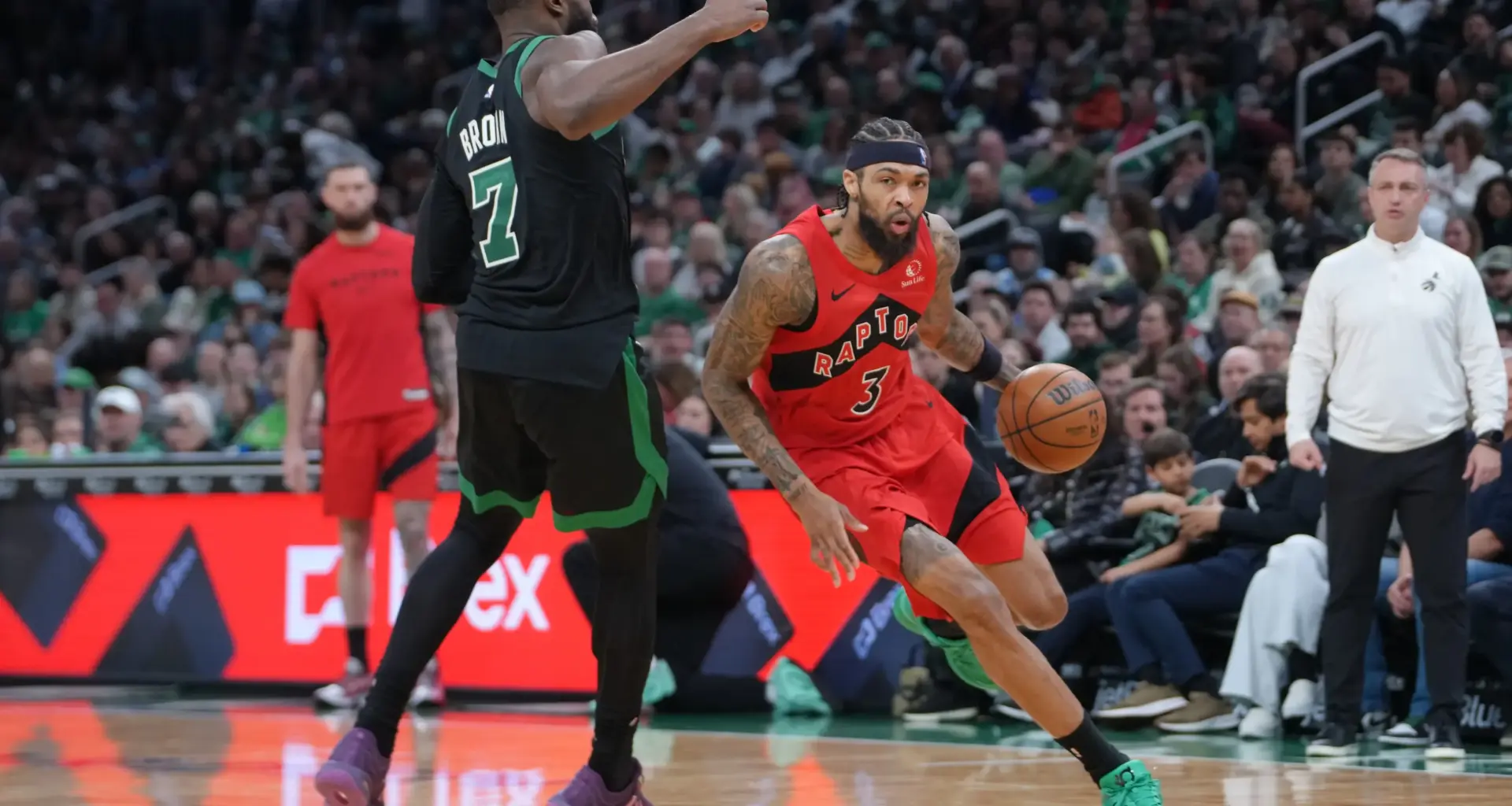
The Toronto Raptors faced one of their toughest tests of the season against the Boston Celtics, but ultimately came up short in a game that highlighted both their potential and their current limitations. Toronto’s 115-101 loss puts them at 43-35 on the year and 7th in the Eastern Conference.
Despite moments of strong play, Toronto struggled to keep up with Boston’s consistency and execution. Those lapses proved costly against one of the top teams in the East; the Celtics took control during key stretches and never fully gave it back.
Toronto Raptors Fall Short in Sunday Clash vs. Celtics
Strong Effort Early, But Boston Responds
The Raptors came into the game with energy and purpose. Early on, they matched Boston’s intensity and showed signs of a team ready to compete at a high level. Ball movement was sharper compared to recent games, and Toronto found success attacking the paint and creating open looks. That approach allowed them to stay within reach and even put pressure on Boston in the early stages.
However, maintaining that level over four quarters was the real challenge. As the game progressed, Boston began to settle in offensively and took advantage of small defensive mistakes. Those breakdowns allowed the Celtics to build momentum and slowly create separation.
Scottie Barnes Struggles to Find Rhythm
Scottie Barnes had a difficult night and struggled to find consistency on offense. He finished with 10 points (5-14 FG, 0-3 3PT), six rebounds and eight assists in 32 minutes.
From the start, Barnes had trouble establishing a scoring rhythm. His shot selection was not as effective, and Boston’s defensive schemes forced him into uncomfortable situations. Rather than dictating the pace, Barnes often found himself reacting to the defense.
While he still contributed in other areas, including playmaking and rebounding, his limited scoring made it harder for Toronto to keep up. The Raptors rely heavily on Barnes as a primary option, and when he is not producing efficiently, the offense becomes more predictable.
Against a team like Boston, that lack of scoring aggression can quickly become a problem.
Boston’s Stars Take Over
On the other side, the Celtics were led by their top players. Jayson Tatum (23 points) and Jaylen Brown (26 points) controlled the game offensively, consistently creating scoring opportunities and putting pressure on Toronto’s defense. Both players showed their ability to score in different ways. Whether it was attacking the rim, hitting mid-range shots, or knocking down three-pointers, they found ways to keep the offense flowing.
What stood out most was their ability to deliver in key moments. When the Raptors attempted to close the gap, Boston’s stars responded with timely baskets that shifted the momentum back in their favor.
Depth and Execution Make the Difference
Beyond their star players, Boston’s depth played a key role in the outcome.
The Celtics received contributions from multiple players, which allowed them to maintain a consistent level of play. Their bench provided energy and scoring, avoiding the type of drop-offs that can change the course of a game.
Toronto, on the other hand, struggled to match that level of consistency. While there were positive contributions from players like RJ Barrett (15 points, five rebounds, four assists, one block), the overall production was not enough to keep pace.
Execution also became a factor. Boston’s offense remained structured and efficient, while Toronto experienced stretches where possessions became stagnant. Those moments allowed the Celtics to build and maintain their lead.
Defensive Gaps and Missed Opportunities
One of the biggest issues for the Raptors was their defensive inconsistency. Moments of strong effort were often followed by lapses. Rotations were sometimes late, and Boston capitalized by finding open shooters or attacking closeouts.
Rebounding also played a role. Giving up 12 offensive boards allowed the Celtics to extend possessions and add pressure on Toronto’s defense.
Missed opportunities on offense also hurt the Raptors. There were several sequences where they generated good looks but failed to convert. Against a team like the Celtics, those missed chances quickly add up.
What This Game Reveals
This game served as a clear indicator of where the Raptors currently stand. They have the ability to compete and show flashes of strong play, but consistency remains the key issue. Against top-tier opponents, maintaining a high level of execution for the entire game is essential.
Toronto is still in play-in territory, but performances like this highlight the areas of improvement. Offensive efficiency, defensive discipline, and overall execution must be more consistent if the team wants to take the next step.
The Last Word
The Raptors had moments where they looked capable of competing with one of the best teams in the East. However, Boston’s consistency, depth, and star power ultimately made the difference. The Celtics executed when it mattered most, while the Raptors struggled to sustain a high level of play.
For the Raptors, this loss is both a setback and a learning opportunity. If they can address these issues and find more consistency, they still have a chance to finish the season strong.
But against teams like Boston, there is little room for error.
© Gregory Fisher-Imagn Images