
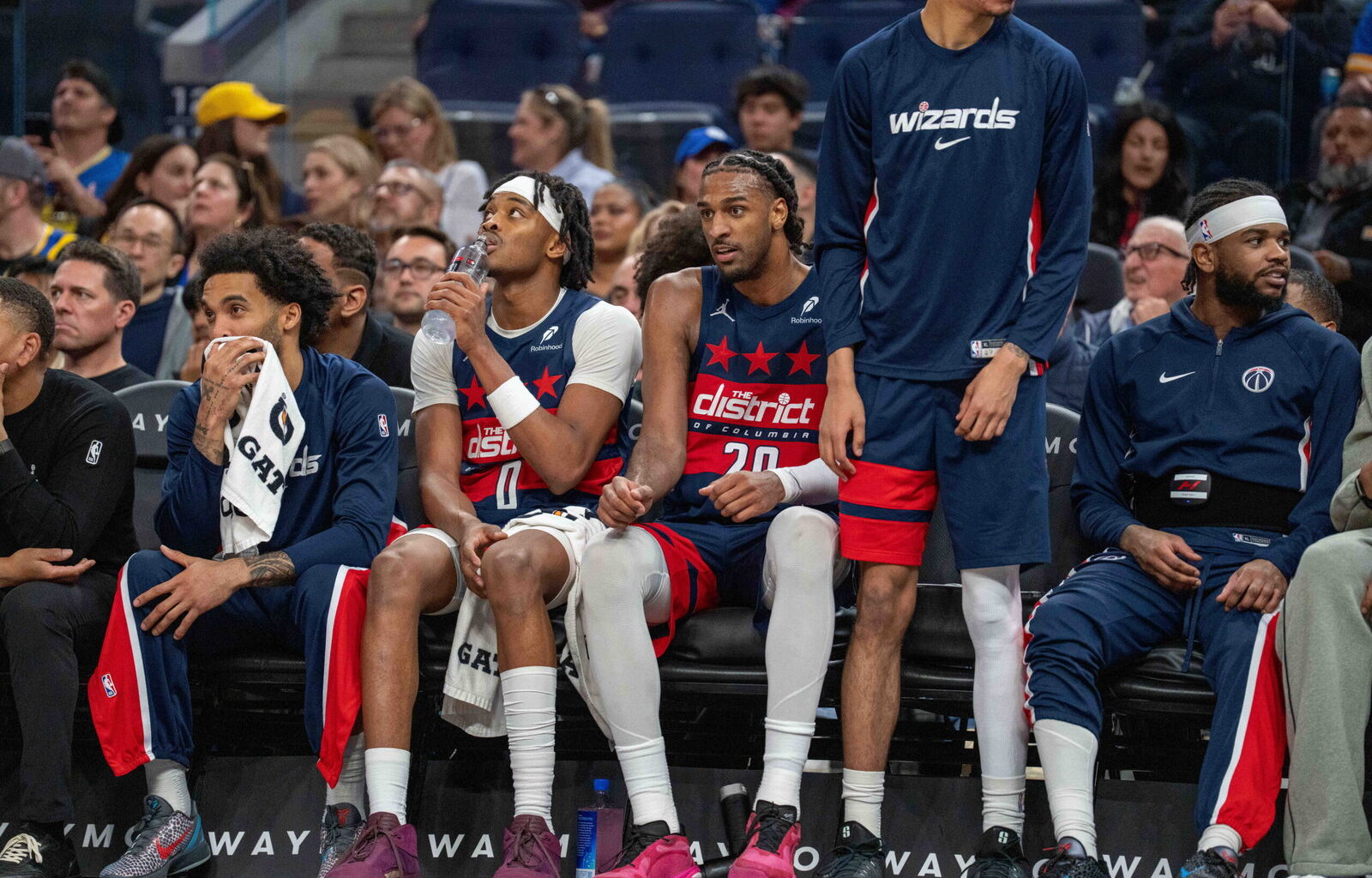
This year, the Washington Wizards’ struggles have been well documented. With the worst record in the NBA, they’ve embodied the league’s lowest tier.
There’s a list of figures to point the blame at. Washington ranks in the bottom seven in points, assists, and rebounds per game, while its bottom-four rank in turnovers has dragged its offensive rating to the league’s second-worst.
So it’s no secret that the Wizards struggle to put the ball in the basket. But what’s really stood out is their defense, or lack thereof.
They recently surrendered 153 points to the Philadelphia 76ers, tied for the league’s second-highest mark this season. Adding to their woes, the Wizards were also the infamous victims of Bam Adebayo’s 83-point explosion — the second-highest single-game scoring performance in NBA history.
Things aren’t looking pretty in Washington. This leads to the natural question: has there ever been a worse defense in franchise history?
Defensive Disaster in 2025-26 Season
The District’s young, inexperienced roster still has to get over the defensive hump. Time is often the best healer for these struggles, but this season, the roster of four rookies and five sophomores has seldom gotten stops.
Washington’s dead-last 121.3 defensive rating, combined with their league-worst -11.4 net rating, tells the story of a team paying for preventable mistakes.
The Wizards give up buckets due to miscommunication, whether in transition or in the pick-and-roll. As guards up top and bigs in drop-coverage handle screens, there have been countless misreads.
One free roll to the rim was so egregious that it had Celtics color commentator Brian Scalabrine baffled in a viral clip.
Even with 7-footer Alex Sarr, who, in fairness, has been plagued with injuries, the restricted area has become free rein for opponents. It’s due to the aforementioned miscommunication and a lack of energy that opponents score 55.5 points in the paint and 17.2 second-chance points per game — second most in the association.
The perimeter defense hasn’t fared much better. Washington’s tendency to over-help on drives often leaves shooters unattended, contributing to opponents hitting 36.6% from distance.
That made for Paul George’s season-high 39-point game.
Compared to the 1993-94 Season
As basketball has evolved, comparing eras has grown difficult. But looking at relative defensive rating helps level the playing field.
The 1993-94 Washington Bullets owned a +5.9 relative defensive rating and a 112.8 defensive rating, both worst in the league. The Rex Chapman and Don MacLean-led unit went 24-58 and boasted the East’s third-worst record.
The Bullets did very few things well and many things poorly. They left shooters open and paid for it, as opponents shot 34.9% from three, 1.6% above the league average.
Despite the lax perimeter defensive effort, opponents thrived within the arc as well. Allowing 52.6% shooting on two-pointers, Washington was the worst out of the NBA’s then 27 teams.
And by rejecting just 3.9 shots per game, they ranked third-worst. That’s even crazier considering the Bullets had the tallest player in league history, Gheorghe Muresan, at their disposal, though he played just 12 minutes per game.
Notably, they failed miserably at one of basketball’s defensive “Four Factors”. Statistician Dean Oliver considers the most important factor in defensive success to be effective field-goal percentage. Washington’s 52.6% allowed mark added up losses on its schedule.
2008-09 Season
The 2008-09 Wizards were transitioning out of one of the few bright periods in franchise history. After making the playoffs four years in a row for the first time since 1988, they went 19-63 — a hard fall from 43 wins the season prior.
With Gilbert Arenas only playing two games as he rehabbed from knee surgery, Washington dropped to the bottom of the league’s power rankings. While Antawn Jamison and Caron Butler recorded career years, defense wasn’t their strong suit.
The Wizards tallied a 113.6 defensive rating, second-to-last in the NBA, and a +5.3 relative defensive rating. Rebounding was a major weakness, as they managed to haul just 28.4 defensive boards per game and allowed 13.2 second-chance points.
Opponents faced little resistance. Teams shot 2.3% better from the floor than league average playing against Washington and moved the ball with ease, as the Wizards allowed a league-high 24.6 assists per game.
The low point came on Dec. 11, when the reigning champion Boston Celtics blew them out by 34 points.
The Verdict
There are three key criteria to consider: relative defensive rating, raw damage (points allowed), and context.
Of the three, the 2025–26 Washington Wizards stand out immediately. They don’t just own the worst relative defensive rating in franchise history — they separate themselves from the pack. This isn’t simply bad, it’s uniquely bad.
The eye test reinforces the numbers. Outside of highlight blocks from Sarr, Washington defines their defensive possessions by blown coverages, slow rotations, and lazy point-of-attack defense. It’s also hard to get past the fact that they concede 124.3 points per game, and their reputation won’t recover quickly after allowing Adebayo to pass Kobe Bryant‘s 81-point record.
An important factor is the team’s roster construction. This tank squad isn’t expected to be good; they’re expected to grow, but this level of inefficiency couldn’t have been the plan.
The 1993-94 Bullets posted the second-worst relative defensive rating. Their raw damage may not be as glaring as this year’s, but the context of their failures makes it that much more unacceptable. This was a team of veterans who all played the season largely healthy, which makes their shortcomings less excusable.
The 2008-09 Wizards deserve more grace. With the face of the franchise sidelined, they lacked direction. Still, a 24-win decline from the season before is hard to ignore.
With the slow-paced style of the late 2000s, they didn’t surrender eye-popping amounts of points to their opponents. Their relative defensive rating, on the other hand, was 5.3 points above the league average and ranked third.
Ultimately, the 2025-26 Wizards take the title as the organization’s most dysfunctional defense. Adjusted for era, no team has performed worse relative to their competition. Night after night, they give up points in ways that reflect a team unable to cover the basics of defense.
But there’s reason to believe light exists at the end of the tunnel. With the franchise shifting direction after acquiring Anthony Davis, these struggles may end soon, and this season could be remembered as the low point before the revival.