
WASHINGTON — Will Riley has always sought artistic outlets.
As a child, without taking a lesson, Riley taught himself to play the piano. He learned how to juggle. Around the seventh grade, he started cutting friends’ hair, even setting up a makeshift barbershop in his mom’s basement. He customized his own clothing, occasionally turning pairs of jeans into art pieces.
When his family would gather for major holidays, he sometimes entertained everyone with juggling and magic shows. His mom used to joke with him that, if his basketball career didn’t work out, he could always make a living as a circus performer.
“One thing I know about Will is that he’s a very creative kid,” his mom, Tracy Hooks-Riley, said in an interview.
Riley still plays the piano — with one of his first NBA paychecks, he even purchased a baby grand — but these days, he saves most of his creativity for the basketball court.
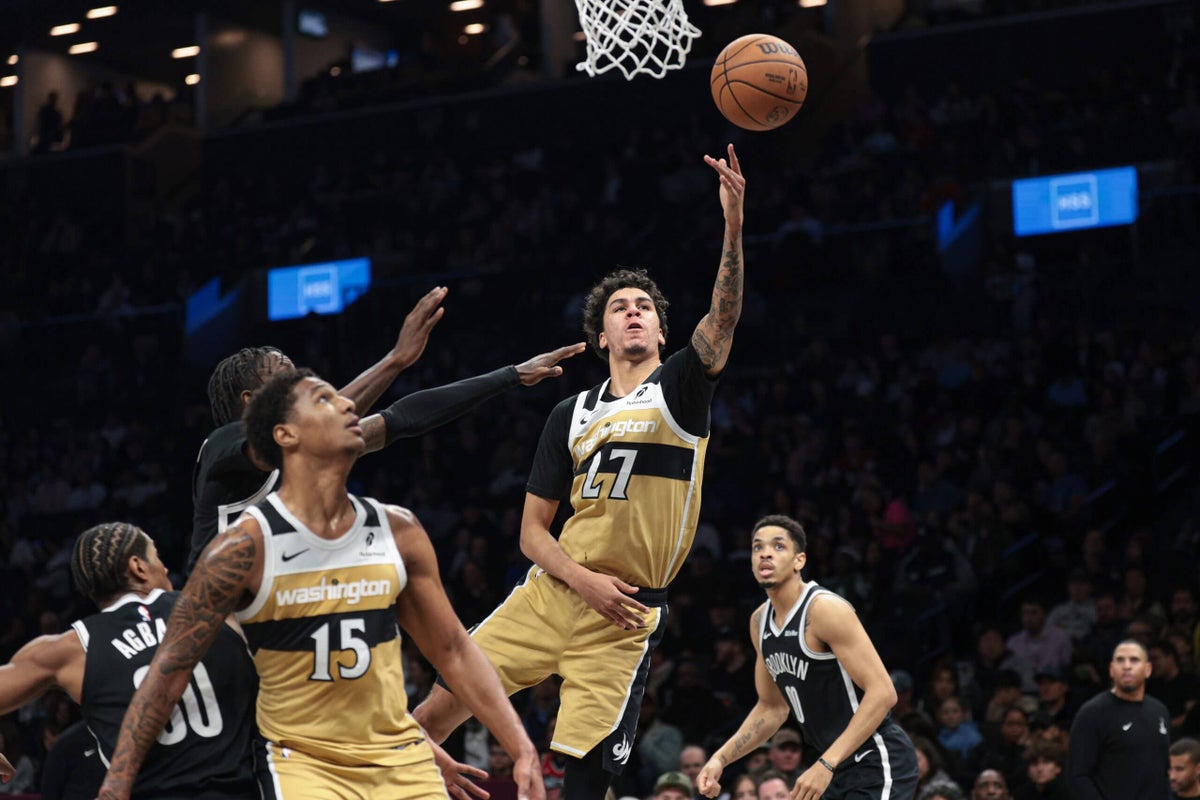
A 6-foot-10 rookie swingman, Riley has emerged as one of the Washington Wizards’ most intriguing players, an impresario when he dribbles and drives to the hoop. With team officials sitting many other rotation players down the stretch, Riley has led the Wizards in scoring in five of their last six games, including a 31-point performance in a loss Saturday in Miami and a 30-point performance in a defeat Sunday in Brooklyn. His late-season surge could earn him votes for one of the league’s two All-Rookie teams.
The scoring totals indeed have impressed, but perhaps even more promising for his future, and for the Wizards’ future, is how Riley has compiled his points. He plays with an artistry, a sophistication and a distinctive pace that sets him apart from most first-, second- and third-year players. He has excelled at finishing near the rim and at drawing fouls. He makes difficult shots against tight defenses, but he also manages to generate open shots for himself through his unpredictable dribbling, shifty footwork and improvisational use of his pivot foot.
None of this has surprised his Wizards teammates. Bilal Coulibaly, the team’s best perimeter defender, has played plenty of one-on-one against Riley. Coulibaly found it challenging.
“There’s one guy I cannot guard. It’s Will Riley …,” Coulibaly said. “He’s just different. Like the way he moves, you don’t see it really often. So that makes him really, really tough to guard.”
Over the last two weeks, Riley has made accomplished veteran defenders such as the Golden State Warriors’ Draymond Green, the Portland Trail Blazers’ Jrue Holiday and the Los Angeles Lakers’ Jarred Vanderbilt look foolish.
On March 27 in San Francisco, Riley found himself guarded by Green one-on-one during the final eight seconds of the shot clock. Using hesitation dribbles and dekes, he drove from the right wing to the basket, faking out Green with a modified show-and-go, up-and-under scoop layup.
On March 30 in Los Angeles, Riley cut across the lane, toward the basket, and received a pass from Tristan Vukčević. Because Vukčević led Riley a bit too much, Riley’s momentum carried him along the baseline, heading to the court’s right corner, with Vanderbilt draped over Riley’s back. Riley maintained his dribble, rotated to his left and faked out Vanderbilt. The sequence ended with Riley tiptoeing along the baseline for a dunk with Vanderbilt unable to contest the shot.
Two days later, a reporter showed Riley video of that possession against the Lakers and asked him to describe how he maneuvered past Vanderbilt. “I think it’s just feel and just knowing where your defender is and just making a read off him,” Riley answered.
Riley sounded as if he had made a routine play. His response was almost a matter-of-fact response, as if he did not want to sound boastful. To team outsiders, he tends to appear quiet and almost unduly modest.
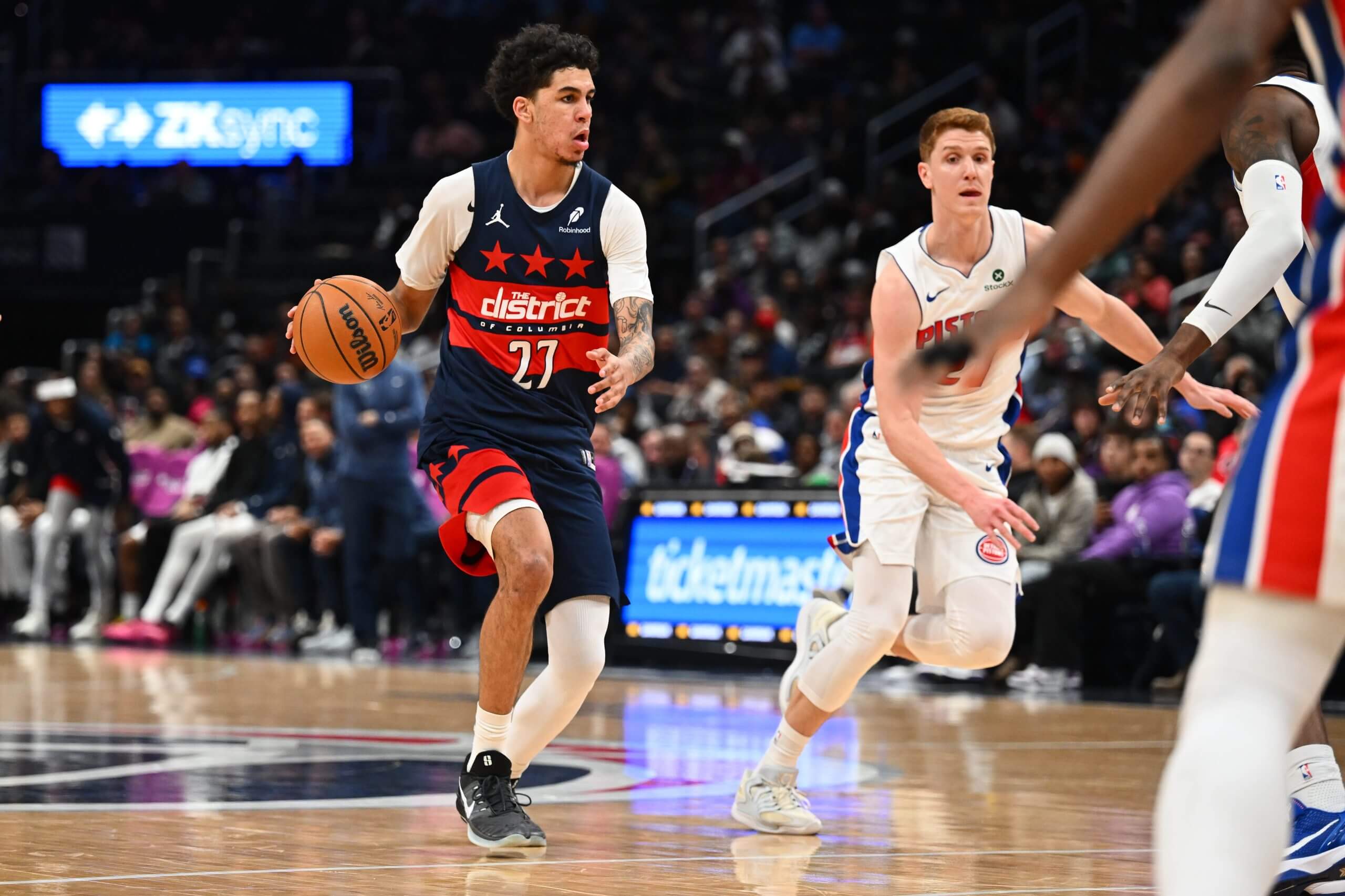
An array of fakes, dekes and hesitation dribbles makes Will Riley a difficult player to guard. (Brad Mills / Imagn Images)
He does not need to tout himself, though. His teammates will do that for him.
“Timing peoples’ dribbles is the best way to guard them,” guard Bub Carrington said. “… You can’t time his dribble. He has a unique way of dribbling, a unique way of moving. So, in a way, you can’t time him, you can’t guess. So, you’re always reacting (as a defender against him), you’re never the aggressor. You’re always reacting to Will. So, you react too late or you react not enough. You’re going to foul him or whatever. He’s got you from there.”
Riley’s statistics show how difficult he has been to guard. Since the All-Star break, he has made 49.8 percent of his shots overall and 34.8 percent of his 3-point tries.
In that same span, Riley ranks in the 88th percentile among the league’s wings in converting attempts at the rim and in the 89th percentile among wings in drawing shooting fouls, according to Cleaning the Glass, an advanced analytics database.
“His efficiency, for someone who is so young in this league, that’s pretty unique,” Wizards coach Brian Keefe said. “Most guys aren’t that efficient, especially around the rim. His ability to get to the rim, his ability to get fouled, that stuff really stands out.”
If Riley is this efficient now, having turned just 20 years old in February, how much better can he become, especially when he’s complemented by more experienced teammates? In recent weeks, he’s played most of his minutes alongside players such as Carrington, Jamir Watkins, Justin Champagnie and Anthony Gill. Next year, he might earn a higher proportion of his minutes alongside Trae Young, Kyshawn George, Anthony Davis and Alex Sarr, who should all command opponents’ attention to a greater extent than Carrington, Watkins, Champagnie and Gill do.
These “what ifs?” make Riley’s future especially tantalizing.
If it sounds as if Riley came out of nowhere, there’s a reason for that. During his one-and-done season at the University of Illinois, he started slowly. Although he was named the Big Ten Sixth Man of the Year, he did not make the conference’s All-Freshman team. He was overshadowed by Rutgers’ Dylan Harper and Ace Bailey, Maryland’s Derik Queen, Michigan State’s Jase Richardson and Illinois teammate Kasparas Jakučionis.
He lasted until the 21st pick in the draft last June, and the Wizards acquired his draft rights (along with Watkins’ draft rights and a pair of future second-round picks) from the Utah Jazz for Walter Clayton Jr.’s draft rights. The trade has the potential to be one of the most insightful decisions that Washington’s current front office has made.
General manager Will Dawkins said the Wizards’ scouts had studied Riley’s game as far back as Riley’s early prep school days in Ontario, Canada, viewing him as a potential ballhandler and offensive initiator.
“We knew he kind of fit our profile,” Dawkins said. “We spent a lot of time on the grassroots watching and seeing who he is as a player there. He was different than when he was at Illinois.”
To put it another way, Dawkins and his scouts recognized a creativity in Riley’s game that Riley didn’t always have the opportunity to show in college but has always been there.
Riley still plays the piano, about every other day when he’s in town, for about 15 to 20 minutes at a time. He said it serves as a release when he’s bored.
His interest in music and his on-court skills stem from the same place.
“A creative mind,” he said. “I feel it takes me very far.”