
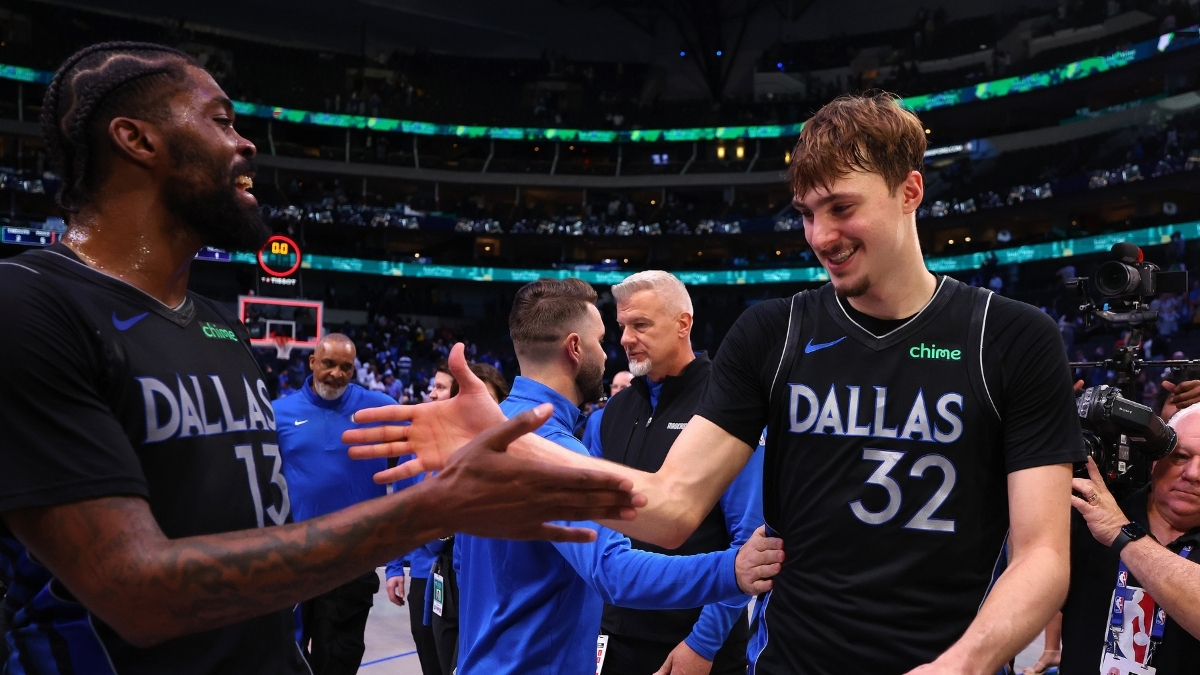
DHJ Quick Take: Collective Excellence
The Turnover Turnaround: The Mavericks committed just seven turnovers—their lowest mark of the season—including a turnover-free fourth quarter. Jason Kidd noted that this discipline allowed Dallas to maintain offensive rhythm and maximize the impact of Cooper Flagg as a primary initiator.
The Transition Weapon: Dallas outscored the Los Angeles Lakers 24-14 in fast-break points. Cooper Flagg and Jason Kidd both highlighted a deliberate shift toward transition play, using Flagg’s instincts at speed to keep the Lakers‘ defense from setting up, resulting in a season-high 41-point first quarter.
Secondary Playmaking: While Flagg’s 45 points stole the show, Kidd praised the “connective tissue” provided by Brandon Williams and Naji Marshall (who posted his 9th 10-5-5 game of the season). Their ability to keep the team “organized” allowed the “ball to hum” throughout the 134-128 victory.
DALLAS — Seven turnovers. 134 points. 14-of-32 from three. 24 fast-break points. Zero turnovers in the fourth quarter. Sunday night against the Los Angeles Lakers, the Dallas Mavericks put together the most complete offensive performance of their season — and did it when it mattered most, on national television, against a playoff-bound roster, in front of a sellout crowd that had been waiting months for a night like this.
The final score told part of the story. The process behind it told the rest.
“I thought it was great,” Cooper Flagg said of the offensive performance. “It’s something I always come back to when we have a better offensive game — we’re organized. When guys are on the same page, it looks a lot better out there.”
The Turnover Difference
Dallas has been one of the league’s most turnover-prone teams this season, a byproduct of youth, injury-driven roster instability, and the burden of asking Flagg to initiate nearly everything offensively. Sunday night was different.
The Mavericks committed just seven turnovers in the game — and none in the fourth quarter, when the Lakers were mounting their most dangerous run and every possession carried maximum weight.
Jason Kidd pointed to ball security as the foundation everything else was built on.
“I think we’re getting a little bit better at taking care of the ball,” Kidd said. “When we do take care of the ball, we get good looks. Tonight’s another example of that.”
Kidd referenced a recent game against the Denver Nuggets where Dallas had similarly protected the ball in stretches — an indication that Sunday was not a one-night aberration but part of a developing pattern.
“I don’t know if it was the Denver game where we might not have had a turnover in a half or had three — something extremely low,” Kidd said. “So when we do take care of the ball, we get good looks.”
The Pick-and-Roll Blueprint
The offensive structure that made Sunday work was not complicated. It was disciplined. Dallas ran pick-and-roll actions with purpose, got the matchups they wanted, and let Flagg operate from there.
P.J. Washington broke it down simply postgame.
“I think for us it’s just being able to get stops and play in transition,” Washington said. “We did a good job of bringing who we wanted into the pick-and-roll and letting Cooper kind of do his thing. Obviously, he made shots tonight. He made the right reads on pretty much every possession. We passed the ball, we got good shots, we hit. The ball was humming, and I just felt like everybody had a great game and we just played together.”
That collective rhythm — ball movement, purposeful screening, and players hitting their spots — produced 134 points on 52.3% shooting and 43.8% from three. It was the Mavericks’ 16th game this season with at least 14 three-pointers on 40.0% shooting or better.
Williams and Marshall as the Connective Tissue
One of the most encouraging elements of Sunday’s offensive performance was not Flagg’s individual production — which was historically dominant at 45 points, 8 rebounds, and 9 assists — but rather the players who kept things organized when he needed a breather.
Brandon Williams ran the offense with poise in stretches, finishing with 13 points, 5 assists, and 2 steals while generating consistent advantages in pick-and-roll coverage. Naji Marshall was equally effective as a secondary playmaker, posting 13 points, 7 rebounds, and 7 assists in 31 minutes — his ninth 10-5-5 game of the season.
Kidd credited both for keeping the offense humming in ways that extended beyond the box score.
“Brandon Williams — we’ve been talking about him running the team — he’s been doing a great job,” Kidd said. “I think Naji also loves playing the point guard position, so being able to play through him and for him to get us organized has been great. And then again, Cooper handling the ball down stretches has been good for us, too.”
That last point matters. Flagg’s ability to function as a primary ball-handler in critical moments — making reads, finding cutters, and getting to the free-throw line — gave Dallas a multilayered offensive attack that the Lakers had no consistent answer for.
Transition as a Weapon
Dallas outscored Los Angeles 24-14 in fast-break points Sunday night — a margin that reflected both the Mavericks’ defensive activity and their ability to push pace before the opposing defense could set up.
Flagg had emphasized the transition game as a deliberate strategic choice.
“We wanted to play with great pace and get up the floor really fast, just to keep the rhythm in our favor,” Flagg said.
Kidd had laid out the same philosophy pregame, describing how the Mavericks had built their offensive identity around Flagg’s instincts at speed.
“For him to understand at that speed how to make plays — he’s not always looking to score, but he’s trying to make the game simple and fun,” Kidd said.
The numbers validated the approach. Dallas scored 41 points in the first quarter — its highest-scoring period of the season — on 61.5% shooting, with 7 fast-break points in the period alone.
A Blueprint for Next Season
The significance of Sunday’s offensive performance extends beyond the final score. With Kyrie Irving and Dereck Lively II both expected to return from surgeries next season, and a high draft pick on the way, the Mavericks are building toward a roster that will be significantly more capable than the one that has taken the floor this year.
What Sunday showed is that the offensive infrastructure — the pace, the ball movement, the pick-and-roll execution — is already in place. When the personnel around Flagg is healthy and consistent, the ceiling for this offense is considerable.
Washington pointed to health as the single biggest variable heading into next season.
“Obviously, we get Kai back, we get Dereck back, start to build a really great team,” Washington said. “Guys will be healthy, guys will be working together. I think it’s going to be really good for us to get some time off and then some time to work together and just see how we look next year.”
Sunday night was one game. But it looked, for stretches, like a preview of something bigger.
Up Next
The Mavericks take on the Los Angeles Clippers at Intuit Dome on Tuesday night.