
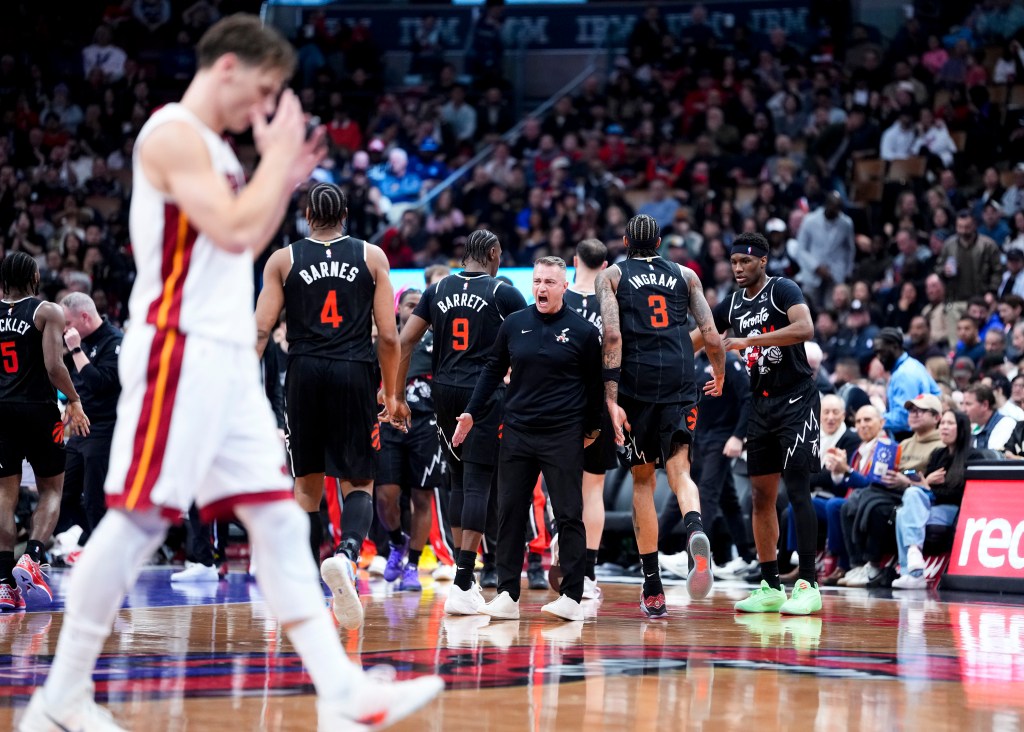
Q: Ira, I know it’s your job to ask questions and try to get answers. But blah, blah, blah, blah, blah. Don’t say it, do it. Have some pride. – Angel.
A: Agree, because even as the questions are asked and then answered by Erik Spoelstra, Bam Adebayo and Tyler Herro, the words aren’t getting anything done. With the Panthers you could appreciate the physical wear and mental drain of three consecutive seasons in the Stanley Cup Final. No one is asking them to explain themselves for this season’s step back. They’ve earned the time off. But this is a Heat team that has been done in the postseason by May 1 each of the past two years. The fatigue should be with losing. Even last year, during the 10-game losing streak, the games were more competitive than this recent stretch. It hasn’t felt this low since the 11-30 start to 2016-17. But even then there was time to make things right with the 30-11 finish. Now there is only an expiring clock.
Q: Ira, so If you feel that the Heat’s 10th-place position is based on 10th-place talent and not on Erik Spoelstra (and now four straight years in the play-in), the blame must fall at the feet of Pat Riley. – Joel, Plantation.
A: Or at the feet of an institutional mindset of refusing to step back to step forward. Say what you want about the personnel moves of Pat Riley and his staff, but also look at how almost every elite contender has been built, as in with lottery-level talent, players picked at the top of respective drafts, players such as Cade Cunningham (No. 1 overall), Jayson Tatum and Jaylen Brown (each a No. 3), Evan Mobley (also a No.3) in the East, Victor Wembanyama (No. 1), Chet Holmgren (No. 2), Jamal Murray (No. 7), Amen Thompson (No. 4) in the West. Now, in some cases, teams have traded up for such picks by moving off proven talent, so perhaps that is what Pat Riley and the Heat have to consider next. But this is more an institutional approach, one that transcends merely Riley, one that only truly can be set at the top, by the Arisons.
Q: Ira, I know the Heat point to victories over the Pistons, Knicks, Cavs, Nuggets, Thunder and Rockets as proof that they are better than the record, but that’s not what matters. What matters is proving you can routinely beat such teams, since it takes four wins in the playoffs. So let’s settle down about what you have termed “the good wins.” Good wins are doing it and then doing it again. – Steven.
A: No disagreement here. While many point to a record inflated by loading up on victories against the likes of the Nets and Wizards and Bulls, there also have been enough victories over quality opposition (albeit while some of the opposition’s leading men have been injured) to make a case for the Heat being postseason worthy. But save for the seven-game winning streak (one that included a pair of those wins over the Nets and another over the Wizards) there has been little in terms of enduring success since early in the season. So are the Heat built to beat anyone on any given night? Erik Spoelstra has a way of stepping up to such moments. But are they capable of beating playoff-quality competition four times over seven games? We have not seen that, which means a team simply not good enough to make it out of April.