
LAS VEGAS — “None.”
That’s how much interest former Brooks Bandits head coach and general manager Ryan Papaioannou said T.J. Hughes garnered from NHL clubs in his three seasons in the AJHL from age 17-20.
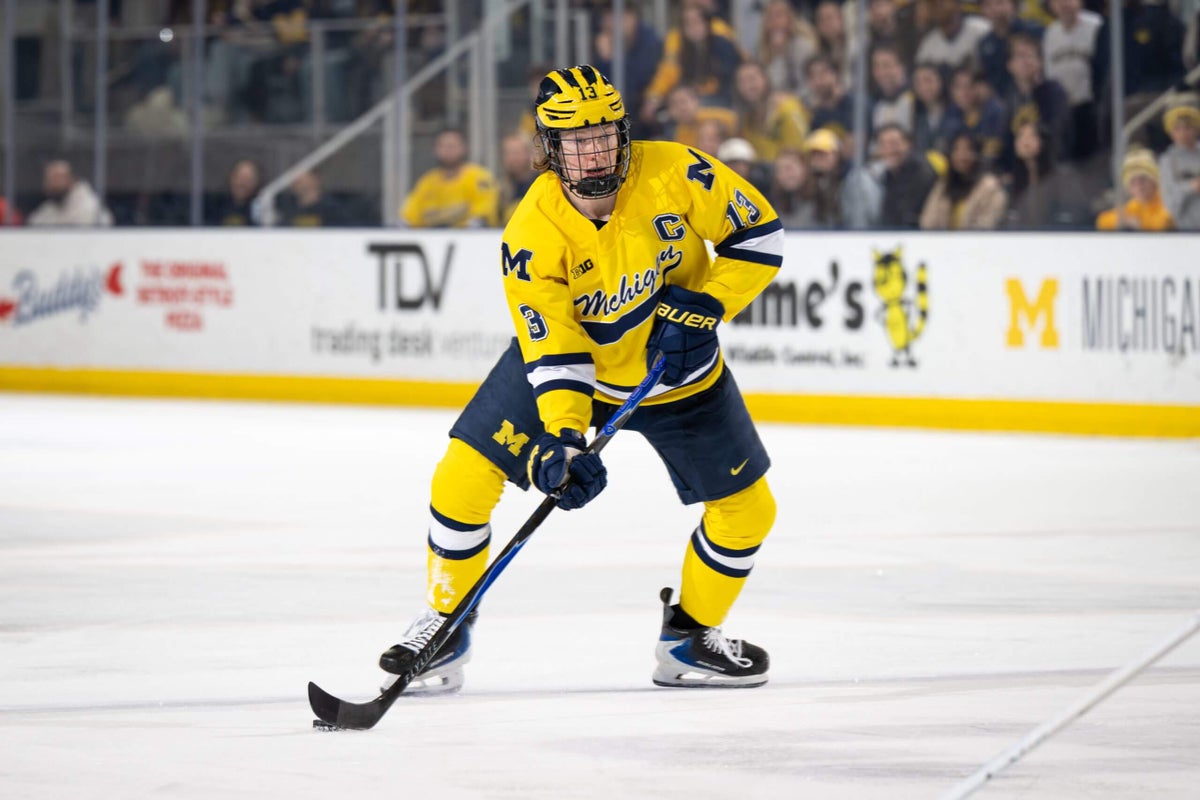
Four years later, inside the Presidio Ballroom at Las Vegas’ Park MGM hotel and casino on Friday night, Hughes was a nominee for the 2026 Hobey Baker Award as the top player in Division I NCAA men’s hockey after he finished second in the country in scoring with 57 points in 40 games.
A night earlier, he scored in the Frozen Four semifinal, but his Wolverines came up a goal short against the University of Denver.
At the podium in defeat, Michigan head coach Brandon Naurato called Hughes a program changer who had done something “really special” for the Wolverines, setting a new standard with his daily habits at and away from the rink, and leading a team that, following a disappointing 2024-25 season, had brought in 15 new players and 12 freshmen.
“There’s really no words,” Hughes said of his time at Michigan, his voice quiet. “It means everything. I’ve tried my best to leave the block better than I’ve found it, and there’s just so many people that have impacted my life in a positive way. I’ll forever be blessed, I’ll forever be grateful. I just couldn’t be more grateful to be a Michigan Wolverine.”
And in the coming days (potentially as soon as today), Hughes, a 6-foot, 183-pound center, will field a long list of offers from NHL teams as a coveted college free agent and make his decision.
His journey to this point has been a long and winding one.
An Ontario scout for Brooks found Hughes playing Jr. B hockey for the Hamilton Kilty B’s, and the Bandits convinced him to leave home, where both of his parents, Terry and Lisa, are teachers and his two older sisters, Olivia and Vanessa, were high-level basketball players, to move to the southeast Alberta town of about 14,000 people.
After speaking with a couple of people who’d played in Brooks, he decided to take the chance.
Initially, Papaioannou said it didn’t click for Hughes. He turned 18 in November of that first season, and even though he’d had success at the Jr. B level in the GOJHL, the jump to Jr. A and the move out west proved to make for a trying season for him.
He spent much of that first year on a deep Brooks team’s fourth line, and while it was “no fault of his own,” that first year was “maybe a bit of a step back,” according to Papaioannou, who’s now the head coach of the ECHL’s Wheeling Nailers.
“It definitely took time,” Papaioannou said.
But Papaioannou and Hughes had good meetings all year, and a year-end meeting that his former coach remembers as the most impactful conversation they had.
When Hughes returned, he was a different player, committing in that offseason to change a lot of his habits, from when he slept to what he ate and how he trained.
The following season, though it was COVID-shortened, he took off, leading the league’s pseudo-bubble campaign in scoring with 31 points in 20 games.
“I was a late bloomer. Even in high school, compared to my friends my age who were even not hockey players, I was just always one of the smallest guys height and weight-wise,” Hughes said. “I didn’t really grow and kind of get bigger until later in high school, and then once I caught up that way, I was able to compete more and play the way I wanted to. I always had a good brain and a good IQ, and once my body caught up, that’s when things clicked for me.”
After returning for a third season, he registered another 66 goals and 127 points in 60 games. That year, he won an AJHL championship with the Bandits and the league’s top forward award. He also added another 12 points in six games at the national Jr. A championship, the Centennial Cup.
“He was just a tremendously different person and player by the time he was leaving. He was probably the poster child for how you do it right, the way that he ate, trained and treated his body. He became a model citizen for the rest of our players to look at and understand what we thought at the time it took to be a pro,” Papaioannou said. “They saw that he was doing all the right things off the ice, and then on the ice, it was the puck skills, the deception, the offensive intelligence. He was operating at a different level than other players and other teams by the time he left. He was fortunate to have some real good linemates and guys on his power play unit at the time, too, and those guys absolutely feasted on the competition that year.”
Still, while he was “elite at a lot of things” by the time his time in Brooks was done, according to Papaioannou, his skating was still just OK, and nobody “saw him as a prospect yet.”
But the one thing he had going for him was that “his brain was at another level,” Papaioannou said.
Michigan’s coaching staff, led by Naurato, saw it too and offered him a scholarship.
At the time, Papainoannou wasn’t sure if the Wolverines, with all of their top recruits, were the best fit for Hughes.
“I don’t know if you’re going to play enough,” he remembers telling Hughes.
Today, though, he laughs about that.
“Yeah …” Papaioannou said. “T.J. just keeps proving people wrong.”
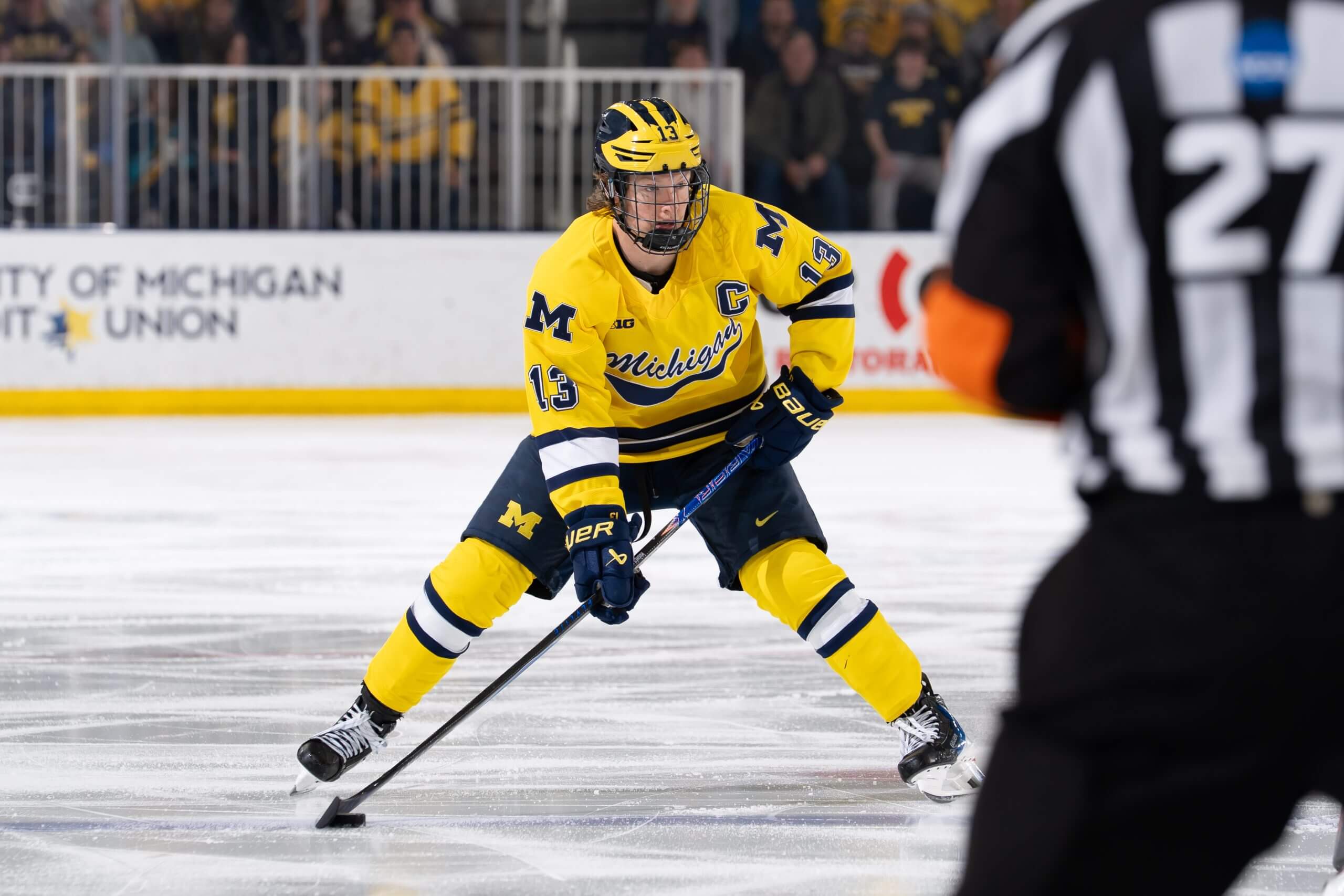
T.J. Hughes was named Michigan’s captain this season. (Michigan Photography)
Interest in Hughes started immediately in college. He was nearly a point-per-game player as a freshman and above it as a sophomore and junior.
He could have turned pro last spring. But after a disappointing season by Michigan’s standards resulted in them missing out on the national tournament, he decided instead to return for his senior year and finish his degree in kinesiology.
Naurato and his staff named him captain, and he delivered on his promise to help get them back to where they wanted to be as a program.
“It wasn’t the year our team wanted to have, and you come to Michigan to win championships, make the tournament, and win Big Ten championships,” Hughes said of the decision. “It felt bitter not even making the tournament. I always wanted to stay the four years, graduate and have an impact and be a Michigan man. It was always my goal to do that. … I’ve been so happy to lead them this year.”
Michigan finished the regular season as the No. 1 team in the country. Hughes delivered in the Big Ten championship game with three points, and again with another three in the first round of the Albany Regional. And though it wasn’t enough, he gave the Wolverines a 2-1 first-period lead over Denver on Thursday night. At Christmas, he also wore an “A” for the U.S. Collegiate Selects at the Spengler Cup, registering four points in four games.
When his collegiate career was over, he’d registered 179 points in 156 NCAA games, averaging 45 points a year.
“It’s going to be really, really, really tough to replace T.J. Hughes,” Michigan assistant coach Kevin Reiter told The Athletic, “not only the points and everything on the ice but just what he brings and embodies off of the ice, in the room, in the community. It’s everything he does. I can’t say enough about the quality of person he is. How prepared he gets our group. What he has done to help us be there and be ready.”
In his three seasons coaching him at Michigan, Reiter said Hughes made the biggest improvements in his 200-foot game and overall responsibility and awareness defensively. His skating and pace of play have come around, too.
“I think the pace and the processing and the way he sees the ice and the plays he makes just continues to get better and better and better,” Reiter said. “People talk about his pace of play, but I think his game is being able to hold onto pucks and see plays develop that others can’t. At times in college hockey, everybody’s going a thousand miles an hour, and he uses it to his advantage to find second layers, pull up, find entries, find seams and find pockets and holes. And with foot races and battles, he always seems to get there, and it’s amazing how many he gets into in a game. In loose puck retrievals and different things we track, I don’t question the first three steps. There’s a lot of guys that probably don’t get around the ice like he does that play a hell of a long time.”
When scouts called him this year about Hughes and asked about his age, Reiter told them simply, “Guys, I think he plays,” and flipped some of their questions back on them.
“Guys are like ‘Oh, T.J.’s 24 years old, he should be dominating’ and I’m like ‘He stayed, and he graduated, and he turned down NHL contracts, I thought that was a good thing?’” Reiter said. “The steps he has made are going to put him in a position to be successful at the highest level.”
His big NHL decision now looming, Hughes calls his decisions to go to Brooks and Michigan the two best of his life.
Now he has to make the next one, and it’ll shape where his NHL career, which could start as early as this week, takes him.
The list of teams to sort through ranges from rebuilding clubs to contenders.
Papaioannou, Naurato, Reiter and everyone else from along the way will be watching closely to see who he proves wrong next.
“I don’t know that T.J. had a whole lot of bad days,” Papaioannou finished. “And he was there for himself. Not in a bad way, he would just do what he needed to do every day to get a little bit better, and I think he was just really focused on himself and the things he needed to do. He was just operating at a different level where he knew what he wanted to do with his career, and he was willing to put things aside to make it happen.”