
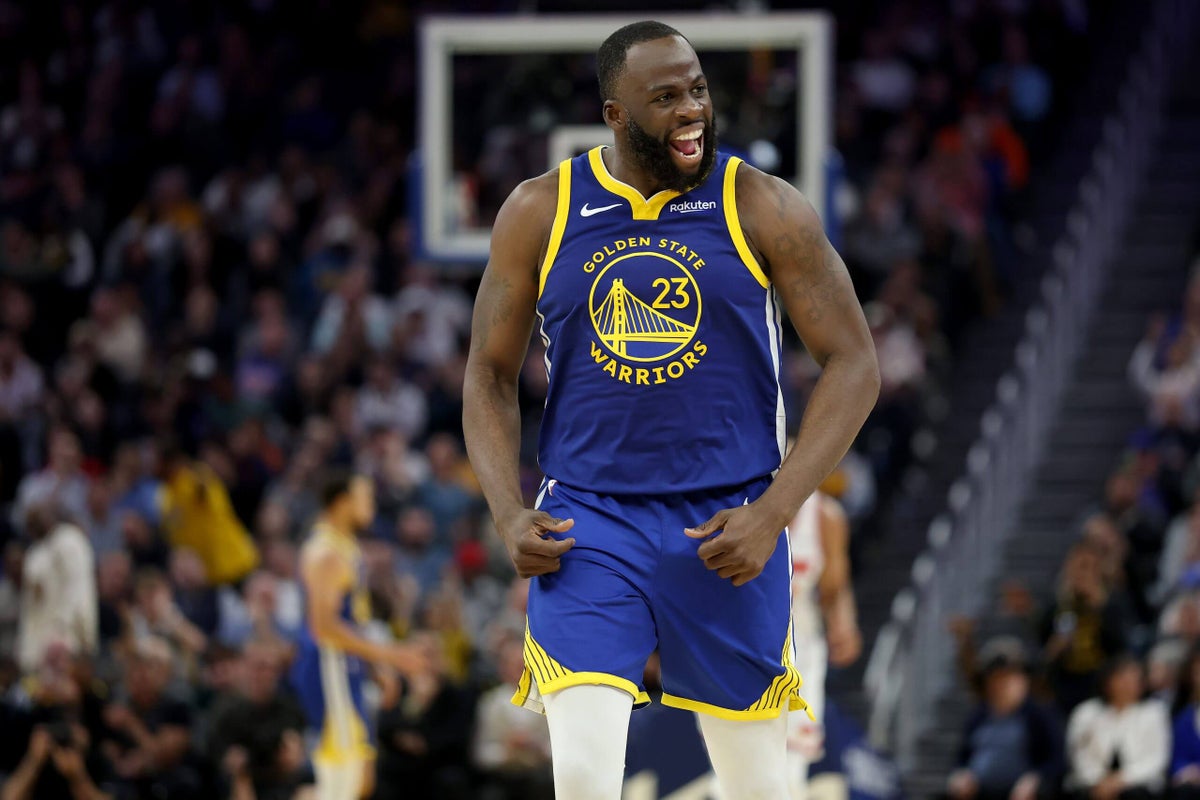
Draymond Green smiled before he answered the question. It was a smile that acknowledged possibility and improbability. Expressed confidence and expertise while underscoring the potential for discombobulation.
The Golden State Warriors, locked into the Western Conference’s No. 10 seed, have their backs against the Play-In Tournament wall. They need two wins to advance. And their best chance of doing so requires two stout defensive performances. On the road. With hardly any room for error.
The question: If he galvanized this Warriors’ defense into the No. 8 seed, where would that rank among Green’s greatest feats? The pride of the responsibility stretched his grin from one end as the difficulty of the task pulled from the other.
“Would be up there,” Green said. Smiling.
This underwhelming season has narrowed to something unforgiving, something almost cruel in its simplicity. What began with hopes of a deep playoff run will come down to winning two road games to salvage the season. For Golden State, the injuries, the limitations, the long stretches of mediocrity now compress into a single demand — put together two worthy defensive performances. Earn the right to need four more. Or, for the second time in three years, miss the postseason party.
And in the middle of that demand stands Green, the anchor of the belief that this can be done.
“You gotta be locked in, No. 1,” he said. “I think these will be very detailed game plans. The guys you want shooting, you’ve got to have them shooting. You’ve gotta stay locked in on your defensive responsibility. You can’t have defensive lapses. There’s just no space for defensive lapses in playoff games, man. So I think it’s a matter of everybody understanding what the game plan is and accomplishing it.”
He has lived too much basketball to be fooled by the moment. He knows what the postseason requires, knows the difference between bluster and truth, knows what the Warriors have and sorely lack. And he knows Golden State’s remaining hope in this campaign is him quarterbacking current chaos into a collective resistance.
Golden State ranked middle-of-the-pack defensively despite using a league-high 968 lineups. That’s quite a feat on its own. But the inconsistency in their rotations undermined the cohesion necessary for good defense.
So two premier defensive performances at this juncture appear improbable with all the Warriors have working against them.
They won’t have momentum. They won’t have Jimmy Butler — whose size, versatility and IQ had been essential to their defensive schemes.
So Green must do what he has always done, only more urgently. Call out coverages before they happen. Close gaps that shouldn’t exist. Demand focus from teammates who struggled to hold it. Be both conductor and safety net.
“His impact on the defensive end,” Warriors guard De’Anthony Melton said, “you can feel him. Sometimes he jumps out and he’ll double. Randomly catch you and the ball-handler off guard.”
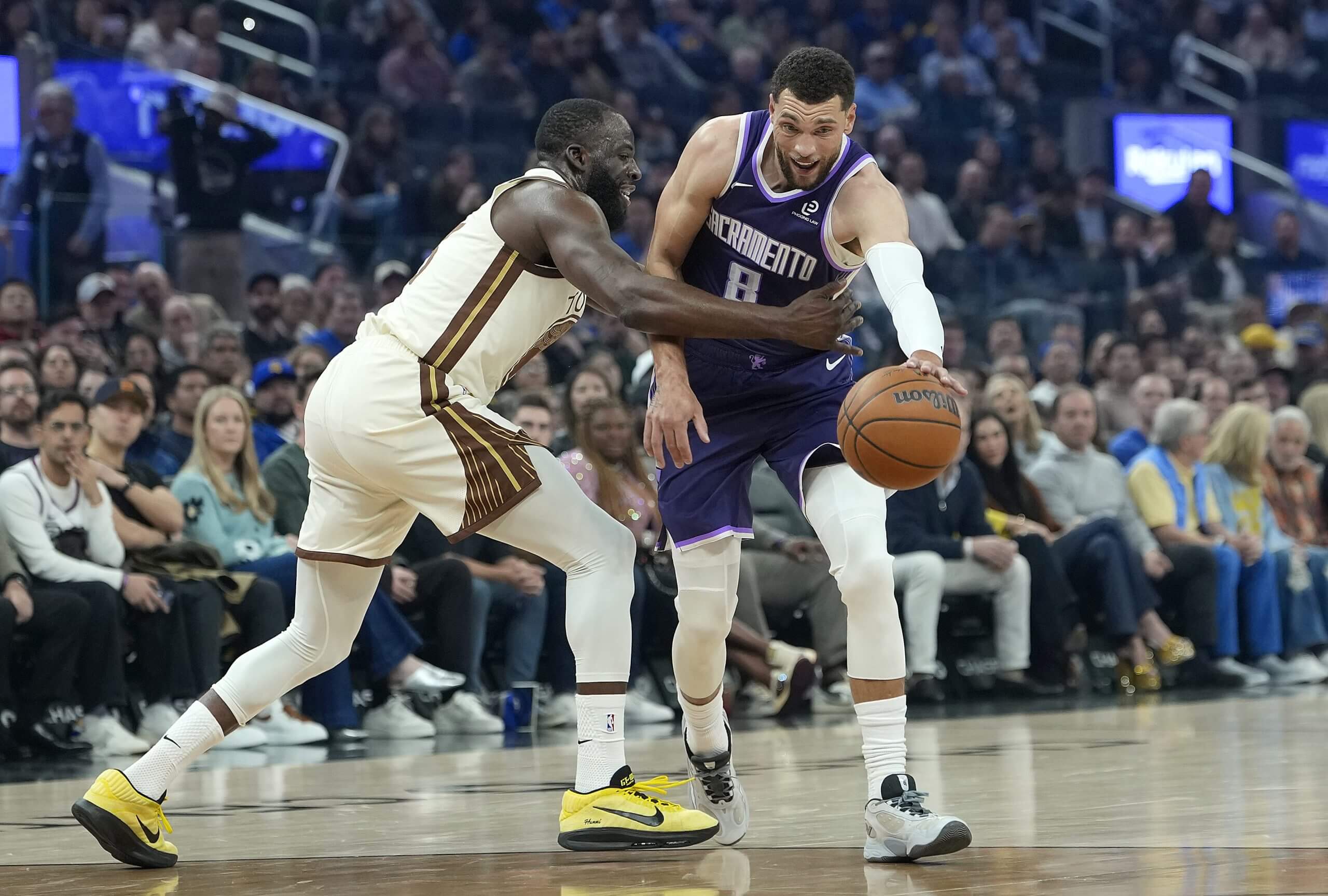
“His impact on the defensive end, you can feel him,” Warriors guard De’Anthony Melton says of Draymond Green, here defending the Sacramento Kings’ Zach LaVine. (Thearon W. Henderson / Getty Images)
This wasn’t the dominant defensive season Green mustered last year, when he finished third in Defensive Player of the Year voting. He’s played 68 games in back-to-back seasons for the first time since the peak of the Warriors dynasty with Kevin Durant. The Warriors have a slightly better defensive rating with Green off the floor. But with the influx of G-Leaguers, of end-of-rotation players getting thrust into action, this was a teaching year. Survival through development.
Rookie wing Will Richard keeps a journal for all the lessons. He jots down the gems he receives and reads them over later. In addition to film, Richard reads over his collection of notes. His notebook is full of info from Green.
“I ask questions after almost every game,” Richard said. “Especially that stretch where he had to guard Shai (Gilgeous-Alexander), he had to guard Kawhi (Leonard), he had to guard KD all in like a week span.”
The Warriors will have, so it seems, health and fresh legs. They can put together their best possible defensive lineups when it matters the most.
A healthy Al Horford is vital, their best defensive option at center. He also keeps Green from having to be anchored in the paint. The Warriors are best when Green is free to roam and freelance, go where he needs to be. The presence of Kristaps Porzingis gives the Warriors more minutes with size at center, freeing up Green to match up with the likes of Leonard — the top scorer and All-Star for the Los Angeles Clippers, a potential Warriors play-in opponent — or help when breakdowns happen.
Melton and Gary Payton II give the Warriors two perimeter defenders who can guard wings and guards. The Warriors have a perennial problem stopping penetration, so having their two best perimeter athletes is significant.
“We’re oftentimes very small,” Green said, “which opens up more gaps, which makes rebounding harder, which makes finishing the possession harder. And so I think it means just having the size. Somebody 6-2 (with their arms out wide) and somebody 6-7, that’s a big difference. The health of this team hasn’t really allowed us to put our size on the floor.”
And with all that, Green still needs to bring his best for it to matter. The playmaker on defense. The singular force he can be. He’s 36. And he spent a lot of his minutes this season as the center in the Warriors’ small-ball.
This feat requires a particular kind of influence. Not the loud, chest-thumping kind. But a focused, orchestrative leader. Humble and focused. Knowing this is no longer completely in his hands.
So this becomes a test for Green as much as it is for the Warriors. The challenge is to impose clarity, encourage discipline and put out fires without getting burned himself. Whether he can manufacture sudden chemistry under his voice.
And with Steph Curry back, and Porzingis providing scoring punch, the Warriors might have enough offense. If their defense holds up. A Curry explosion only matters as much as the Warriors can contain opposing offenses. Can they limit opposing stars and prevent the season-long habit of allowing breakout games to role players?
Of course they can. That’s what Green’s smile also declares. That’s the job. That’s always been the job for him.
But Green has seen enough versions of pressure, enough situations in his 14 seasons, to know the difference between can and will. Between having the capacity and having the command to reach it. And in that space — the narrow, vulnerable gap between belief and execution — is where this season now lives. This becomes one of Green’s greatest challenges.