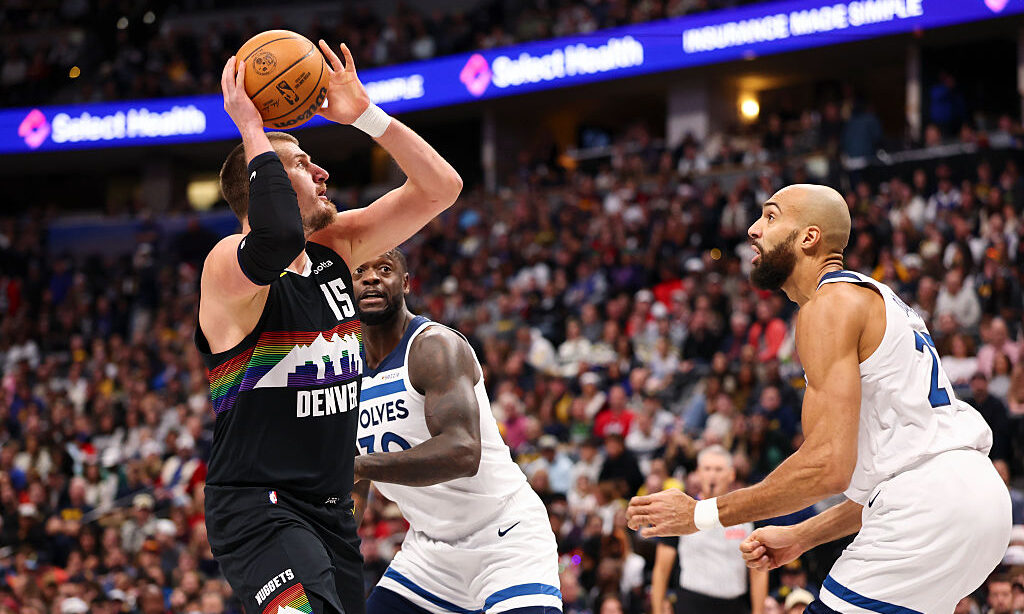
DENVER — Nikola Jokic and the Denver Nuggets (54-28) are trying to make history by winning a second title this summer, but the road is incredibly tough and it begins with the team’s biggest recent rival — a first-round showdown against the Minnesota Timberwolves.
First full-year Nuggets coach David Adelman may have said it best when he first reacted to the matchup getting set Sunday: “This is going to be a hell of a series.”
It’s the third time in four postseasons the Nuggets have matched up against the Wolves, and when the two teams tip the series Saturday, it’ll be their 29th game against each other since the start of the 2022-23 season. While there’s a lot of recent history on the floor between these two, there’s a ton on the benches and in the front office as well.
Still, there have been a lot of changes since these two teams last met in the playoffs, and the question is — will it be enough for the Nuggets to overcome a rivalry that’s haunted them for two years?
It started with the worst collapse in modern Nuggets history. Denver held a 20-point lead in Game 7 of Round 2 in 2024, only to watch Minnesota rip it away and send the defending champions home. That loss — the largest Game 7 blown lead ever — left a scar on this core that lingered well into the following season. The Wolves won all four regular-season meetings in 2024-25, two of them blowouts and two tight games Denver let slip away, extending their stranglehold over the Nuggets to six straight.
Denver finally snapped the streak early this season and took the 2025-26 series 3-1. The crown jewel was Christmas Day at Ball Arena, where Jokic poured in a 56-point triple-double and Anthony Edwards answered with 44 in a 142-138 Nuggets win that was one of the best games in the NBA this season. But both teams were banged up for much of these matchups, so it’s hard to lean on the regular season too heavily. What matters is that the monkey is off Denver’s back. Now the Nuggets have to prove it holds when the lights are brightest.
Health isn’t too big of a question in the Mile High City where the team finally got all on the floor together at the same time to rattle off a dozen wins to end the season, including the last two games where much of the rotation sat ahead of this series. Meanwhile, Minny is limping into the playoffs and there are big health questions in the Twin Cities. Their star guard Edwards and starting forward Jaden McDaniels have been dealing with injuries.
It all sets up what would be the beginning of one of the toughest titles ever if the Nuggets are able to claim it. But before any of that can happen, Denver has to leash the Wolves — and that means figuring out a way to contain the most dangerous scorer in basketball, even if he’s not 100% going into the series.
Summary of the Timberwolves
The Timberwolves are making their fifth straight trip to the postseason and have reached the Western Conference Finals each of the last two years, beating the Nuggets along the way in 2024 before falling to Dallas and then dispatching the Lakers and Warriors in 2025 before OKC ended their run in five games. Minnesota’s 49-33 record doesn’t scream juggernaut, and they enter the playoffs as a significant underdog, but this is a veteran group that knows how to flip a switch when the games start counting double. Last postseason was a relatively breezy run until the Thunder overwhelmed them, and the front office nearly blew it all up at the February trade deadline in pursuit of Giannis Antetokounmpo before Milwaukee decided to hold. That deal would have gutted the roster around Edwards, but the fact that Minnesota was willing to go that far tells you the organization knows its current window is narrowing.
This is a fundamentally different Timberwolves team than the one that broke Denver’s hearts in 2024. The biggest change happened before last season, when Minnesota shipped Karl-Anthony Towns to New York for Julius Randle and Donte DiVincenzo. The swap reshaped everything about how the Wolves play, especially against the Nuggets. Towns was the second banana — a floor-spacing five who could stretch the Nuggets apart. At times KAT could be the defensive weak link, but against the Nuggets in that series, he did a fantastic job of playing primary defense on Jokic.
With Towns gone, the Wolves lost a ton of shooting (KAT shot 41% from three in his final Minnesota season) and individual shot creation. While Randle shot just 32% from deep this year, he gives Minnesota a physical, downhill scorer who averaged 21.1 points, 6.7 rebounds and 5.0 assists this season while playing 79 games. DiVincenzo, meanwhile, stepped into the starting lineup as Mike Conley has aged. The Villanova legend provides shooting with 8 deep balls a night, ball movement and a set of quick hands on defense.
The other notable swap from the 2024 squad: Nickeil Alexander-Walker, who was a pest on the perimeter during that series against Denver. He’s in Atlanta, where he’s likely to win Most Improved Player. After not getting Giannis, the Wolves settled for Ayo Dosunmu at the deadline and he fills much of what NAW did. Ayo had a breakout season at 14.8 points per game, but he isn’t the same disruptive defender NAW was, which will matter against Jamal Murray.
The backbone of the Wolves is their defense, and it starts and ends with Rudy Gobert. The four-time Defensive Player of the Year anchored a unit that ranked eighth in the NBA at 113.5 points allowed per 100 possessions this season. The question for this series is whether Gobert guards Jokic head-to-head or roams as a free safety behind Randle. In 2024, KAT drew the Jokic assignment while Gobert lurked off Aaron Gordon — a scheme that allowed the Frenchman to contest at the rim and crash passing lanes off the then weaker Denver shooters.
Without Towns, the Wolves may have Gobert take Jokic straight up, which limits his ability to help elsewhere but does put the NBA’s most decorated rim protector directly in the big fella’s path. That’s good news for the Nuggets — some of Jokic’s best career games have come with Gobert draped on top of him. The question is whether Denver goes small and forces Gobert to defend in space, or big with their rebound-grabbing monster, Jonas Valanciunas.
McDaniels is the other defensive star, and he’s taken a real step — career highs in scoring (14.8 PPG) and 3-point shooting (41%), a massive leap from 33% a year ago that changes the math for Denver. He smothered MPJ in the 2024 series after Porter cooked the Lakers, and McDaniels may shift to Murray this time around. The more interesting question is whether his improved shooting gives the Wolves enough spacing around Edwards and Randle, a non-shooter from deep, to survive without a KAT-level marksman. McDaniels was dealing with left knee patella tendinitis down the stretch and returned just before the end of the season.
Then there’s the Minnesota bench, which has some good threats off it but ranks basically in step with the Nuggets at 35 points per night. Naz Reid is the headliner there: the former Sixth Man of the Year tallied 13.6 points, 6.2 rebounds and 2.2 assists per game as one of the NBA’s better reserves for the third straight season, though his 3-point shooting has dropped each of the last two years.
Reid has historically been a Nuggets killer, averaging 11.5 points in 28 career games against Denver, including playoff contests, and he brings a physical, bruising style combined with a soft touch that Denver’s bench hasn’t always had an answer for.
Behind Reid, Bones Hyland — the former Nugget — shot 39% from three this season in 71 games and averaged 12.5 points per game over the final 20 games when the Wolves needed him to fill some scoring for the missing Edwards. Mike Conley, who was an integral part of the 2024 squad, regressed significantly this season, opening the door for Hyland and Terrence Shannon Jr. to collect his minutes. Shannon dealt with a foot injury that cost him time, but when healthy, he’s an athletic wing who can score in bunches — he dropped 33 on Orlando in one of the final regular-season games. The question of how deep Chris Finch goes will matter: do the Wolves play Kyle Anderson, who appeared in just 19 games this year? Do they lean on Shannon’s scoring punch or Hyland’s shooting in crunch time?
Despite all the talent, the health cloud over this team is real and it tilts the series. Edwards missed 11 of the final 14 regular-season games with a right knee issue. McDaniels has his own knee concerns. Gobert, Randle, Reid, Hyland, Dosunmu and Conley were all held out of the season finale for rest or maintenance, but nothing was at stake. The Wolves went 12-9 without Edwards during the regular season versus 37-24 with him. Finch openly admitted the team isn’t the same without its star and McDaniels flanking him. Edwards is expected to play Saturday, but conditioning after three weeks of limited action is the wildcard. Edwards knows how to hurt this specific team, even if the deep ball isn’t to his normal shining level — the question is whether Edwards’ body will let him do it for a full series.
Timberwolves Projected Starting Five
G: Donte DiVincenzo
G: Anthony Edwards
F: Jaden McDaniels
F: Julius Randle
C: Rudy Gobert
Star of the Timberwolves
Anthony Edwards, guard, 6-4, 61 GP, 28.8 PPG, 5.0 RPG, 3.7 APG, 48.9% FG/39.9% 3FG/79.6% FT
Edwards had the best season of his career, and he’s done it by becoming a different scorer than the one Denver saw in the 2024 postseason. The 24-year-old averaged a career-high 28.8 points while leaning harder into his 3-point shot — 8.4 attempts per game, up from 6.7 a night the last time these teams met in the playoffs — though he’s actually dialed back from the 10.4 attempts he jacked up last season.
Edwards has also leaned harder into his midrange game and his ability to get to the rim and draw fouls. That shift is why his field goal percentage leapt from 44.7% to 48.9% and his free throw attempts rose to a career-best 7.2 per game. He’s not settling for as many threes as last year but he’s far more willing to shoot across the board than the last time Denver saw him in the postseason. When Edwards does shoot from deep, he hits 40%. When he attacks downhill, he’s one of the most violent drivers in the NBA, capable of dunking over, around or through whoever stands between him and the rim.
“He’s a tough guard,” Christian Braun said Wednesday. “Even this year, opposed to when we played in the past, in the playoffs, he’s shooting the ball a lot more and a lot better. He can do a little bit of everything. He’s physical, he’s fast, he’s got the pump fake, the sweep through moves. He’s just a really good player, one of the best in the league.”
“His change of pace, his ability to finish the ball, to shoot the ball. He’s so talented,” Jokic said. “He can do a post up, he can shoot, he’s really good one on one. Definitely one of the hardest players to guard.”
Edwards knows this matchup. In the 27 games he’s played against Denver since the start of the 2022-23 season, including the playoffs, he’s averaged 28 points, 5.2 assists and 5.2 rebounds on 59% shooting from the field — absurd efficiency, even if the three-ball has been streakier at 33% in those games. His 44-point explosion on Christmas Day at Ball Arena was a reminder of what he can do when he’s right against this specific defense, even with Jokic dropping 56 on the other end.
What makes Edwards particularly dangerous in this series is that he’s been here before and learned from it. Minnesota has reached the Western Conference Finals in each of the last two postseasons, and Edwards has been the engine of both runs. His approach has matured — he no longer tries to do it all from the jump.
“Never get too high, never get too low,” Edwards said Wednesday. “We’ve been down in the series, we’ve been up, and I think when we’re up, we get a little too high. So just going in with an even mindset.”
That patience feeds Edwards’ supporting cast. When Denver sends a second or third body at him — and they will, especially given his past frustrations with extra bodies — Edwards has to trust the kick-out. He knows it’s coming.
“I’ve seen everything now,” he said. “Nothing they’re going to throw at me is unexpected. I know they’re going to put two, three on the ball. I just got to be willing to make the right play and take my shots and live with it.”
He’s also signaled a willingness to be a two-way weapon.
“I’m willing to take on whatever role I got to,” Edwards said. “If my offense isn’t going that night, if I got to go guard Jamal, cool. If I got to guard Jokic, cool. Whatever it is to win the game.”
Edwards has proven to be a good defender when willing, and one would assume he will be willing in the playoffs. But the elephant in the room is his health. His preparation for this series has been as much about physical conditioning as it is about scouting Denver.
“I haven’t been 218 since I was in college, since I was 18,” Edwards said. “The main thing is getting back in shape. I haven’t played a lot in the last month.”
Finch said Edwards was “full go” at Tuesday’s practice, and there’s no indication he’ll be limited Saturday. But there’s a difference between being cleared to play and being in rhythm, and the conditioning gap is the single biggest variable in this matchup. Edwards acknowledged as much — he’s working on “getting rhythm, getting used to taking my shots, getting comfortable back on the court, running up and down, sliding on defense.”
Braun will likely draw the primary assignment on Edwards, though he’s really struggled to slow Ant and a switch could come quick. When Braun needs a breather, Gordon will slide over, and Denver may throw zone looks to keep fresh bodies in Edwards’ path.
The Nuggets’ defensive game plan will boil down to a simple question: Do they double Edwards or play him straight up? Sending help opens kick-out lanes to McDaniels, who’s now shooting 41% from three, and to Randle, who can punish a rotating defense’s late contest with a freight-train drive. Playing Edwards one-on-one means trusting Braun — and later Gordon or whoever else — to survive against one of the most explosive one-on-one scorers alive. Neither option is great, and that’s what makes Edwards the most dangerous player in this series not named Jokic. If his knee holds up and his conditioning catches up later in the series, the Nuggets could be in for the same kind of fight they lost two years ago.
Series X-factor for the Timberwolves: Rudy Gobert
No single player will shape this series more for Minnesota than Gobert, and the decisions Finch makes with his four-time Defensive Player of the Year will ripple through every possession on both ends of the floor.
Start with the fundamental schematic question that’s changed since 2024: Who guards Jokic? Two years ago, the answer was Karl-Anthony Towns. KAT took Jokic head-to-head and Gobert roamed off Gordon as a free safety, lurking near the rim to contest drives, crash passing lanes and clean up the mistakes of Minnesota’s perimeter defenders. That size also led to the Wolves going plus-20 on the glass over the seven games. That scheme worked — it’s a major reason the Wolves won that series in seven. But Towns is in New York now, and there’s no equivalent replacement. Randle can body Jokic for stretches but doesn’t have KAT’s length, foot speed or rim protection. That leaves Finch with a choice: guard Jokic straight up, or find someone else to absorb the punishment and keep Gobert free to help.
Gobert, for his part, sounds ready for either.
“Both are great. I’m comfortable doing whatever the team needs me to do,” Gobert said Tuesday. “And when I’m off him, I’m still on him. It’s really about trying to slow him down as much as we can, but we try to stop the Denver Nuggets as a team. They’re a very smart team. They make a lot of adjustments, and so we have to be able to make adjustments too. Regardless of what we do, I think it’s more about our mindset.”
That last line is key, because Minnesota’s defensive philosophy in this matchup has historically followed a specific hierarchy: stop everyone else first, then deal with Jokic. The theory is that Jokic will get his — he’s averaged 25.2 points, 10.5 rebounds and 8.1 assists in 32 career games against Gobert, including some of his best games ever — so you try to limit the damage from the players around him and force the big man to beat you by himself. That strategy has merit. What it requires is elite help defense, disciplined rotations and a rim protector who can cover for everyone else’s mistakes. That’s Gobert’s job description.
Even at 33, he’s still remarkably good at it. Per Cleaning the Glass, opponents averaged 11.8 fewer points per 100 possessions with Gobert on the floor this season, which ranks in the 98th percentile. They also shot 4.1% worse, placing in the 95th percentile.
He’s no longer the most dominant defensive center in the league — Victor Wembanyama has taken that crown — but even a B-plus version of Gobert remains one of the best rim protectors alive. His 11.5 rebounds and 1.6 blocks per game are the gravitational center of everything Minnesota does defensively.
Jokic has deep respect for the matchup.
“He definitely makes you work a bit more for every shot, for every post up, every catch and shoot,” Jokic said Wednesday. “He’s a big, tall guy, and he’s definitely a defensive presence. He’s definitely changing your shot in every possible way. It will be a challenge for me, for everybody.”
But Jokic also understands that the matchup won’t be a straight one-on-one affair.
“Everybody’s going to guard everybody, and they’re going to guard us,” he said. “It’s not going to be a matchup between somebody. It’s going to be collectively, because there’s going to be so many different coverages on both sides.”
That collective approach is what makes this complicated. If Gobert guards Jokic straight up, the Frenchman is pinned to one man and can’t roam. That hurts Minnesota’s help defense and puts more pressure on McDaniels, Randle and Edwards to contest Denver’s shooters without a safety net. If Gobert plays free safety — guarding Gordon or whoever Denver puts at the four — he can protect the rim but leaves a less capable defender on Jokic, and Denver’s improved 3-point shooting this season (led by Gordon’s multiyear breakout from deep) means there are fewer guys to leave open.
What makes Gobert the X-factor rather than just a defensive chess piece is that his limitations on offense affect the series just as much as his defensive dominance. Gobert’s offensive game has continued to erode. He’s essentially a lob target and a screener at this point — he led the league in field goal percentage because nearly every shot he takes is at the rim, but his free throw shooting has regressed and he creates nothing for himself. The team even seems to trust him less. Edwards was candid about the work they’ve put in to make the Edwards-Gobert pick-and-roll functional.
“Every series we’ve been in when I play with Rudy, they’re daring us to throw it to him,” Edwards said. “Just getting comfortable with throwing that lob, him getting to the dunker spot more instead of in pick-and-roll. Just getting to the dunker and allowing me to go by my man and them helping up. Just throwing that lob, learning how to throw it, how much touch to put on the pass. Like I said, I’m not a traditional point guard, so trying to figure that out with him. But we’ve been working on it.”
Adelman’s defense will either drop on Gobert screens and dare Edwards to create over the top, knowing the lob to Gobert is the play Minnesota wants but doesn’t always execute cleanly. Or they’ll double Edwards on screens and dare him to throw it to Rudy, sometimes rotating to meet him at the rim and other times leaving him wide open.
The non-Jokic minutes will be equally important — Gobert thrived in those stretches in 2024 against a weaker Denver bench, but the Nuggets’ deeper rotation this year should change that dynamic, a point covered below.
If Gobert can toggle between guarding Jokic straight up and roaming as a free safety while surviving on offense — the Wolves have a real chance. If not, the series could be short.
Nuggets Projected Starting Five
G: Jamal Murray
G: Christian Braun
F: Cameron Johnson
F: Aaron Gordon
C: Nikola Jokic
Series X-factor for the Nuggets: Tim Hardaway Jr.
Two summers ago, Hardaway sat on the end of the Dallas Mavericks bench and watched his team beat these very Wolves in the Western Conference Finals and advance to the NBA Finals — mostly without him. After averaging 26.8 minutes a game during the regular season, the veteran guard’s role evaporated in the postseason. Jason Kidd shortened the rotation, Jaden Hardy leapfrogged him, and Hardaway played in just 14 of Dallas’ 22 playoff games. In the Finals against Boston, he averaged 11.9 minutes and 3.8 points across four games — 8 minutes and zero points in his Game 1 debut. His NBA-legend father went on a podcast and ripped the organization. The Mavericks moved on. So did Hardaway — to Detroit for an okay year on an improving team, and then to Denver on a bargain deal that has turned into one of the best value signings in the NBA this season.
Hardaway hasn’t just been good for the Nuggets. He’s been historically good. The 13-year veteran averaged 13.5 points per game while shooting a career-best 41% from three on high volume. He led the entire league in 3-pointers made off the bench with 205. His 224 total makes were good for 10th overall, behind Murray, who set the franchise record. He and Murray became just the third teammate duo in NBA history to each hit 220-plus threes on 40% shooting in the same season, joining the Splash Brothers. He scored 20 or more points 17 times. He’s a legitimate Sixth Man of the Year candidate.
More important than the individual numbers is what Hardaway does to the geometry of Denver’s offense. This is a Nuggets team that has lacked a consistent bench scorer and shooter for years — the kind of player who could enter the game, space the floor and let the Jokic-Murray machine keep humming without a drop-off. Hardaway is that player, and Adelman knows it.
“Bottom line, much harder to bring a third defender to our two best players, not to mention Aaron,” Adelman said Wednesday. “Connected to shooting is a problem. Aaron on the rim brings a body, that means our body is not on a shooter. That’s the bottom line. That’s what Tim does. He makes the court feel enormous. That’s why our offense was historically incredible this year — because we have great players, but we also have people that you have to bring activity to. Tim’s one of those guys.”
Hardaway is a central reason for the Nuggets’ awesome shooting this year. His presence on the floor forces Minnesota’s defense to make a choice it didn’t have to make in previous matchups: leave the bench scorer to help on Jokic, or stay home on Hardaway and let the big man operate with more space. There’s no free rotation anymore.
That spacing matters even more against this particular opponent. In 2024, the Wolves could pack the paint and help aggressively off Denver’s non-shooters, which was part of what made their defensive scheme work. This Nuggets team doesn’t have those weak links. Hardaway, Murray, Gordon, Cameron Johnson and Bruce Brown (since the calendar flipped to 2026) all demand respect from the perimeter. On a night Braun isn’t shooting, Hardaway Jr. could close over the starter, something that happened earlier this season against the Wolves. Simply put: If Gobert is roaming off somebody to help onto Jokic, when he steps into the lane to protect the rim, someone is open — and this year, the Nuggets can play somebody in that spot who can shoot.
“Tim’s been great for us. We got a lot of shooting,” Braun said. “We got a little bit of something we can throw out there for everything.”
That’s the point. It might not be Tim himself but he offers the Nuggets staff the ability to play small, big, with shooting, for defense or some combination of a few of those things. In last year’s playoffs, the Nuggets only had one way to play because their roster was so limited.
The question is whether Hardaway can do it in the playoffs — his postseason history is checkered, and the Dallas collapse is the most glaring example. But Adelman has committed to him as the anchor of the bench all season, not as a regular-season placeholder to be shelved in April. The reps, the rhythm, the trust — it’s all there in a way it wasn’t with the Mavericks.
If Hardaway shoots anything close to 40% from deep in this series, the Wolves’ potential defensive scheme against Jokic becomes exponentially harder to execute. Every double team on the post, every trap on Murray off the pick-and-roll, every helping rotation off a shooter — all of it is riskier when there’s a guy on the floor who led the league’s bench players in made threes and isn’t afraid to let it fly. And if he has one of those 20-point nights where he can’t miss? That might be the game that swings the series.
I asked Jokic Wednesday about the importance of his supporting cast stepping up.
“We need everybody,” he said. “To be champions, you need a team, and you need the guys to step up in the right moment. It’s not your night one game, it’s okay. The next one is coming really soon.”
The next one is Saturday. And for the first time in years, Hardaway is walking into the postseason knowing his coach trusts him, his teammates need him and his role isn’t going anywhere. That’s a dangerous combination for a shooter with something to prove.
What to expect from Nikola Jokic
Jokic became the first player in NBA history to lead the league in both rebounds and assists per game in a single season, finishing with averages of 27.7 points, 12.9 rebounds and 10.7 assists — a triple-double average for the second consecutive year. The last player to lead the league in both categories was Wilt Chamberlain in 1967-68, when leaders were determined by totals rather than per-game averages. No one has ever done what Jokic just did. And nobody has a postseason career quite like him. He is second all-time in career postseason box plus/minus, sandwiched between Michael Jordan and LeBron James.
Against the Timberwolves this season, Jokic was otherworldly. Across the four regular-season meetings, he averaged 35.8 points, 15.0 rebounds and 11.3 assists on 67% shooting from the field. The crown jewel, and maybe his best game ever, was Christmas Day: 56 points, 16 rebounds and 15 assists on 15-for-21 shooting and 22-for-23 from the free throw line. Even in Denver’s only loss — a March 1 defeat where Minnesota was the healthier team — Jokic still put up 35, 13 and 9. The Wolves don’t really have the roster to do what the Thunder did last year or even deploy the Jokic Rules to slow Big Honey.
Jokic is going to have to be the best player in this series, and the way he attacks will depend on how Finch deploys Gobert. As covered in the X-factor section, the Wolves’ defensive hierarchy has historically been to limit the supporting cast first and let Jokic get his. But this year’s supporting cast is far more dangerous than any version Jokic has had around him in a playoff matchup with Minnesota. Which means the 8.5 assists per game Jokic averaged in the 2024 series should climb closer to this year’s average — the supporting cast can actually convert.
Jokic and Murray were the most devastating offensive pairing in the NBA this season: when they shared the court, Denver posted a 127.8 offensive rating. Murray’s career year — and his health — change this matchup entirely from 2024, and how Minnesota tries to defend the two-man game is covered below.
Jokic’s own offensive game has only gotten more lethal. He shot a career-best 55.9% from the midrange this season — the best mark among all NBA players who took at least 100 midrange attempts. He led the league in total points and assists from both post-ups and the elbows. His post-ups yielded 1.13 points per possession, which ranked fifth league-wide. He was the NBA’s fifth-best isolation scorer. He led the league in contested rebounds at 6.0 per game. And he assisted the most 2-point baskets and the most 3-point baskets of any player in the NBA — the only player to lead both categories. When Jokic was on the floor this season, Denver posted a 126 offensive rating, which would go down as the best offense in league history.
Against Gobert specifically, Jokic has had to work but has put together some of his most iconic moments.
“He definitely makes you work a bit more for every shot, for every post up, every catch and shoot,” Jokic said. “He’s a big, tall guy and he’s definitely changing your shot in every possible way. It will be a challenge for me, for everybody.”
Jokic will also need to be excellent on defense, where he has historically raised his level in the playoffs. He’ll likely be active at the level of screens near Edwards, using his elite hands to deflect and steal passes — a strategy that covers up some of Denver’s rim protection concerns. Against Edwards, the principle is: disrupt on the perimeter, let Gordon and the wings rotate down to protect the paint.
Jokic is raring to go. And after a season in which he did something no player in 56 years had done — something no player had ever done in the per-game era — the only question left is whether the team around him can match his level for four wins. If they can, and Jokic plays at even 80% of what he showed in those four regular-season meetings against Minnesota, the Wolves are going to need every bit of the fight Gobert promised.
How the Nuggets can beat the Timberwolves
Denver won three of the four regular-season meetings and had the NBA’s best offense while Minnesota’s defense was inconsistent enough to earn the team a C grade from ESPN. The blueprint is there. The challenge is that playoff defense tightens, Edwards should be healthier than he was in some of those matchups, and the Wolves have a track record of leveling up against this specific opponent when the games matter most. But the Nuggets should be healthier, too. And still, Denver has more paths to victory in this series than it’s had in any playoff matchup with Minnesota — and more than it had against anyone last postseason.
The Nuggets can shoot them off the floor. This is the single biggest difference between this series and the 2024 matchup. Two years ago, the Wolves could pack the paint, sag off non-shooters and funnel everything toward Gobert’s waiting arms at the rim. That scheme worked because Denver didn’t have the perimeter shooting to punish it. This year, the Nuggets led the league in 3-point percentage at 39.6% — the best in franchise history and third-best by any team in the last decade. Murray shot 44%. Gordon continued his breakout from deep. Hardaway hit 41% off the bench. Johnson and Brown have been reliable. Even Braun, who battled an ankle injury all year, shot the ball much better down the stretch as his explosiveness and confidence returned.
“They have a lot more shooting than the previous versions,” Finch acknowledged Tuesday. “Definitely changes the geometry on the floor. Makes them a little more dangerous in transition from the 3-point line. More weapons that you surround Jokic with, the more people you can get involved.”
Minnesota’s defensive strategy of stopping the supporting cast first and daring Jokic to beat them alone is far more dangerous to execute when every player on the floor demands a closeout. When Gobert steps up to contest a post move, Gordon — who Denver was plus-19.8 per 100 possessions better with on the floor next to Jokic this season, per databallr — is cutting to the rim or spotting up from deep.
The Nuggets will need to exploit the Murray matchup. In the 2024 series, Minnesota blitzed and trapped Murray relentlessly off the pick-and-roll, turning him into a turnover machine. It worked because Murray was visibly hurt and because the Wolves had the perimeter personnel to execute it — Alexander-Walker’s length and quick hands, Conley’s veteran positioning and a second line of defenders who could rotate without breaking the scheme. None of that infrastructure exists anymore. NAW is gone. Conley has aged out of a meaningful playoff role. Dosunmu is solid but not the same disruptive presence. And Murray is a completely different player than he was two years ago — healthy, confident and coming off a career year where he led the league in off-the-dribble threes — but more importantly, he’s become a way better decision-maker, tossing a career-best 7 assists per game.
“He’s had a heck of a season,” Finch said. “Leading the league in off-the-dribble threes, a lot of those self-generated, playing with a ton of confidence. You just got to try to wear him down, make him work. It’s really hard to stop these guys, especially with this two-man game.”
If Minnesota even tries the same blitzing scheme against Murray, there’s way better and more reliable outlets. The Wolves may have to play Murray straighter, which means McDaniels could draw the assignment — and while McDaniels is an elite defender, that also takes him away from guarding the perimeter shooters who are now a much bigger threat.
A big point for the Nuggets will be controlling the pace — both, by getting stops and scoring themselves. Minnesota wants to run. Finch has talked about pushing the pace all week, and the Wolves’ transition offense was a strength in the second half. Edwards acknowledged it — he used his time off to study the team and came back saying he wanted to push more and take fewer dribbles in the half court. Randle confirmed it: “We got a lot of athletes on the team and we’re best when we’re playing fast and moving the ball.”
The good news for Denver is that transition offense requires defensive stops, and the Wolves are unlikely to get many against the NBA’s best offense. Denver averaged 122.1 points per game in the four head-to-head meetings this season. If the Nuggets execute in the half court and take care of the ball — always a concern with their sharing style — Minnesota simply won’t have the live-ball turnovers and missed shots they need to get out and run. Make the Wolves play in the mud of a half-court game, where Gobert’s declining offense becomes a bigger liability and Denver’s spacing advantage is maximized.
The deeper Nuggets have a chance to not just survive but win the non-Jokic minutes. This is where the Hardaway addition and Brown’s return change the calculus. In 2024, Denver’s bench was a sieve against the Wolves — Reid feasted on a smaller, less talented second unit, and the Nuggets routinely gave back whatever Jokic had built during his minutes. This year, Adelman has a deeper rotation and more flexibility.
“I think Naz kills everybody,” Adelman said Wednesday. “He’s one of the more unique bench players in our league. He can post up smalls, the pick and pop stuff. Finch does a great job with all the flare screens, getting him threes. Where we can be much better is if we switch a small onto him, they got to have better activity. You got to front him. You got to make him work for his catch.”
Making Reid’s life harder than it was two years ago is important — and possible. With Hardaway spacing the floor and Brown providing defensive toughness, those non-Jokic minutes don’t have to be a black hole anymore. Denver can also choose to go big with Valanciunas to match Reid’s physicality, or go small and force him off the line and to defend in space on the other side. The optionality is the point.
Denver can also exploit the limitations on both ends with Randle and Gobert. Randle isn’t a rim protector or help defender — involve him in actions and he’ll be out of position. If his 3-point shot isn’t falling, Denver can sag off and pack the paint against Edwards. On the other end, Gobert’s offensive erosion means whoever guards him can cheat toward Edwards, knowing Gobert won’t punish them. The less Minnesota generates from Gobert offensively, the more Denver’s defense can focus on everyone else.
Dominating the glass will be important in this matchup. Without Towns’ size, Minnesota is more vulnerable on the boards than in 2024, when they went plus-20 on the glass over the seven-game series. Jokic’s league-best work on the contested glass — plus a 19-rebound effort against Minnesota in October — gives Denver an edge the Wolves won’t easily match. Gordon is one of the best offensive rebounders in the league. Second-chance points off Jokic’s boards — and the putbacks he creates for Gordon — could be a quiet but decisive edge in tight games, especially late in the fourth quarter when Gobert may be in foul trouble or fatigued.
If Denver can marry the emotional discipline Adelman has instilled with the best offense in franchise history, the best 3-point shooting team in the league, a healthy Murray, a deeper bench and a Jokic who just did something no player had ever done — the Nuggets should win this series. The Wolves are dangerous, they know how to hurt Denver, and Edwards at full strength changes everything. But the paths to a Nuggets victory are wider and more numerous than they’ve been in any postseason meeting between these two teams. For the first time in this rivalry, Denver has the answers to every question Minnesota can ask.
Stat of the series:
Two of Jokic’s three best games ever have come against the Wolves in the last 13 months, according to Game Score. Jokic’s Christmas performance is his best game ever, and his career-high 61-point triple-double in a double-overtime loss last April ranks third, according to that metric.
Another few things you should know about Nuggets vs. Timberwolves
Not only is this the third playoff matchup in four years, but the fourth matchup ever between these two teams. Each time the winner has gone on to at least the conference finals. That other, way back showdown was in 2004, when Kevin Garnett’s Wolves beat rookie Carmelo Anthony’s Nuggets in five games in the first round. The Timberwolves lead the all-time playoff series 9-8 in games, but Denver owns the regular-season history at 92-61.
The Nuggets are the only team the Timberwolves have beaten in a playoff series more than once. Minnesota’s only other series wins in franchise history have come against the Kings (2004), Lakers (2025) and Warriors (2025). That makes this rivalry uniquely personal for the Wolves — and uniquely painful for Denver’s fan base, which remembers 2024 like an open wound.
Both Edwards and Finch confirmed the rivalry framing this week.
“Yeah, for sure,” Edwards said Wednesday when asked if it’s a rivalry. “I don’t think there’s anything else to call it.” Finch agreed: “We’ve played them the most in the last five years of any team in the league. We’ve been trying to level up where they’ve been. This is kind of a rubber match, if you will. It has all the makings of what a rivalry should be.”
The Tim Connelly connection looms over everything. Minnesota’s president of basketball operations is the man who built Denver’s championship roster. He drafted Jokic in the second round. He drafted Murray. He traded for Gordon. He constructed the framework that produced a title, then left for Minnesota and has been building a team to beat his own creation ever since. Jokic was asked about Connelly Wednesday and was characteristically warm: “I think people see him as a general manager, but Tim is a really good person, really good friend. I wish people knew Tim — don’t look at him as a general manager.”
Connelly isn’t the only familiar face on the other bench. Micah Nori, now an assistant under Finch, was a longtime Nuggets assistant who worked closely with Jokic during his development. Jokic joked about their relationship: “He always made me run lines and I didn’t get the ball from him late. He didn’t trust me at all. And he always wants to take all the credit for my success.” Behind the humor, there’s real intel — Nori knows Denver’s system inside and out, as does Finch, who was also on the Nuggets staff.
But the front office and coaching connection isn’t just one-sided now as the Nuggets’ new co-general manager Jonathan Wallace left Connelly’s Wolves for his current role last summer. Wallace had a big voice in Denver’s changed roster, and maybe he’s learned a thing or two from his days in the Twin Cities.
Hyland returns to Ball Arena as a member of the Wolves’ playoff rotation — and he has a chip on his shoulder. The Nuggets drafted Hyland 26th overall in 2021, and he made the All-Rookie Second Team after averaging 10.1 points as a rookie. But Denver soured on him and vice versa. In February 2023, then-GM Calvin Booth traded him to the Clippers in a four-team deal. He was the last guy moved off the championship-winning team and did not get a ring. After bouncing to Atlanta and getting waived, Hyland signed with Minnesota on a minimum deal last offseason and revived his career — shooting 38.8% from three in 71 games and averaging 12.5 points per game over the final 20 games of the season. Now he gets to face the team that gave up on him and he forced his way out of.
Backup Nuggets guard Tyus Jones began his career with the Wolves as a first rounder. In his four seasons there, he’s most remembered in Denver as playing in the Game 82 overtime contest against the Nuggets that pushed Minny into the playoffs over Jokic’s squad.
The Antetokounmpo shadow still hangs over Minnesota’s future. Multiple reports indicate they’ll be back in the mix for the star this summer. How this playoff run ends could determine whether Minnesota’s front office makes a seismic move — potentially involving McDaniels or other core pieces — to pair Edwards with a second superstar. This series is a referendum on whether the current core is good enough.
This is Adelman’s first playoff series as a head coach from the start. He took over as interim during the 2024-25 season after Michael Malone’s departure and led Denver through two rounds, but he inherited a team midstream. This time, he’s had a full season to install his system, build trust with the roster and develop the even-keeled, preparation-first culture he’s preached all year.
“Every year feels different,” Adelman said. “Every year is its own thing, its own book.”
Game
Day
Date
Away
Home
Time (MT)
TV
1
Sat.
April 18
Minnesota
Denver
1:30 p.m.
Prime
2
Mon.
April 20
Minnesota
Denver
8:30 p.m.
NBC
3
Thu.
April 23
Denver
Minnesota
7:30 p.m.
Prime
4
Sat.
April 25
Denver
Minnesota
6:30 p.m.
ABC
5*
Mon.
April 27
Minnesota
Denver
TBD
TBD
6*
Thu.
April 30
Denver
Minnesota
TBD
TBD
7*
Sat.
May 2
Minnesota
Denver
TBD
TBD
-350 Denver, +280 Minnesota
Jake’s pick
Nuggets in 5